
Last updated: 9 September 2026
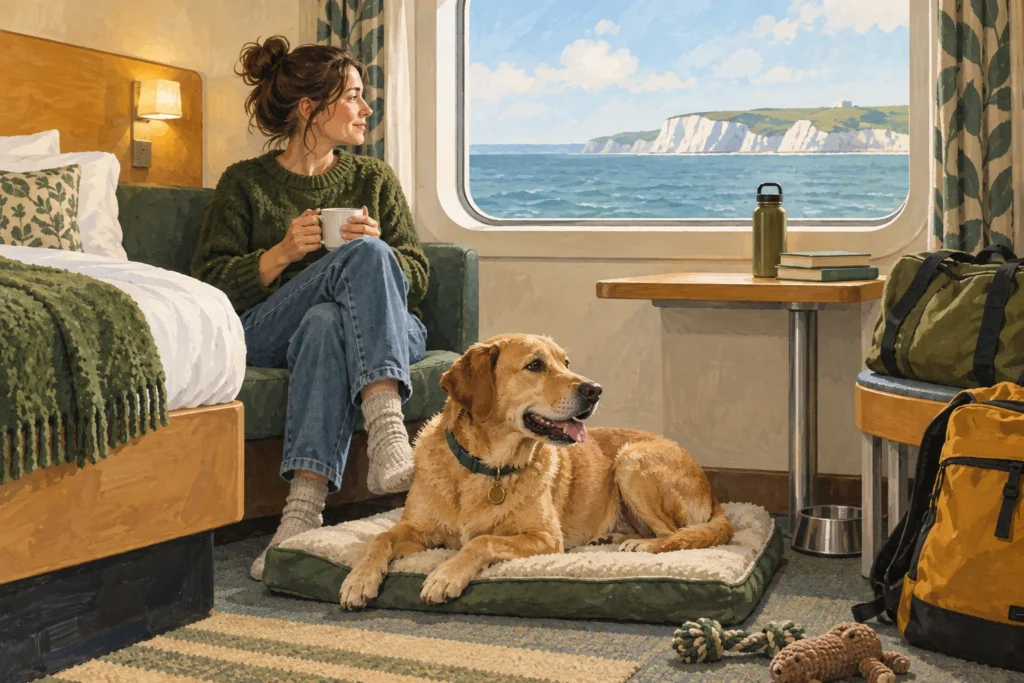
Before taking a dog on a ferry, confirm where the dog will stay on the exact sailing and book that space explicitly. A pet-friendly route does not mean every ship offers the same cabin, kennel or vehicle arrangement. Choose accommodation your dog can manage, then check documents and boarding instructions for the destination.
Brittany Ferries, for example, describes three possible arrangements across its fleet: a car, an onboard kennel or a pet-friendly cabin. Which options exist depends on the ship and route. Treat that as a prompt to inspect your actual booking, not as a universal rule for every ferry operator.
Table of Contents
Compare the onboard arrangements
| Arrangement | Potential advantage | Questions before booking |
|---|---|---|
| Pet-friendly cabin | Being with the dog in a designated private space | Capacity, permitted areas, bedding and cleaning rules |
| Onboard kennel | A designated animal accommodation area | Internal dimensions, visiting access and supervision arrangements |
| Vehicle | A familiar travelling space | Whether permitted, access restrictions and the dog’s welfare throughout |
A dog who cannot comfortably be separated from you may struggle in a kennel even on a relatively short crossing. A cabin can reduce that particular problem, but it does not remove engine noise, movement or the unfamiliar surroundings. Discuss significant travel distress with your vet before committing to a demanding trip.
Do not assume you can return to the vehicle deck whenever you wish. Ask the operator directly about access and its animal-welfare procedures. If the permitted arrangement does not meet your dog’s needs, choose another sailing or another plan.
Check the ship as well as the route
Record the ship name, departure time and pet accommodation on the confirmation. Ask what happens if the ship changes: will the replacement have an equivalent space, and what are your options if it does not? Keep that information with the booking rather than relying on a general marketing page.
Foot-passenger acceptance can differ from carriage with a vehicle. Confirm it explicitly if you will be walking aboard. Also check requirements for leads, muzzles, carriers and designated routes through the ship. A muzzle requirement needs preparation before travel, using a suitable fit and gradual positive introduction.
For kennels, compare internal measurements with your dog’s needs. The travel crate sizing guide helps you think beyond the label large. Ask whether you supply bedding and whether there is a secure way to move between the kennel and exercise area.
Documents depend on where you are going
International travel requires more than a ferry pet booking. For journeys from Great Britain to the EU, consult GOV.UK’s current guidance on animal health certificates, microchips and rabies vaccination, plus the destination’s requirements. Allow time for veterinary appointments and any waiting periods.
Northern Ireland has a separate pet travel document scheme for eligible journeys from Great Britain. Do not apply the EU holiday checklist automatically to that route, or assume the Northern Ireland document permits onward travel into Ireland or the rest of the EU. Follow the official guidance for the complete itinerary.
Check the return journey too. Different treatment or documentation requirements may apply before re-entering Great Britain. Arrange relevant veterinary appointments in advance instead of leaving the task until the final day of the holiday.
Pack a small bag for the crossing
Put essential documents, the usual lead, water, a bowl, suitable food, waste bags, cleaning supplies and a familiar washable mat in an accessible bag. Keep prescribed medication in its original labelled packaging with instructions. Do not leave everything buried beneath luggage in the car.
This article contains Amazon affiliate links. As an Amazon Associate, we earn from qualifying purchases.
Find washable roll-up dog travel mats on Amazon UK if a compact resting surface would be useful. Choose one the dog already knows before departure, and check cabin or kennel dimensions. Our travel water bottle guide covers another space-saving item, but a familiar bowl may work equally well.
Plan a toilet opportunity before check-in and understand where the dog may toilet onboard. Build in the operator’s required arrival time without leaving the dog waiting unnecessarily in a warm vehicle.
Prepare for delays and the return sailing
Allow for late arrival, a rough crossing or a changed port arrangement. Carry enough essential supplies for a delay and save the operator’s contact details offline. Follow crew instructions while raising any immediate concern about the dog’s welfare promptly.
The best ferry option is the one whose specific arrangements fit your dog for the whole crossing. Compare access, comfort and contingency plans before comparing the lowest fare, then recheck the sailing details shortly before travelling.