
Last updated: 9 September 2026
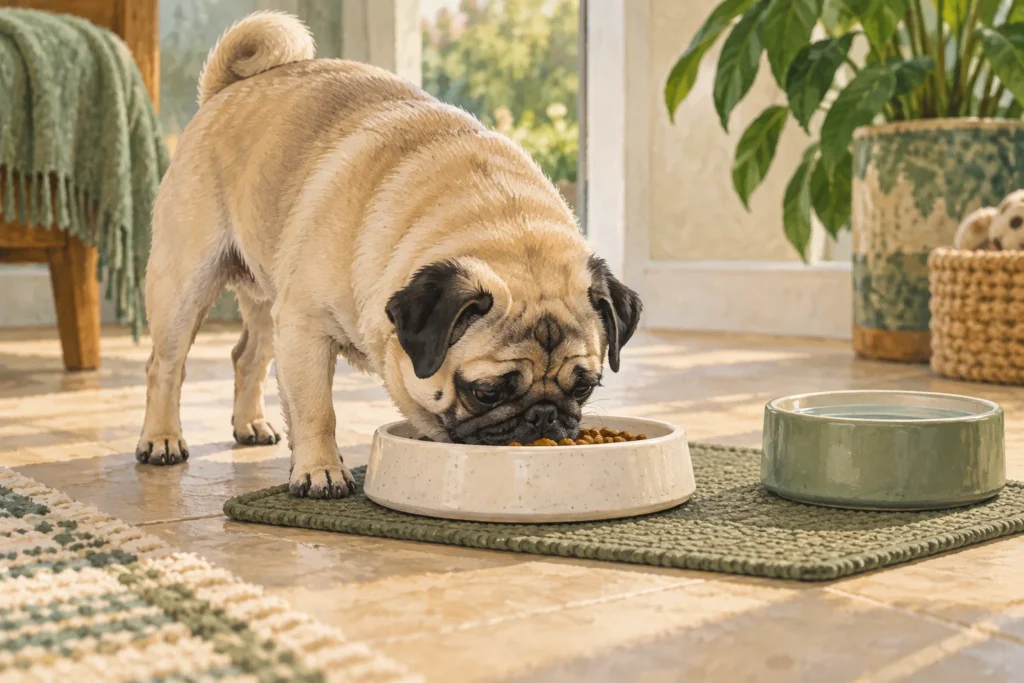
Dog bowls for flat-faced dogs should make food easy to reach without the dog pressing their face into deep sides or narrow channels. Start by observing how your dog uses the current bowl. A broad shallow dish may be sufficient; a complicated slow feeder is not automatically an improvement.
This article contains Amazon affiliate links. As an Amazon Associate, we earn from qualifying purchases.
Table of Contents
Watch an ordinary meal before shopping
Look at whether your dog can reach food around the edge, whether the bowl slides and whether they repeatedly abandon hard-to-reach pieces. Notice the position of the bowl on the floor and any crowding from furniture or another animal.
Difficulty eating, coughing, repeated regurgitation, breathing concerns or an abrupt change in feeding behaviour needs veterinary advice. Do not assume a new bowl will resolve a medical problem. Bowl selection is about practical access, not diagnosing why a dog struggles.
Compare usable space rather than stated capacity
A bowl’s litre capacity tells you how much it can contain, not how easily a short muzzle can reach that food. Measure the internal width, depth and shape of the sides. A large external diameter can hide a small usable area when the rim is thick.
| Design | Reason to consider it | Main limitation |
|---|---|---|
| Wide shallow stainless-steel dish | Simple access and a surface that is easy to inspect. | A lightweight dish may need a stable base. |
| Shallow ceramic dish | Weight can help it remain in place. | Check for chips and whether you can lift and wash it comfortably. |
| Wide partitioned feeding plate | Spreads food across a larger area. | Partitions still need to be accessible to this dog’s mouth. |
| Deep maze bowl | May slow some dogs’ access to food. | Narrow high-sided channels can make reaching food difficult. |
First shortlist: a simple shallow dish
A plain wide dish is a sensible baseline when the existing problem is depth or restricted access. Find wide shallow stainless-steel dog dishes on Amazon UK. Check internal dimensions and the condition of the rim, and choose a size that holds an ordinary meal without needing a deep heap.
Place it on a stable surface and watch a supervised meal. If food remains inaccessible around the sides, a different shape may be needed. Avoid buying several matching bowls before confirming the first one works for your dog.
Second shortlist: a broad feeding plate
LickiMat’s SloDog uses a wide, shallow plate with raised partitions rather than a deep bowl. The UK product page lists a 35 × 26cm footprint and suitability for different food textures. That creates a useful format to compare when a dog finds conventional maze walls awkward.
Find LickiMat SloDog feeding plates on Amazon UK. Check the model and dimensions carefully because similarly named sizes and regional versions exist. The plate still needs individual observation: accessible for one flat-faced dog does not mean accessible for all.
Do not treat manufacturer claims about digestion or bloating as proof that the plate prevents illness. The practical question here is whether the dog can collect the meal comfortably and whether the feeding pattern is manageable.
Think about the food you actually serve
A dish that works with dry pieces may behave differently with a sticky wet meal. Spread a suitable amount without packing food into corners or channels the dog cannot clear. If the dog becomes frustrated, simplify the setup rather than interpreting a longer meal as a success.
Our slow-feeder guide considers the wider category. Use it after resolving basic access; slowing a meal should not require an uncomfortable feeding position.
Do not add height or tilt without a reason
A raised stand or angled bowl changes the setup but does not guarantee a better one. Check that it remains stable and allows comfortable movement. If your vet recommends a particular feeding position for a health reason, follow that individual advice rather than choosing a fashionable stand.
Also consider reach to water. A food plate is not a replacement for a suitable water bowl, and a shallow water dish may need refilling more often. Keep fresh water accessible in a design your dog uses comfortably.
Make cleaning easy enough to repeat
Check whether the complete item is dishwasher safe or whether rubber bases and removable parts require separate care. Inspect hidden grooves and the underside. Replace chipped, cracked or damaged items rather than trying to make them last indefinitely.
The best purchase is often the simplest bowl that solves the observed problem. Confirm comfortable access, reasonable stability and straightforward cleaning before adding a second feeder or an accessory stand.