
Last updated: 9 September 2026
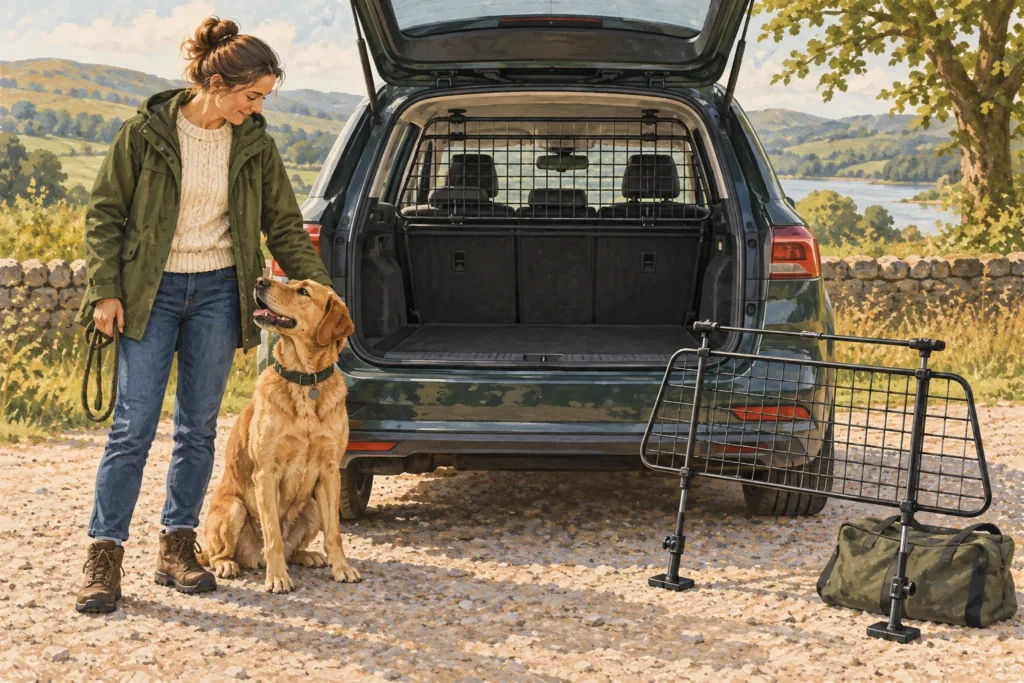
The best dog guard for your car is compatible with the exact vehicle, mounts securely as instructed and closes the relevant gaps between the boot and passenger area. Vehicle-specific guards are usually the first option to investigate when you keep one car; an adjustable universal guard needs particularly careful checks of mounting and coverage.
A guard is one component of a travel arrangement. It should not be treated as proof that every dog, piece of luggage and emergency situation inside the boot has been addressed.
Table of Contents
Vehicle-specific versus universal guards
| Type | Potential advantage | Buying question |
|---|---|---|
| Vehicle-specific guard | Designed around the car’s interior and fixing points | Does the exact body style and model year match? |
| Adjustable universal guard | May suit more than one compatible vehicle | Are the mounting method and adjustment range appropriate? |
| Guard with matching divider | Separates the dog’s space from luggage | Which pieces are required and what space remains? |
| Guard with compatible tailgate barrier | Adds a barrier when the boot is opened | Can the dog still be reached and removed in an emergency? |
Universal does not mean compatible with every headrest, seatback or roof shape. A guard that depends on compression or headrest mounts must have suitable surfaces and components to attach to. Do not improvise fixings or drill around vehicle safety equipment to make an unsuitable guard fit.
Start with the exact car details
Record make, model, year and body style. Check distinctions such as estate versus hatchback, generation changes, seating layout and any panoramic-roof or trim restrictions in the fitting notes. A registration lookup is helpful, but read the resulting compatibility details before ordering.
Travall is a useful vehicle-specific range to compare. The manufacturer describes steel guards designed for particular vehicles, installed without drilling or permanent modifications, with compatible divider and tailgate options where offered. Compatibility is determined by the actual product selected, not by the brand name alone.
This article contains Amazon affiliate links. As an Amazon Associate, we earn from qualifying purchases.
Find Travall vehicle specific dog guard on Amazon UK. Establish the correct Travall product code using the manufacturer’s vehicle selector before choosing a marketplace listing. Check that the fixing kit and instructions are included, particularly for a used guard.
What Rule 57 does and does not tell you
In Great Britain, Highway Code Rule 57 says animals should be suitably restrained so they cannot distract the driver or injure themselves or others during a quick stop. It lists several possible arrangements, including a dog guard. This is guidance about the travel outcome, not a certification awarded to any guard advertised online.
When a maker says “crash tested”, look for the exact product, test conditions and report. A quality-management certification is not the same thing as a demonstrated dog-protection result. Avoid assuming that a barrier test answers what happens to an unrestrained dog moving within a large boot.
Consider the whole arrangement with advice from the relevant manufacturers. If using a crate, our travel crate sizing guide helps you start with the dog’s usable space; the crate must also be suitable and secured for the vehicle.
Inspect gaps from the dog’s point of view
Once installed, check above the seatbacks, around the outer edges and between split seats. A gap that looks modest to a person may be accessible to a small dog. Check the guard with the seats in the actual travelling position, and repeat after folding or adjusting them.
Remove loose luggage from the dog’s area or separate and secure it appropriately. A guard behind the passenger seats does not stop a suitcase sliding into the dog. Provide a stable surface, enough comfortable space and ventilation without relying on an open window as the travel plan.
Plan loading and unloading
A dog can leave the vehicle as soon as the boot opens if there is no additional barrier. Practise calm loading and arrange the lead before opening fully in a safe place. Do not attach the dog to an arbitrary hook or improvised tether without checking whether it is an intended restraint point.
Think through access if the rear door cannot be opened. Check whether a crate or divider blocks another exit, and retain access to essential equipment. Avoid filling every remaining gap with luggage merely because it fits.
After the first short journey, recheck the manufacturer’s fixings and look for movement or rattling. Inspect the guard after vehicle servicing, seat changes or removal. A well-chosen guard should fit your regular travel routine without requiring a new improvisation each time you put the dog in the car.