
Last updated: 9 September 2026
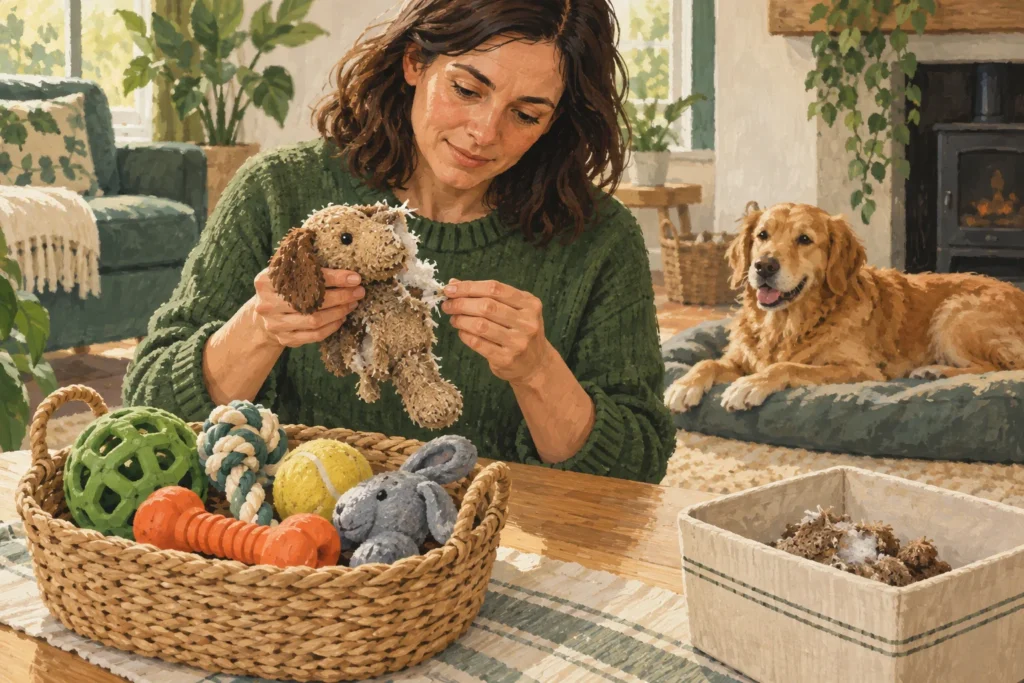
A safe choice of dog toy depends on its size, construction and how your particular dog uses it. No toy is indestructible, and a product that lasts for months with one dog may be pulled apart in a single session by another. Inspecting it during use is as important as choosing it carefully in the first place.
Start by deciding what the toy is for. A fabric tug for a game with you, a food-stuffable rubber toy and a soft comfort toy have different jobs. Do not assume that surviving a game of fetch proves a toy can be left available for prolonged chewing.
Table of Contents
Match the toy to the mouth and the activity
Follow the manufacturer’s size and supervision instructions, then consider the dog in front of you. Can the item fit too far into the mouth? Does the dog try to swallow rather than carry it? Are they able to peel off an edge or expose a smaller internal part? Breed labels and body weight are useful starting points, not the complete assessment.
Blue Cross advises choosing appropriately sized toys and checking for parts that could be chewed off and swallowed. For a household with different-sized dogs, keep the smallest dog’s toys away from a larger dog who could engulf them. Separate play areas can be simpler than trying to find one toy for everyone.
This article contains Amazon affiliate links. As an Amazon Associate, we earn from qualifying purchases.
KONG distinguishes its rubber ranges by chewing style. That is a reminder to check the exact model, not treat the brand name as a universal durability guarantee. Find KONG Extreme (medium example) on Amazon UK if you are comparing that tougher rubber range, then use its current sizing instructions. A stronger formulation still needs inspection and appropriate supervision.
A check before each session
| Look at | Warning sign | Practical response |
|---|---|---|
| Seams and stitching | Opening fabric or exposed filling | Remove the toy from play |
| Rubber edges | Splits, loose chunks or peeling sections | Retire the damaged item |
| Rope and handles | Loose strands or a failing join | Stop the game and inspect fully |
| Squeakers and inserts | A component becoming accessible | Prevent access rather than waiting for it to come out |
| Overall size | A puppy has outgrown the original choice | Reassess the size and play format |
Run your eyes and hands over the whole toy, including its underside. A small split may widen when compressed. Do not hide damage with tape or glue: that adds materials the dog may detach, without restoring the original construction.
Watch the dog’s technique
Two dogs can interact very differently with the same object. One carries it gently; another pins it with both paws and works at a single seam. Observe the first sessions closely enough to interrupt before a weak point becomes an ingestion hazard. Being in the same house is not the same as supervising the activity.
Put interactive toys away after the game. A rope handle useful for throwing or tugging is not automatically suitable for chewing alone. Stop if play becomes frantic or another dog is trying to take the item. Offer a calm exchange rather than chasing the dog around the room with the prize.
For food puzzles, check moving lids, pegs and removable pieces as well as the outer shell. The dog puzzle guide is a starting point for choosing formats, but difficulty should not come from a frustrated dog having to bite the puzzle apart.
Keep cleaning and inspection connected
Clean according to the exact product instructions and inspect again once dry. Dishwasher approval for one rubber model does not apply to every fabric, electronic or glued toy from the same company. Trapped food, damaged surfaces and damp storage can make a once-useful item harder to maintain.
Store clean toys separately from items awaiting washing or disposal. A damaged favourite left in an open basket is still accessible. In a family household, make the retirement decision clear so someone else does not return it to the dog later.
If part of a toy is missing
Remove the remaining toy and contact your vet promptly if swallowing is possible, particularly if you cannot account for a piece. Do not wait for symptoms or attempt to make the dog vomit without veterinary direction. Keep the packaging or a matching photograph and tell the vet what material, size and approximate time may be involved. Breathing difficulty or collapse needs emergency veterinary help.
The aim is not to remove every enjoyable activity. It is to choose toys that suit the individual, notice changes early and replace a damaged item before a small fault becomes a bigger problem.