
Last updated: 9 September 2026
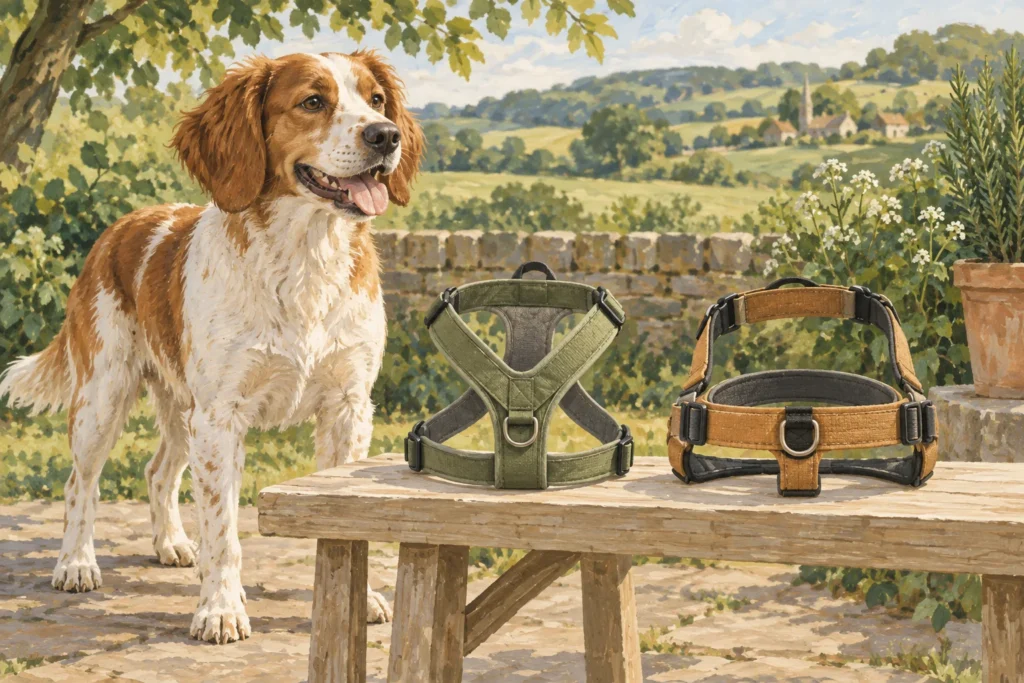
A Y-shaped harness and a chest-strap harness place material differently across the dog’s front, but the outline alone does not settle the buying decision. Check where the straps sit on your dog, how the harness moves and whether it remains secure. A well-marketed shape can still fit poorly.
This article contains Amazon affiliate links. As an Amazon Associate, we earn from qualifying purchases.
Table of Contents
Identify the actual design
Y-shaped designs generally have straps meeting over the front of the chest and continuing between the front legs. Chest-strap or Norwegian-style designs commonly use a more horizontal strap across the front. Individual models vary in padding, adjustment and the route of the remaining straps.
Do not assume every harness from a brand has the same shape. Also distinguish the harness’s base construction from optional chest pads or add-on straps, which can change how a particular setup works.
| Check on the dog | Y-shaped design | Chest-strap design |
|---|---|---|
| Front position | Check the junction sits appropriately on the chest. | Check the horizontal strap’s height and position during movement. |
| Leg clearance | Watch the between-leg strap and girth near the armpits. | Watch the front strap and girth as the dog steps. |
| Adjustment | Look for useful adjustment for this dog’s proportions. | Check whether both chest and girth settings achieve a stable fit. |
| Lead pressure | Observe twisting or riding up with the chosen attachment. | Make the same checks rather than judging while standing still. |
Ruffwear Front Range: an everyday Y-style example
Front Range offers several adjustment points, padding and front and back lead-attachment options. Its design gives a useful reference for comparing how a Y-style harness sits on the chest and around the body.
Find Ruffwear Front Range harnesses on Amazon UK. Check the exact current version and size guide. The reinforced front attachment differs from the metal back ring; follow the manufacturer’s intended use rather than treating every attachment as interchangeable.
A dog can still pull in this type of harness. A front connection may be used within a suitable handling plan, but equipment does not replace learning to walk comfortably on a lead.
Julius-K9 IDC Powerharness: a chest-strap example
The IDC Powerharness is an example of a more substantial body panel with a chest-strap layout, a back attachment and a handle. Julius-K9 also offers separate accessories for certain models and sizes.
Find Julius-K9 IDC Powerharnesses on Amazon UK. Confirm what is included in the chosen listing. Do not assume an optional front D-ring accessory is part of the standard harness or compatible with every size.
The handle can be useful for brief appropriate control, but it should not be interpreted as permission to suspend or routinely lift the dog. Follow the model’s instructions for any assistance.
Look at movement without making universal claims
Observe ordinary walking, turning and sniffing in a safe place. Does the harness rotate to one side, press towards the throat, rub behind the legs or interfere with the dog’s usual posture? A static photograph cannot answer those questions.
There is no reason to claim that every Y-shaped harness leaves every shoulder unrestricted, or that every chest-strap design necessarily causes injury. Body shape, dimensions, adjustment and the task all affect the practical fit. Seek individual advice where movement looks uncomfortable.
Consider how it goes on
A shape that looks ideal on paper may be awkward for a dog who dislikes the fitting process. Check whether the harness passes over the head, requires stepping in or has clips that open around the body.
Teach comfortable handling in small stages. If resistance appears suddenly, consider pain or sensitivity and speak to your vet. Buying a tighter harness to prevent the dog moving away does not address why the process became difficult.
Fit for the actual activity
An ordinary walking harness is not automatically suitable for canicross, restraint in a vehicle or lifting a dog over obstacles. Those jobs can require different designs and evidence. Begin with what the product is intended to do.
Our harness-versus-collar guide gives wider context. If pulling is the main problem, use equipment selection alongside appropriate training rather than expecting a particular silhouette to fix it.
Recheck after ordinary use
Inspect the skin and coat beneath contact areas, and check buckles and stitching. Reassess adjustment after washing, growth or a change in coat. A harness that fitted on the first day can loosen or become unsuitable later.
Choose the design that fits this dog’s proportions, can be put on comfortably and remains stable during normal movement. That observed fit is a stronger basis for purchase than treating a shape label as a universal verdict.