
Last updated: 9 September 2026
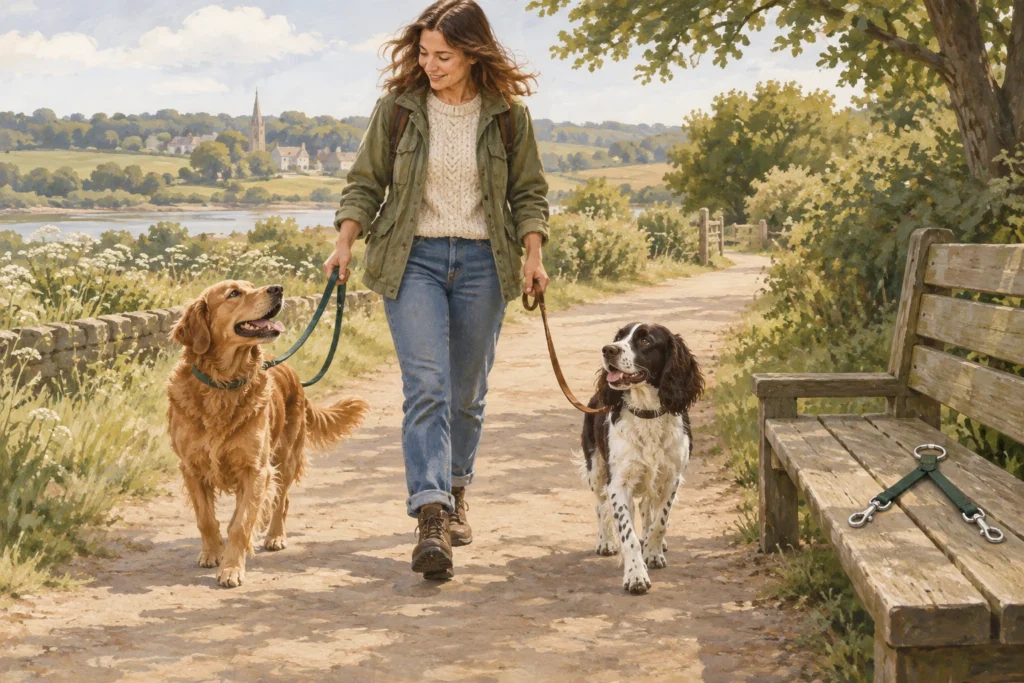
Two separate leads are usually the more flexible starting point for walking two dogs because you can manage each dog’s distance and direction independently. A coupler can simplify carrying when the dogs walk comfortably together at a similar pace, but it also connects their movements. One dog’s sudden stop or lunge can affect the other immediately.
Choose the arrangement around the dogs you have, not the number of handles you would prefer to hold. If either dog finds walks difficult alone, linking them together rarely makes teaching the missing skills easier.
Table of Contents
What a coupler changes
A coupler normally joins two short branches to one main lead. Each branch attaches to a dog, so movement is shared through the central junction. Adjustable branches can help accommodate different heights, but they do not give the independent space of two full leads.
| Situation | Separate leads | Coupler |
|---|---|---|
| Different sniffing pace | Easier to allow a brief individual pause | Dogs may pull against each other |
| Narrow pavement | Can position each dog deliberately | Less independent positioning |
| Similar calm walkers | Two handles to organise | One main handle may be convenient |
| One dog needs extra distance | More scope for individual management | Both dogs move as a linked group |
A swivel may reduce twisting at one point, but it cannot prevent every tangle around legs or furniture. Treat anti-tangle marketing as a feature description to examine, not a guarantee of effortless walking.
Consider compatibility between the dogs
Look at body size, comfortable pace, preferred walking side and response to other dogs. A small dog beside a much stronger dog may experience abrupt force through a shared setup. Two dogs who compete over space or rewards may also be uncomfortable in close proximity.
Practise walking together with enough help to manage them individually before deciding whether a coupler is suitable. If one becomes worried or frustrated, increase space and simplify the arrangement. Do not expect them to negotiate a narrow shared radius without support.
Dogs Trust’s professional walker guidance emphasises appropriate grouping and management. The same practical question applies at home: can the person handling this pair keep both dogs comfortable and under control in the intended environment?
Features to check if a coupler suits the pair
This article contains Amazon affiliate links. As an Amazon Associate, we earn from qualifying purchases.
TRIXIE’s Premium Coupler is an example described by the manufacturer as adjustable webbing. Find TRIXIE Premium dog couplers on Amazon UK if you are comparing that format, checking the exact branch lengths, width and clip size. The available dimensions must suit both dogs and the intended lead attachment.
Inspect the central ring, stitching and each clip. Check the manufacturer’s limits for the complete product rather than assuming that two apparently strong branches make the central connection equally suitable. Avoid attaching a coupler to a device whose instructions do not allow it.
Use an appropriate main lead that you can hold securely. A coupler combined with a retractable lead adds handling complexity and should not be improvised from unrelated products. If in doubt, keep the independent fixed-lead arrangement and ask a qualified trainer for practical help.
Organise two leads without wrapping your hands
With separate leads, establish a comfortable hand position and avoid winding straps around fingers or wrists. Keep enough slack for ordinary movement without allowing loops to trail where dogs or people can step through them. Stop in a safe place to untangle rather than trying to fix crossed leads beside traffic.
Find fixed-length dog leads on Amazon UK if you need a matching pair that is easier to identify and organise. Different colours can help distinguish dogs, but suitable length, clips and grip matter more than appearance. Check harness fit too; our harness guide explains why equipment needs to work alongside training.
Reward each dog fairly and manage food carefully if either guards rewards. Individual practice sessions may make joint walks easier than asking both dogs to learn new skills while sharing your attention.
Trial the arrangement somewhere simple
Start with a short outing in a quiet, spacious place. Observe whether the dogs can stop, turn and walk without repeatedly bumping or pulling each other. Finish if the setup creates frustration or reduces your ability to respond safely.
Check for rubbing and inspect equipment afterwards. Reassess as a puppy grows, an older dog slows down or either dog’s behaviour changes. A coupler that once suited two similar walkers may stop being the right arrangement.
Convenience is worthwhile only when it preserves comfortable control. Use a coupler for a compatible pair who already walk well together; keep separate leads when their individual needs call for independent movement and handling.