
Last updated: 9 September 2026
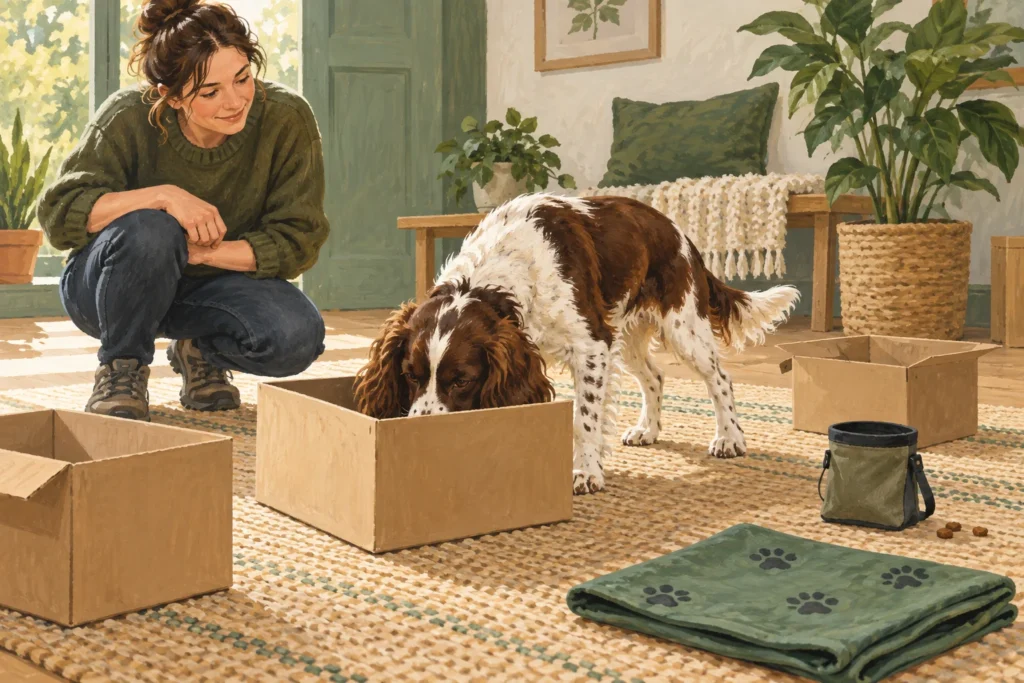
For simple scent games at home, you can often start with your dog’s usual food or a favourite suitable toy and a safe search area. A specialist scentwork kit becomes useful when you are following a course that teaches a particular target odour. Ask the instructor for the exact equipment list before buying jars, swabs or scented materials.
The distinction saves money and prevents confusion. Finding a familiar treat and indicating a trained scent are related activities, but they do not require identical equipment or handling. A large kit advertised for “all scentwork” may contain items you will not use.
Table of Contents
Decide which kind of scentwork you want
Blue Cross describes straightforward food and toy search games that use a dog’s interest in something they already know. These can begin with an easy, accessible hiding place and become more varied as the dog understands the task. There is no need to buy concentrated oils to make a first food search interesting.
Organised scentwork uses specified target odours and rules. Scentwork UK’s current guidance identifies particular odours and preparation methods, with differences between levels. That is why a kit from another programme or country may not match your class, even if the product title sounds right.
Ask whether the first sessions involve searching for food or toys, introducing odour or practising a learned indication. The instructor may supply the specialist materials initially, leaving you to bring only ordinary walking equipment and rewards.
A practical beginner equipment list
| Item | When it is useful | What to check |
|---|---|---|
| Usual reward | Food or toy search and class rewards | Dietary suitability and a comfortable toy size |
| Lead and harness | Controlled access to the search area | The class’s requirements and the dog’s fit |
| Safe search objects | Exercises selected by your instructor | No sharp edges, trapping spaces or swallowable parts |
| Separate sealed containers | Storing instructed odour materials | Correct size, clear labels and secure storage |
| Notebook | Recording the exercise and dog’s response | Keep notes simple enough to use consistently |
Use existing items where they meet the requirements. A notebook can be a phone note; rewards can come from the planned food allowance. Buy specialist equipment only when you can explain its role in the session.
Keep scent materials separate and inaccessible
Ask the instructor how materials should be prepared, labelled, handled and stored. Keep scented and unscented items separate so accidental transfer does not turn every object into the target. Do not repurpose food-storage containers without clearly separating their new use from household food preparation.
This article contains Amazon affiliate links. As an Amazon Associate, we earn from qualifying purchases.
Find sealed jars for instructed scentwork storage on Amazon UK if sealed jars are on your instructor’s list. Check the required size and closure rather than buying the smallest decorative set. These are storage containers for human handling, not objects for the dog to carry or open.
Small tins, magnets, swabs and clips can be swallowing hazards. The dog should not be able to remove or ingest hidden materials. Use only the placement and equipment arrangement your instructor considers suitable, and account for every small item after the exercise.
Do not improvise an odour recipe
A scent mentioned in a sport’s rules is not an instruction to apply a concentrated oil directly to a toy or the dog’s surroundings. Follow the exact programme and qualified instruction. Scentwork UK’s guidance, for example, distinguishes specific products and preparation methods; similar-sounding household products are not automatically interchangeable.
Avoid adding essential oils, cleaning products or unknown scented substances to a homemade kit. Keep all preparation materials away from children and pets. If an item is swallowed or a concerning exposure occurs, contact your vet with the product details rather than waiting to see whether the next session goes well.
Start in a search area you can control
Use a quiet space free of hot appliances, unstable furniture, sharp edges and gaps that could trap the dog. Choose hiding places they can reach comfortably. Do not make an exercise harder by encouraging climbing or pushing into unsuitable spaces.
Let the dog work at a manageable level. If they seem confused, worried or frustrated, make the task easier or stop. Short successful practice is more useful than continuing until the dog gives up. Seek veterinary advice about activities if health restrictions apply; scentwork still involves movement.
Judge a kit by compatibility and repeat use
Before ordering, ask the seller for the exact contents, whether items arrive scented, which programme they match and what instructions are included. Check the cost of replacing consumable materials. A clearly described small kit is easier to manage than a bundle of unlabelled accessories.
Our puzzle toy guide offers other food-game formats if you want variety without formal scent training. For a class, let the instructor’s list determine the purchase. For a first home game, a familiar reward, a safe space and an achievable search may already be all you need.