
Last updated: 9 September 2026
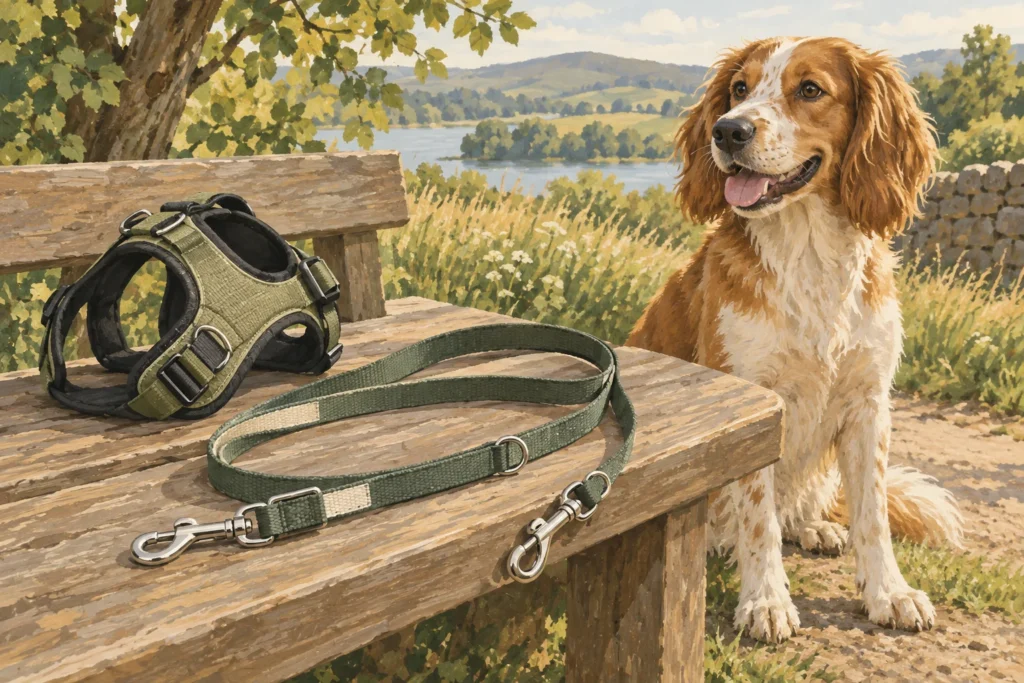
The best double-ended dog lead has clips that fit your equipment, enough usable length for the intended arrangement, and material you can hold comfortably. Two ends can allow a front-and-back harness connection or different lead lengths. They do not automatically make every arrangement suitable for every dog.
Before buying, decide what the second clip will do. If you only want a normal lead at one fixed length, extra rings and metalwork may add complexity without solving a problem.
Table of Contents
Halti Training Lead or Halti Double Ended Lead?
The similar names can be confusing. Company of Animals distinguishes the Training Lead’s webbing and connection-ring design from the Walking range’s Double Ended Lead, which adds neoprene padding and reflective detailing. Check the exact item rather than relying on a listing headed simply “Halti lead”.
| Option | Reason to shortlist | What to check in person or in the listing |
|---|---|---|
| Halti Training Lead | Adjustable arrangements using two clips and connection rings | Width, clip size and how the webbing feels folded in your hand |
| Halti Double Ended Lead | Padding and reflective detail for everyday walking | Bulk in the hand and usable length in your chosen configuration |
This article contains Amazon affiliate links. As an Amazon Associate, we earn from qualifying purchases.
Find Halti Training Lead double ended on Amazon UK. For the padded walking model, Find Halti Double Ended Walking Lead padded on Amazon UK. Confirm the size and manufacturer’s suitability guidance for your dog; similar-looking clips can differ between sizes.
Understand the arrangement before attaching it
With a compatible harness, one clip may connect at the back and the other at the front according to the equipment instructions. That allows the handler to manage two points of contact. It is not a reason to keep both sections tight or steer the dog through sharp corrections.
A double-ended lead can also be clipped back onto one of its own rings to change length. Check where the resulting handle sits and whether unused metalwork hangs against the dog. Rehearse the change while stationary in a secure place rather than halfway across a road.
If a headcollar is involved, follow that exact product’s introduction and attachment instructions, including any specified safety link. The appropriate headcollar setup is a separate decision; do not improvise it from a photograph of a different product.
Measure usable length, not just the advertised total
A lead advertised at two metres does not necessarily leave two metres between your hand and the dog in every arrangement. Clipping both ends to a harness or forming a handle consumes some of that length.
Use a piece of cord indoors, without attaching it to the dog, to visualise the length you want between hand and harness. Compare that with the maker’s configuration diagrams. The aim is enough slack for comfortable walking without loops dragging around the dog’s legs.
Choose clips you can operate accurately
Try the clips with the gloves you normally wear if possible. A small trigger can be awkward in winter, while a large heavy clip can be disproportionate on a tiny harness. Make sure the clip closes fully around the intended ring and does not jam against adjacent hardware.
Check swivels, stitching and ring attachments regularly. If sand or mud stops a clip moving freely, follow its cleaning guidance and assess whether it remains dependable. A clip that only works after repeated fiddling is a reason to stop using the lead.
Padding is personal; control is practical
Neoprene padding may feel pleasant when holding a single section, but folding several layers can produce a bulky handful. Webbing may pack more easily but feel different against wet hands. There is no universal comfort winner without considering the person holding it.
Do not choose waist-worn use solely because a product advertises it. Think about balance, pulling strength and the environment first. Walking two dogs on one lead also introduces a separate handling problem; two available clips are not enough to establish that it is appropriate.
Pair the purchase with a clear walking routine
Our lead and collar buying guide covers basic equipment, and the harness guide for pulling discusses compatible features. A lead can help organise handling, while reward-based practice teaches the dog what to do.
On the first walk, use the simplest permitted arrangement in a quiet place. Check that you can gather slack, switch hands and reward the dog without dropping a section. The right double-ended lead makes those ordinary actions easier; it should not require a complicated sequence of clips every time you leave home.