
Last updated: 9 September 2026
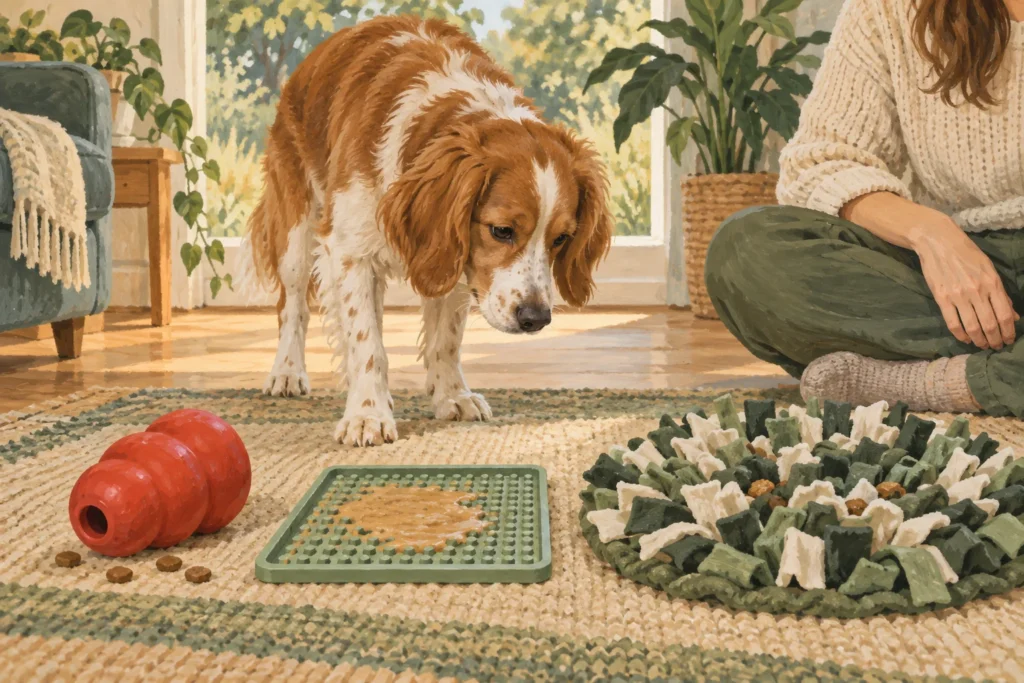
Choose a KONG-style food toy when your dog enjoys working food out of a hollow rubber shape, a lick mat for an accessible spread of suitable soft food, and a snuffle mat for searching out dry pieces. None is automatically the best enrichment tool: the right choice depends on how your dog uses it.
You do not need all three to give your dog an interesting day. Start with one activity that is easy enough to succeed at, watch the response and adapt. The aim is enjoyable participation, not making dinner take the longest possible time.
Table of Contents
Compare the actual activity
| Tool | What the dog does | Preparation | Main watch-out |
|---|---|---|---|
| Hollow rubber food toy | Licks, nudges or manipulates food out | Load appropriate food loosely at first | Wrong size, damaged rubber or inaccessible filling |
| Lick mat | Licks food from shallow texture | Spread a measured thin layer | Chewing or swallowing the mat |
| Snuffle mat | Uses the nose to find dry food | Scatter visible pieces before hiding more | Pulling out fabric or swallowing strips |
Watch what your dog chooses to do, rather than what the packaging says they should do. If they pick up a snuffle mat and shake everything out, they have found a solution. You can make the search easier or choose a different activity; there is no benefit in turning it into a frustrating contest.
When a KONG makes sense
A classic hollow KONG offers a compact way to present part of a meal. KONG’s selection guidance starts with an appropriate size and rubber choice for the dog. The toy must not be so small that it creates a swallowing risk, and stronger rubber does not remove the need to inspect it.
This article contains Amazon affiliate links. As an Amazon Associate, we earn from qualifying purchases.
Find KONG Classic (medium example) on Amazon UK. Choose the size and rubber version deliberately. Start with food that comes out readily while your dog learns the activity, rather than tightly packing a difficult frozen filling on the first attempt.
Freezing is optional, and the food’s own storage instructions still apply. A toy being freezer-safe does not make previously thawed food suitable for refreezing. Use the dog’s normal suitable food where possible and count every addition in the daily allowance.
When a lick mat is more practical
A lick mat exposes more of a soft filling at the surface. That can make the task easier to introduce and easier for you to see when it is finished. Texture depth varies, so a shallow design may be a better starting point than a deeply divided one.
Find LickiMat Tuff Buddy (red) on Amazon UK. LickiMat offers several formats, including Classic and TUFF designs; check the exact item’s cleaning instructions and construction. A more rigid backing should not be interpreted as permission to let a dog chew it.
A thin measured layer is often enough for a useful activity. Covering the whole mat with high-calorie extras can turn a small enrichment session into a substantial unrecorded snack. Keep the mat on a stable surface and remove it when the food is finished.
When a snuffle mat suits the meal
A snuffle mat works especially neatly with dry food that can be picked out of fabric. Begin with pieces visible on top. Add a few between folds once the dog understands the search. Do not bury the entire meal deeply and assume every piece will be found.
Find PAW5 Wooly Snuffle Mat on Amazon UK. PAW5 describes its Wooly as machine washable, which is useful for a fabric feeding tool. Check the current care directions and inspect the mat after washing for loose material.
Wet food is generally awkward in fabric folds: it leaves residue that is harder to see and remove. A washable solid feeding surface is usually a more practical choice for a soft meal. If your dog tears fabric instead of searching, put the mat away and choose another supervised activity.
Change difficulty before buying another product
If the dog gives up, make food easier to reach. If they finish quickly and look content, the activity may already be doing its job. If they guard the item, avoid reaching in or challenging them; use management and seek qualified reward-based help.
Supervise all three tools, separate dogs when needed and wash food-contact surfaces after use. Check hollows, grooves and fabric folds for leftovers. Marketing claims about calming do not make these products treatments for separation-related distress or other behaviour problems.
For a wider range of challenges, see our dog puzzle toy guide. Let your dog’s comfortable engagement guide the choice: a simple successful search can be more rewarding than a cupboard full of increasingly complicated equipment.