
Last updated: 9 September 2026
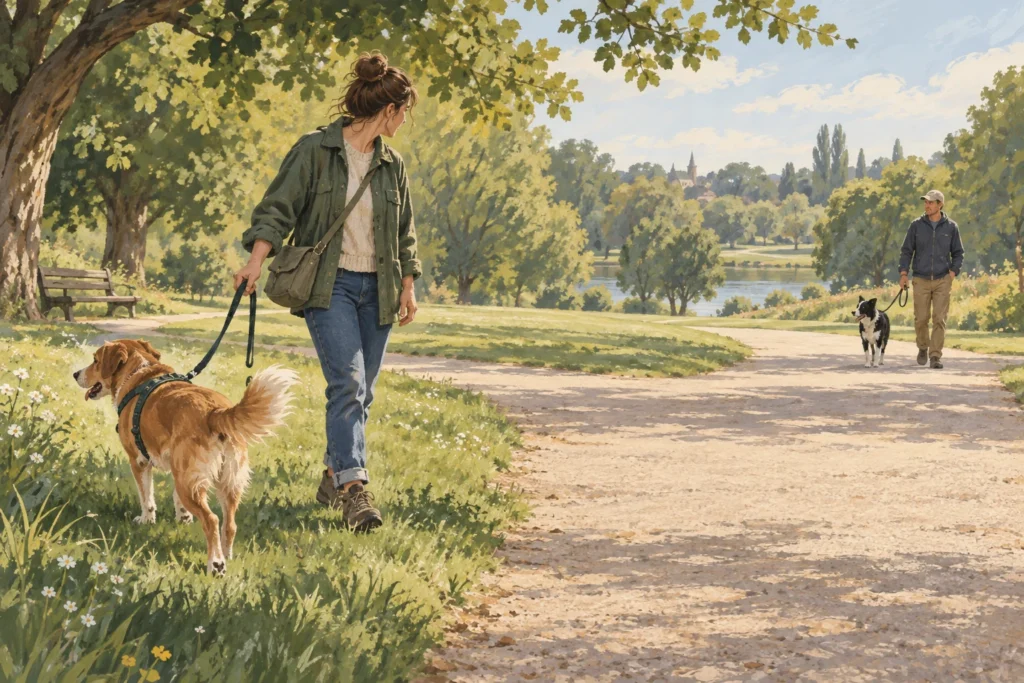
If your dog barks at other dogs on walks, start by creating more space and making encounters easier to avoid. Repeated close passes are rarely a useful starting lesson. A safer plan combines suitable equipment, calmer routes and professional help when reactions are intense, worsening or difficult to manage.
This article contains Amazon affiliate links. As an Amazon Associate, we earn from qualifying purchases.
Table of Contents
Do not assume barking has one meaning
A dog can bark because they are worried, frustrated, excited or experiencing several feelings at once. The same outward noise does not prove that two dogs need the same training. Sudden changes also warrant a veterinary check, because health and comfort can affect behaviour.
Record a few ordinary details: distance to the other dog, whether either was moving directly towards the other, the width of the path and how long recovery took. Do this without deliberately provoking another reaction to collect information.
Plan walks with room to move away
Choose routes and times where you can cross safely, turn around or step into a wider space. Avoid narrow passages with no exit while you are establishing a plan. Looking ahead is more useful than waiting until two dogs are nose to nose.
A change of direction is a valid success. You do not need to prove your dog can pass every other animal at close range. If you know a particular corner routinely creates a difficult encounter, choose a different approach or pause at a safe distance rather than repeating it daily.
Check the equipment before adding exercises
Use well-fitted equipment you can handle securely, without relying on discomfort to stop movement. Inspect straps, clips and the lead connection before going out. A harness that allows a dog to reverse out creates an additional problem when they are startled.
Find a fixed-length dog walking lead on Amazon UK. Choose a length that suits controlled pavement walking and your ability to manage it. A long training line used in open space is a different tool from the lead needed beside a road. No lead or harness treats the reason a dog reacts.
Practise where your dog can still think
Work at a distance where your dog can notice another dog without becoming overwhelmed and can respond comfortably to you. Reward an easy useful behaviour, such as looking back towards you or moving with you away from the situation. A qualified trainer can help identify the right starting level.
If the dog is staring rigidly, lunging or unable to disengage, do not stand still repeatedly asking for a sit. Increase distance when safe and allow recovery. Food refusal can be a sign the setup is too difficult, although appetite also varies for other reasons.
| What happens | Useful adjustment |
|---|---|
| Comfortable at a distance | Keep practice brief and reward manageable responses. |
| Reaction begins as the path narrows | Use a wider route and plan the exit earlier. |
| Several encounters build into a difficult walk | Reduce exposure and allow a quieter recovery period. |
| You cannot safely hold or redirect your dog | Seek individual professional support before attempting staged encounters. |
Keep other dogs out of the training experiment
Do not approach unfamiliar dogs to see whether yours will cope this time. Their owners have not agreed to participate, and the interaction may be difficult for both animals. Planned setups should use appropriate professional guidance and consenting helpers where needed.
Ask others to give space in simple terms. You do not owe a stranger a demonstration that your dog is friendly. Declining a greeting can prevent an encounter neither dog enjoys.
Get the right support early
Your vet can assess possible health contributions and help you access qualified behaviour support. This is particularly important with snapping, bites, strong fear or reactions you cannot manage safely. Avoid advice built around forcing close contact, lead corrections or punishing warning signals.
Our clicker guide explains a reward marker if one forms part of your plan, but the first improvement may simply be a walk with fewer difficult encounters. Judge progress by comfort, safety and recovery, rather than demanding immediate silence at any distance.