
Last updated: 9 September 2026
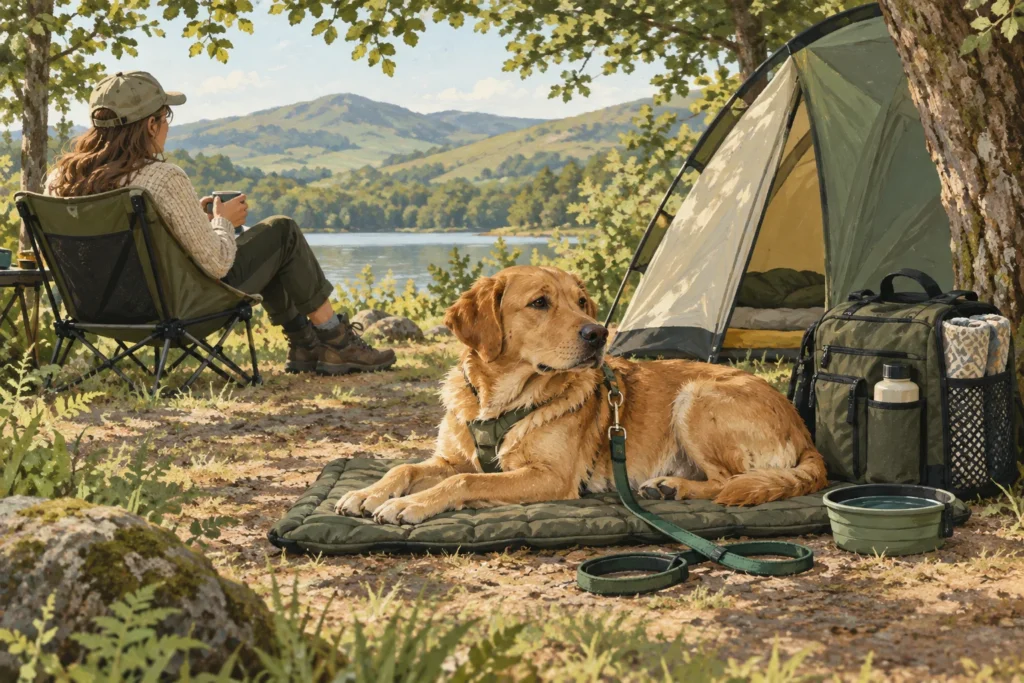
The dog camping equipment worth packing is the equipment that supports ordinary needs away from home: comfortable rest, water, suitable food, secure handling and cleaning up. Start with familiar items, then add only what the campsite and journey require. A complete new outdoor range is unnecessary if the dog’s existing kit works well.
The first distinction is whether you are camping beside the car or carrying everything on foot. Weight matters in both cases, but a backpacking trip makes water, food volume and the dog’s ability to manage the route especially important. Seek individual advice before demanding activity if health or mobility is a concern.
Table of Contents
Build the kit around five jobs
| Job | Useful equipment | Check before departure |
|---|---|---|
| Rest | Familiar mat or bed with suitable insulation | Fits the sleeping space and dries reasonably |
| Drink | Water supply and a stable bowl | Capacity for the route and reliable refill points |
| Eat | Usual food, portions and storage | Temperature requirements and enough for delays |
| Control | Suitable lead, fitted harness or collar | Site rules, condition and identification |
| Clean | Waste bags, towel and cleaning supplies | Disposal and washing arrangements |
Add prescribed medication, the dog’s relevant records and nearby veterinary contact details. Store essentials where you can reach them during the journey, rather than under the entire tent and cooking kit.
Choose a sleeping setup the dog knows
Practise with the sleeping mat and tent environment before a longer trip. Consider the ground beneath the bed as well as the top surface: a thin blanket on cold or damp ground may not provide the same comfort as it does on a carpet at home.
This article contains Amazon affiliate links. As an Amazon Associate, we earn from qualifying purchases.
Find roll-up dog camping mats on Amazon UK if your existing bed is too bulky. Compare packed volume, cleaning instructions and the dog’s actual resting size. A raised camp bed may keep the dog above damp ground but adds weight and may need another layer for comfort; it is not automatically the lightest solution.
Keep the resting area away from cooking equipment, heaters, cables and the entrance people repeatedly step through. An awning or closed vehicle can become hot, so check conditions rather than treating shade fabric as a temperature guarantee.
Make water and food predictable
Carry enough drinking water for the planned activity and uncertainty along the route. Do not rely on unfamiliar streams, puddles or lake water. A collapsible bowl is useful only if it stands steadily and the dog will drink from it. Find collapsible camping dog bowls on Amazon UK if you need a compact option.
Portion the dog’s usual food before leaving and retain its label information. For chilled or frozen food, confirm reliable storage for the whole stay; a cool bag is not an indefinite substitute for a fridge. If travelling abroad, check food-import restrictions before packing.
Use manageable enrichment that fits the diet, such as a familiar suitable food toy during supervised quiet time. Avoid bringing an unfamiliar difficult puzzle as the only plan for keeping the dog occupied.
Check site rules before buying restraints or pens
The Camping and Caravanning Club currently requires leads no longer than two metres on its Club Sites. Its policy also allows compounds within specified conditions while requiring dogs to remain on leads. Other sites may differ, so read the exact site’s rules rather than assuming a portable fence permits off-lead time.
Keep a fixed lead ready for moving between the pitch, facilities and walking areas. A stake, tether or pen needs appropriate manufacturer instructions and supervision; it does not make leaving the dog alone on the pitch a suitable arrangement.
Plan who manages the dog while the tent is pitched, showers are used and meals are cooked. Practical supervision is a bigger part of a successful trip than the number of clips attached to the camping chair.
Prepare for wet and muddy days
Pack an absorbent towel and a way to keep wet kit separate. Dry the dog and inspect paws and equipment after suitable activity. Bring enough waste bags and follow disposal instructions; never leave filled bags beside a pitch or path for someone else to collect.
A small first-aid kit can support an informed response, but it does not replace knowing when to contact a vet. Avoid adding human medicines for the dog. Save the local practice and emergency service details offline before entering an area with poor signal.
For vehicle transport, the travel crate sizing guide helps you check space alongside the packed luggage. The crate or restraint must remain usable when the car is fully loaded.
Try a short trip first and note what you actually used. Keep the comfortable essentials, remove redundant bulky items and add only what solved a real problem. A familiar, well-organised kit gives the dog a more manageable holiday than a collection of untested camping gadgets.