
Last updated: 9 September 2026
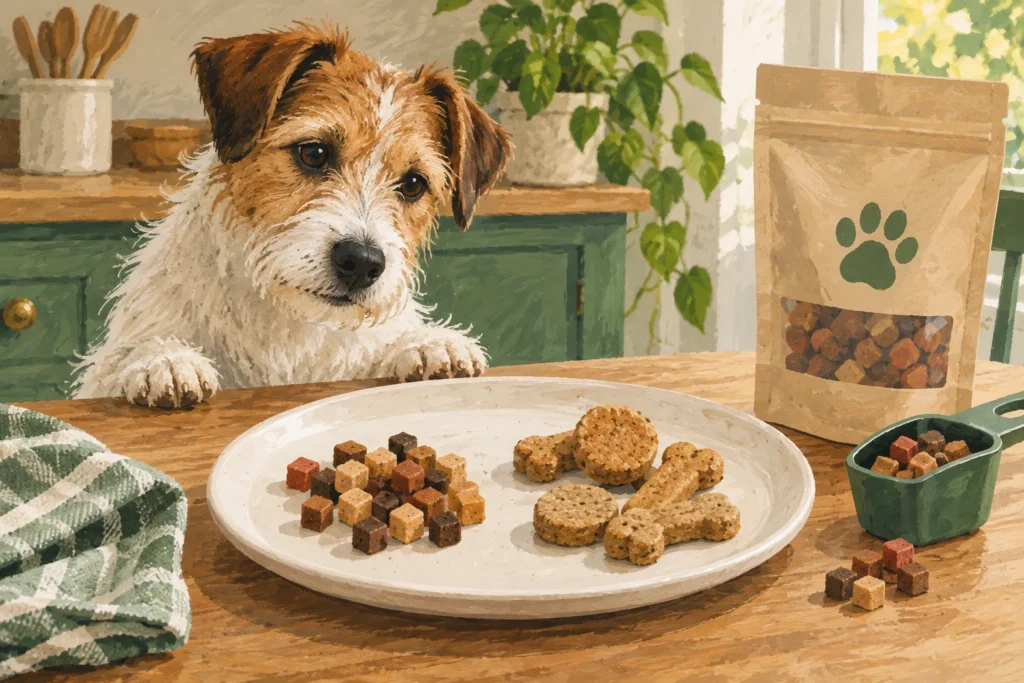
For low-calorie dog treats, compare the calories in the portion you will actually give, then multiply by the number of rewards in a session. A small piece of an energy-dense treat can contain fewer calories than a large “light” biscuit. The packet’s fat percentage alone does not answer the question.
The useful aim is a reward your dog enjoys, can eat comfortably and that fits their daily food allowance. A treat that needs several minutes of chewing is a different tool from one used repeatedly while practising a simple skill.
Table of Contents
Find one of three energy statements
| Label information | Calculation |
|---|---|
| kcal per treat | Multiply by the number given |
| kcal per 100g | Divide by 100, then multiply by the grams used |
| kcal per kg | Divide by 1,000, then multiply by the grams used |
| No calorie information | Ask the manufacturer rather than estimating from the name |
Use kilocalories, usually written kcal, consistently. Do not mix them with kilojoules. If you weigh several treats together to find an average, remember that irregular pieces may differ; the result is a practical estimate, not a laboratory value for every piece.
A real label example
Pooch and Mutt lists its Cheddar Cheese Treats at 2,930kcal/kg, or 2.93kcal per gram. If you weighed out 10g, the labelled energy would be about 29kcal. That calculation tells you the energy in the weighed portion; it does not tell you how many treats your individual dog should receive.
This article contains Amazon affiliate links. As an Amazon Associate, we earn from qualifying purchases.
Find Pooch and Mutt Cheddar Cheese dog treats on Amazon UK. Match the recipe and current label before using the number. The manufacturer describes this as a complementary food suitable from 12 weeks, so it is an extra to an appropriate diet, not a complete meal.
The same page lists a low fat percentage, yet the treats still contain calories. This illustrates why “low fat” and “low calorie per reward” are related questions rather than interchangeable claims. We are using the product to show transparent label maths, not declaring it the lowest-calorie treat on sale.
Compare a whole training session
Suppose two hypothetical options provide 1kcal and 4kcal per piece. Thirty rewards contribute 30kcal or 120kcal respectively. If the larger treat can safely be divided into four useful pieces, each small piece could provide the same 1kcal as the first option. Piece size and practicality can change the comparison completely.
Choose pieces small enough for repeated rewarding but suitable for your dog’s size and eating style. Do not create hard fragments or offer pieces a dog is likely to gulp dangerously. If mouth pain or chewing difficulty is suspected, ask your vet rather than simply choosing softer treats.
Use the food you already have
For tasks your dog finds easy, some of their normal complete food may be an effective reward. Take it from the daily allowance before serving meals. This makes the arithmetic simpler and avoids buying a separate product for every activity.
Keep a small amount of a more motivating reward for harder situations when appropriate. The reward’s value is the dog’s response, not its price or meat percentage. PDSA also suggests considering non-food rewards your dog enjoys, such as attention or play.
A shared treat pot can help a household stay coordinated. Fill it with the day’s agreed allowance, and ask everyone to take rewards from that pot. Remember dental chews, filled toys and treats from a walker or trainer when reviewing the total.
Fit extras into the complete diet
UK Pet Food advises that treats should contribute no more than 10% of daily calories, with most energy supplied by complete food. This is a general ceiling, not a required amount. Dogs on a prescribed diet, weight-loss programme or food trial may need a different plan from their veterinary team.
Do not cut a large amount of complete food to make room for an expanding collection of snacks. If training requires many rewards, discuss appropriate portion sizes and food choices. A useful plan preserves nutritional balance as well as the calorie total.
Buy a small pack before stocking up
Check the ingredient list, minimum age, texture and storage directions. Avoid assuming grain-free, natural or single-protein means universally suitable. Try a modest amount and confirm your dog will work for it before ordering a large tub.
Our puppy training treat guide covers reward formats for younger dogs. For any age, keep the comparison grounded in the portion you serve: calories per reward, rewards per day and a dog who remains comfortable and engaged.