
Last updated: 9 September 2026
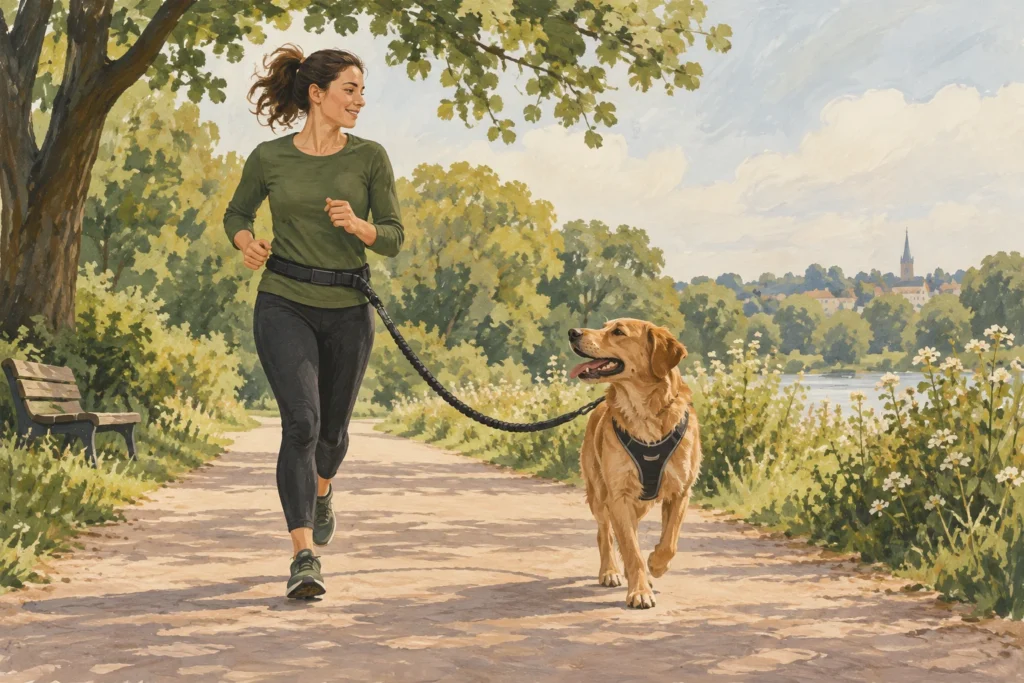
The best hands-free dog lead gives you a comfortable connection while preserving the control you need on your route. For relaxed walking, that may be a short adjustable lead worn around the waist. For running, a purpose-designed belt and compatible line may be more appropriate, particularly when the dog runs ahead under tension.
Hands-free describes where the lead attaches. It does not mean you can stop paying attention or that a dog who lunges becomes easier to manage because the force reaches your waist.
Table of Contents
Choose the activity before the attachment
| Activity | Setup to investigate | Important limitation |
|---|---|---|
| Calm everyday walking | Adjustable waist-worn walking lead | Needs a manageable working length |
| Occasional easy jogging | Running lead with appropriate stretch and a suitable harness | Dog and runner need gradual conditioning |
| Canicross with deliberate pulling | Sport-specific belt, line and pulling harness | Learn fitting and technique from a qualified club or coach |
| Busy pavements or unpredictable lunging | Close hand-held control and training support | A waist attachment can destabilise the handler |
Do not fasten a lead to an ordinary trouser belt or bag loop unless it is specifically designed and rated for that use. The connection needs to be part of a suitable system, with a buckle you can operate and a lead clip that matches the dog’s attachment point.
A convertible running lead to compare
Ruffwear’s Roamer is designed for hand-held or waist-worn use and incorporates stretch webbing. The current UK page lists a traffic handle and two length ranges, including a shorter 1.7–2.1m version and a longer 2.2–3.4m version. Those ranges describe unstretched and extended lead lengths, so check how the chosen waist adjustment affects your usable connection.
This article contains Amazon affiliate links. As an Amazon Associate, we earn from qualifying purchases.
Find Ruffwear Roamer bungee dog lead on Amazon UK. Confirm the generation and selected length. A longer version can be useful on suitable open routes, but extra reach is a disadvantage where it lets the dog cross another person’s path or approach the road.
The Roamer is an example of a convertible design, not a substitute for advice on a dedicated pulling sport. We have not compared its stretch response or comfort against competing leads in a running test.
Understand what the bungee changes
Elastic sections allow movement between dog and handler, but the dog can travel farther than the relaxed length suggests. Consider the fully extended distance when passing pedestrians, cyclists, livestock and traffic. A short handle is useful only if you can reach and hold it in time.
A non-stretch lead can give a more predictable distance for walking. A stretch lead may feel smoother during steady running, yet still transmit a sudden pull. There is no universal amount of stretch that suits every dog-handler combination.
Practise stopping, turning and gathering the lead while walking in a quiet area. If the dog repeatedly crosses in front of your legs, work on positioning before increasing speed. Do not wrap spare webbing around fingers or let loops trail where feet can catch.
Fit the human end properly
Measure over the clothing you will wear. Check the manufacturer’s minimum and maximum adjustment, whether the belt rides up and whether the load falls where the design intends. A padded handle converted into a waist loop will feel different from a separate running belt.
Try the buckle with gloves if you run in winter. Understand any release function before you need it, but do not treat unclipping an uncontrolled dog as the default response near hazards. Keep a hand available where your route demands immediate control.
Choose the dog’s equipment and pace carefully
Use a suitable, well-fitted harness for the intended activity. A walking harness and a harness designed for pulling are different choices. Our harness guide should be read with that distinction in mind; equipment marketed to discourage pulling is not automatically appropriate for canicross.
Discuss a new running programme with your vet, particularly for a growing dog or one with health or mobility concerns. Begin with manageable sessions and appropriate conditions, allowing sniffing and recovery rather than expecting the dog to match your training plan immediately.
Highway Code guidance says dogs should be kept on a short lead beside roads and paths shared with cyclists or horse riders. Adapt the lead arrangement to the setting. Wash and inspect the webbing, clips and stitching according to the maker’s instructions, and replace worn parts. The best hands-free setup is one you can smoothly turn into close control when the route changes.