
Last updated: 9 September 2026
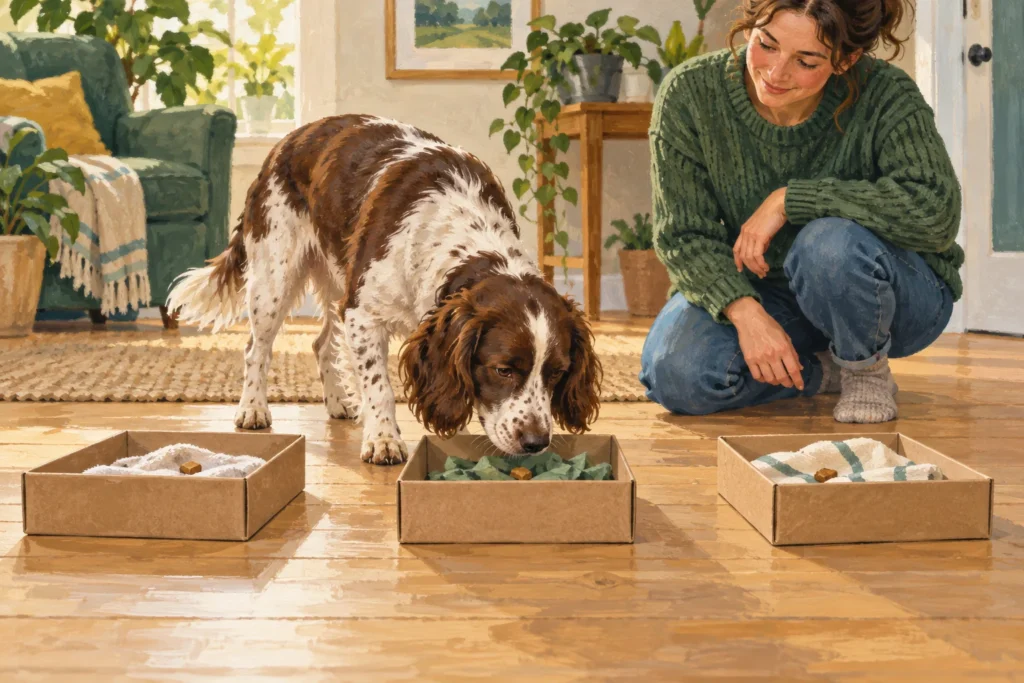
Indoor scent games for dogs can start with a few pieces of suitable food in an easy, visible area. Let your dog discover how the game works before making anything harder. A satisfying sniffing session offers choice and achievable finds; it does not need specialist scents or elaborate hiding equipment.
This article contains Amazon affiliate links. As an Amazon Associate, we earn from qualifying purchases.
Table of Contents
Prepare one calm search space
Use a room with a clear, non-slip floor and close access to places the dog should not investigate. Remove food wrappers, medicines and other tempting objects. Other pets should have their own comfortable space so the search does not become a competition.
Set aside a little of the dog’s normal food allowance, if suitable for the activity. Dietary restrictions still apply to training food. Keep track of what goes into the game so you can collect leftovers afterwards.
Game one: an easy scatter
Place several pieces a short distance apart on a clean floor while the dog can see. Give a simple invitation such as “find it”, then allow them to explore. The words are optional initially; the useful lesson is that searching this area produces an accessible reward.
Keep the first arrangement obvious. If the dog looks at you without investigating, point out a piece or reduce the area. There is no benefit in making the first attempt mysterious enough that the dog abandons it.
Repeat only while interest remains. You are observing a preference, not testing whether the dog is clever enough.
Game two: an open-container search
Use a few clean, shallow, stable containers with no sharp edges or detachable pieces. Let the dog see food placed in one. Keep all containers open and accessible so success does not depend on biting, tipping or forcing a lid.
Move the food between positions on later turns. If the dog becomes focused on chewing the container, return to a simple floor search. Skip cardboard completely for a dog who eats it, and supervise any homemade setup closely.
This version adds a small choice while keeping the physical task easy. It should not require the dog to push their head into a narrow opening or reach beneath furniture.
Game three: a small room search
Once simple finds are comfortable, place food in a few accessible locations within the same room. Begin in plain sight, then use slightly less obvious positions at floor level. Avoid shelves, worktops and locations you do not want the dog investigating later.
Know exactly where every piece went. After the session, collect anything missed so food is not left under furniture or found later by another pet. Keep the search area small enough that you can supervise without repeatedly directing the dog.
| What happens | A useful adjustment |
|---|---|
| Dog leaves immediately | Offer a simpler find or choose another activity. |
| Dog paws or bites containers | Remove containers and use an open surface. |
| Dog repeatedly asks you for help | Reduce the search area and make locations easier. |
| Dog finds everything comfortably | Change one feature on a later turn, such as spacing. |
| Another pet interferes | Give each animal a separate arrangement. |
Use a mat only if it improves the setup
A washable snuffle mat can keep a small search in one place. Find washable dog snuffle mats on Amazon UK. Choose a suitable size and supervise for chewing or swallowed fabric. It is optional; an uncomplicated floor search may be better for your dog.
Wash and dry the mat as directed, checking that food is not caught underneath. If the dog simply flips it over, that may be their chosen solution rather than a reason to add tighter hiding folds.
End with an easy success
Finish while the dog is still comfortable, clear the area and allow a normal quiet transition. Avoid turning the last find into an impossible challenge intended to tire them out.
Dogs Trust recommends adapting enrichment to individual health, preferences and responses. For additional formats, our puzzle-toy guide compares more structured activities. Sniffing games can be an enjoyable part of the day; they do not replace appropriate exercise, rest or professional support for anxiety.