
Last updated: 9 September 2026
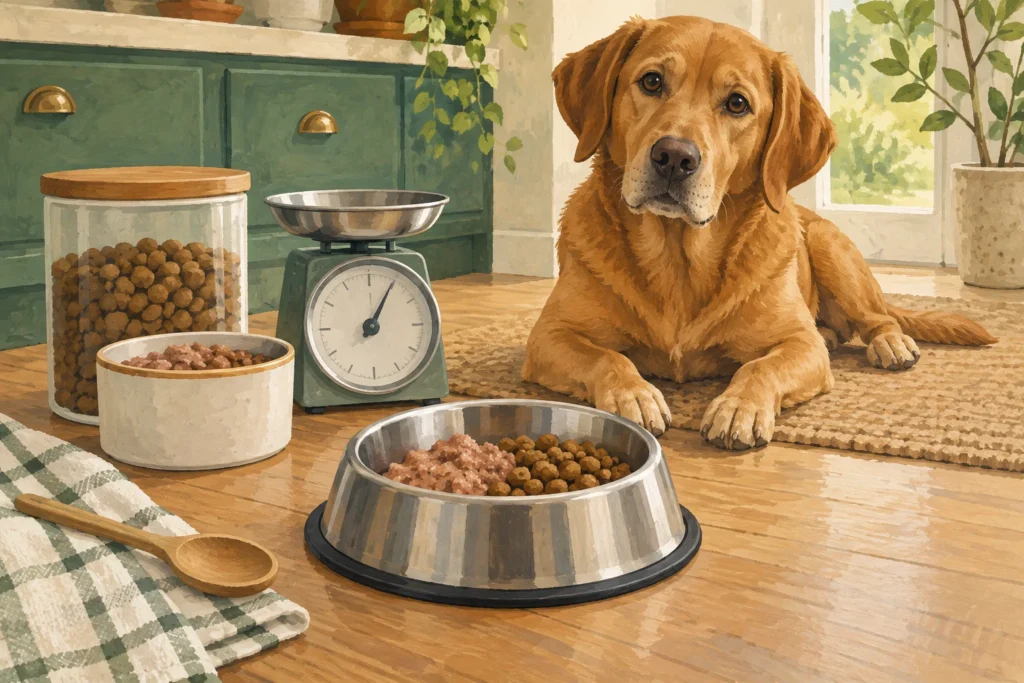
Mixing wet and dry dog food can work when both foods are suitable and the portions add up to the intended daily ration. The central rule is simple: use part of the appropriate wet-food allowance and part of the appropriate dry-food allowance. Do not combine a full day’s amount of each.
PDSA says dogs can eat wet, dry or a combination unless advised otherwise by their vet. For veterinary diets, growth plans or weight management, ask for specific guidance before adding another food that could alter the intended formulation or calories.
Table of Contents
Choose what “half and half” means
Half wet and half dry should describe shares of the intended feeding allowance, not equal gram weights. Wet food contains more water, and different recipes have different energy densities. A scoop of kibble and a scoop of wet food are not equivalent nutritional units.
Forthglade’s feeding FAQ illustrates mixed feeding by reducing the full wet and dry allowances proportionally. Use the instructions for the exact recipes you intend to combine, especially if a manufacturer supplies a dedicated mixed-feeding table.
A worked example without prescribing your dog’s ration
Imagine the appropriate full daily allowance would be 180g of Dry A or 600g of Wet B. These hypothetical amounts produce the following proportional combinations:
| Share of daily allowance | Dry A | Wet B |
|---|---|---|
| Half dry, half wet | 90g | 300g |
| Three quarters dry, one quarter wet | 135g | 150g |
| One quarter dry, three quarters wet | 45g | 450g |
The gram totals differ, but each row combines the same fractions of the two hypothetical full allowances. These numbers are arithmetic examples. Determine the appropriate amounts for your dog and foods before copying the method.
If you calculate using calories instead, obtain energy figures for both exact recipes and the dog’s appropriate calorie allocation. Avoid an online calculator that silently assumes every wet tray or dry kibble has the same energy.
Mix in one bowl or serve separately?
From a household organisation perspective, either arrangement can be convenient. One mixed meal gives a consistent blend. Separate wet and dry meals may simplify opening packs or using dry food for training. What matters is the total amount consumed and any feeding advice specific to the dog.
Watch whether the dog selects only the wet part and leaves the dry. If that happens regularly, the intended calculation no longer describes what was eaten. Record leftovers and discuss persistent feeding difficulties rather than continuing to add wet food on top.
Make the daily amount visible
Weigh the dry allocation into a labelled container and mark the wet allocation on the household feeding note. Include food used in a KONG, snuffle mat or training pouch. Those activities can use part of the meal; they need not become additional uncounted food.
This article contains Amazon affiliate links. As an Amazon Associate, we earn from qualifying purchases.
Find digital kitchen scales grams tare on Amazon UK if you need a straightforward portioning tool. A clear grams display and tare function are more useful than estimating how full the bowl looks.
For example, if breakfast uses some dry food for a short training session, move it out of the daily container before starting. Anyone feeding dinner can then see what remains without reconstructing the entire day.
Storage changes when you add wet food
Follow the wet product’s instructions for refrigeration and use after opening. A small wet allocation may make a large tin awkward to finish in time. Choose a smaller pack or a different planned share if needed; do not extend storage simply to avoid waste.
Once food has been mixed, treat the bowl according to the more perishable component’s handling requirements. Do not assume wet-coated kibble can be left as though it were dry food in the original bag. Remove leftovers appropriately and clean the bowl.
Introduce the change deliberately
If mixed feeding introduces a new food, make the change gradually as appropriate and watch appetite and stools. Keep the rest of the diet stable so you can understand the response. Ask your vet about ongoing symptoms or a sudden appetite change.
Our main dog food guide helps compare formats. Mixed feeding is worthwhile when it meets a practical preference and remains easy to portion. It is not a requirement for every dog, and it should not turn a clear daily feeding plan into guesswork.