
Last updated: 9 September 2026
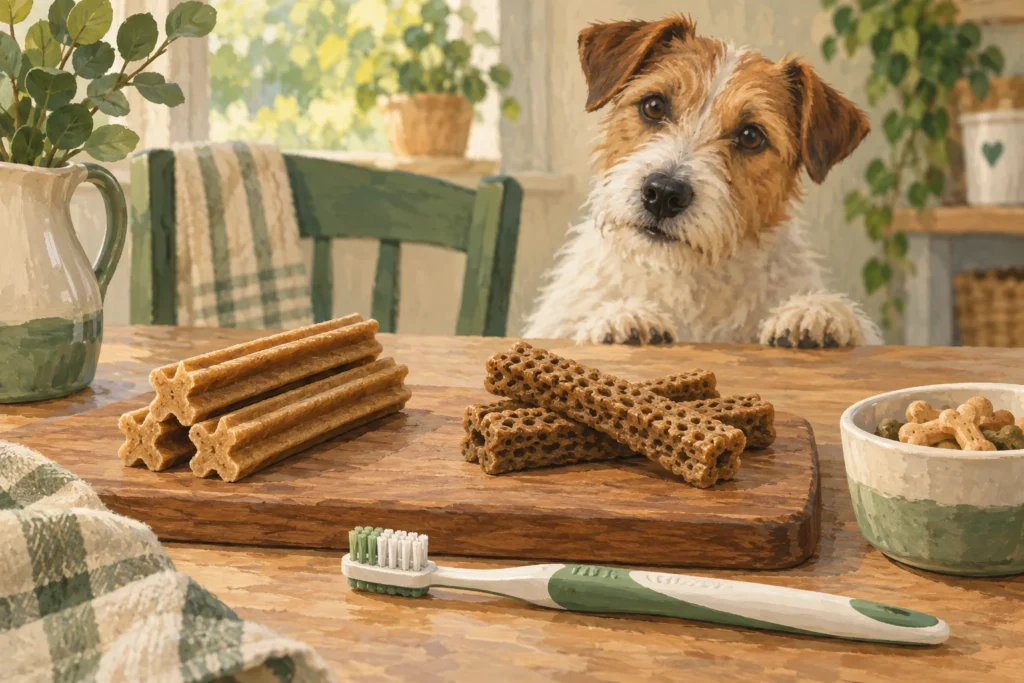
Dentastix and DentaLife both offer dental chews, but a fair comparison needs the exact UK product and size. Start with your dog’s weight, dietary needs and chewing behaviour, then compare the accepted dental claims and normal cost per suitable serving. A chew should support an appropriate dental routine rather than replace assessment of a painful mouth.
This article contains Amazon affiliate links. As an Amazon Associate, we earn from qualifying purchases.
The manufacturer’s instructions and the Veterinary Oral Health Council’s current list provide a more useful starting point than claims that one brand is always best. This guide compares those sources; it does not report a head-to-head trial in our own dogs.
Table of Contents
What the current evidence list says
| Product entry | VOHC accepted claim in the May 2026 list | Buying implication |
|---|---|---|
| Dentastix Daily, PEDIGREE UK | Plaque and tartar. | Match the UK Daily product rather than a similarly named overseas pack. |
| Purina DentaLife Daily Oral Care, European sizes | Tartar. | Use the European/UK feeding instructions for the selected size. |
VOHC reviews submitted evidence against its requirements; it does not perform the product trials itself. An accepted claim is specific to the listed product. It should not be extended automatically to every treat sold under the same brand.
The difference between the entries is useful information, but it is not a direct measurement proving that one chew performs better than the other in the same dog. Separate trials, product instructions and outcome measures cannot simply be turned into a league table.
Match the chew to your dog
Find Pedigree Dentastix Daily UK chews on Amazon UK or Find Purina DentaLife Daily UK chews on Amazon UK once you have checked the appropriate size. Read the pack’s weight range and age restrictions rather than using small, medium or large as universal categories. Purina advises choosing the DentaLife stick that matches your dog’s size and checking the pack’s feeding instructions; do not assume another brand’s Small means the same thing.
Observe how your dog handles the chosen chew. A dog that gulps large pieces creates a different practical problem from one that chews steadily. Supervise, provide water and follow the feeding guidance. Ask your vet for an alternative if the size, texture or behaviour makes the product unsuitable.
Do not cut or modify a chew to fit a dog outside its labelled range unless the manufacturer explicitly directs that use. A smaller portion does not necessarily preserve the intended shape or chewing action.
Compare ingredients and calories
Read the complete ingredient list for the exact flavour and pack. A dental purpose does not exempt a treat from the dog’s dietary restrictions. For a dog on a veterinary diet or elimination trial, check suitability before adding either brand.
Record energy per chew if supplied. If the pack only gives energy per 100g, you also need the appropriate chew’s weight to calculate a serving. For illustration, a 20g chew at 300kcal per 100g contains 60kcal. Those numbers demonstrate the calculation and are not the energy value of either product.
Account for dental chews alongside other treats and meals. If the calories do not fit the feeding plan, discuss other dental-care options with the vet rather than cutting the main diet arbitrarily.
Work out cost per suitable serving
Divide the delivered pack price by the number of chews in the correct size. A 28-chew example pack at £7 costs 25p per chew; a 56-chew example pack at £12 costs about 21.4p. These are illustrative prices, not live retailer quotes.
Then consider the use-after-opening instructions and whether the dog actually tolerates the product. A larger bag is poor value if most of it cannot be used. Compare one-off and subscription prices separately, including what the subscription costs after any initial discount.
Keep brushing and dental checks in the routine
VOHC describes brushing as the gold standard for daily oral hygiene. Chews do not remove the need to look for problems or obtain veterinary care. PDSA advises seeking veterinary advice about existing hard tartar and mouth problems; brushing alone may not address an established issue.
If your dog has bleeding, difficulty eating, a broken tooth or a new reluctance to have its mouth touched, arrange veterinary advice instead of changing chew brands as a treatment. Our dog dental-care product guide provides related routine-care information.
Choose the exact product that fits your dog’s size, diet and behaviour, with evidence for the claim you care about and a price you can maintain. Keep the packaging so you can confirm the variant when buying again.