
Last updated: 9 September 2026
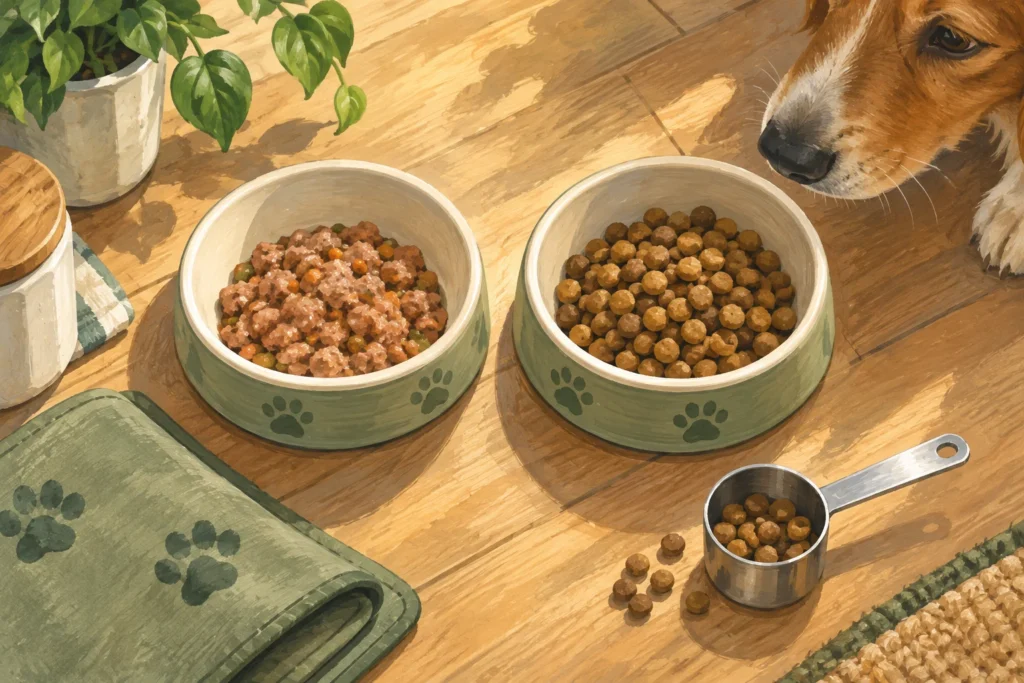
Wet and dry dog food can both provide a suitable everyday diet when the selected food is complete and appropriate for your dog’s life stage and needs. The useful comparison is between two specific foods and the routine each requires. Neither format earns an automatic nutritional advantage from its moisture level alone.
This article contains Amazon affiliate links. As an Amazon Associate, we earn from qualifying purchases.
If your dog has a medical condition or prescribed diet, make changes with your vet. For an otherwise healthy dog, start with the label, the daily feeding amount and the practicalities in your home.
Table of Contents
Compare the formats fairly
| Question | Dry food | Wet food |
|---|---|---|
| How is it portioned? | Weigh the daily grams; a scoop alone can vary. | Weigh the food or use the pack size with its feeding guide. |
| What happens after opening? | Follow the bag’s storage instructions and keep its identity and date. | Follow refrigeration and use-after-opening instructions. |
| How should costs be compared? | Cost of the daily recommended amount. | Cost of the daily recommended amount, including unused portions. |
| What must the label establish? | Complete food suitable for the dog. | Complete food suitable for the dog; some wet products are complementary. |
PDSA distinguishes complete foods, designed to provide the required diet when fed as directed, from complementary foods that need to be used as part of another feeding arrangement. A meaty-looking tray can be complementary, while a less glamorous bag of kibble can be complete. Read the designation instead of judging by appearance.
Look at the daily ration, not equal weights
Wet and dry foods contain different amounts of moisture. Comparing 100g of one with 100g of the other does not usually compare equivalent meals. The same issue affects both the cost and headline nutrient percentages printed on the pack.
Use the label’s daily amount as the starting point, then monitor body condition and discuss adjustments with your vet or veterinary nurse. Activity, age and individual circumstances matter. Do not increase portions simply because a serving looks small to a person.
For example, if one complete food’s guide suggests 200g a day and another suggests 600g, a £4-per-kilogram price would imply 80p and £2.40 per day respectively. These are illustrative quantities and prices, not a recommended ration or a comparison of real products. They show why price per kilogram alone can mislead.
Can you mix wet and dry food?
Yes, if the foods and combined plan suit your dog. The common mistake is to serve a full daily allowance of dry food and add a full allowance of wet food. Use the manufacturer’s mixed-feeding instructions if available, or ask for a suitable plan.
For a simple illustration of proportion, half of a dry food’s full-day allowance plus half of a wet food’s full-day allowance is a starting calculation for a half-and-half arrangement. That does not mean equal grams in the bowl. Keep treats and other extras within the overall feeding plan, and introduce any change gradually.
A digital scale makes small adjustments easier to repeat. Find digital kitchen scales on Amazon UK if you do not already have a suitable one. Use a washable bowl and the tare function rather than measuring wet food directly on the weighing platform.
Choose a routine you can maintain
Write down an ordinary weekday: who feeds the dog, where food is stored and whether meals are prepared away from home. A household taking frequent short trips may value simple portion packing. Someone with limited cupboard space but a predictable refrigerator routine may compare different options. These are logistical preferences, not evidence that one format produces a healthier dog.
Keep feeding instructions somewhere every carer can find them. State grams per meal, number of meals and whether the daily allowance already includes food used in training. “One scoop” or “half a tin” can be misunderstood when the scoop or tin changes.
Do not use ordinary kibble as a dental plan
Daily tooth brushing and veterinary dental assessment have their own role. Do not assume an ordinary dry food replaces them because it is crunchy. If you are choosing a specific dental diet, discuss its suitability and evidence separately. Our dental-care product guide covers that decision.
If your dog suddenly struggles to eat, changes how they chew or loses interest in food, seek veterinary advice rather than repeatedly buying more tempting toppings. A feeding preference and a new physical problem should not be treated as the same shopping question.
The best format is the suitable complete food you can portion accurately, store correctly and afford consistently. Compare our dog-food guide with the specific dry-food option you are considering, using normal repeat-purchase prices.