
Last updated: 9 September 2026
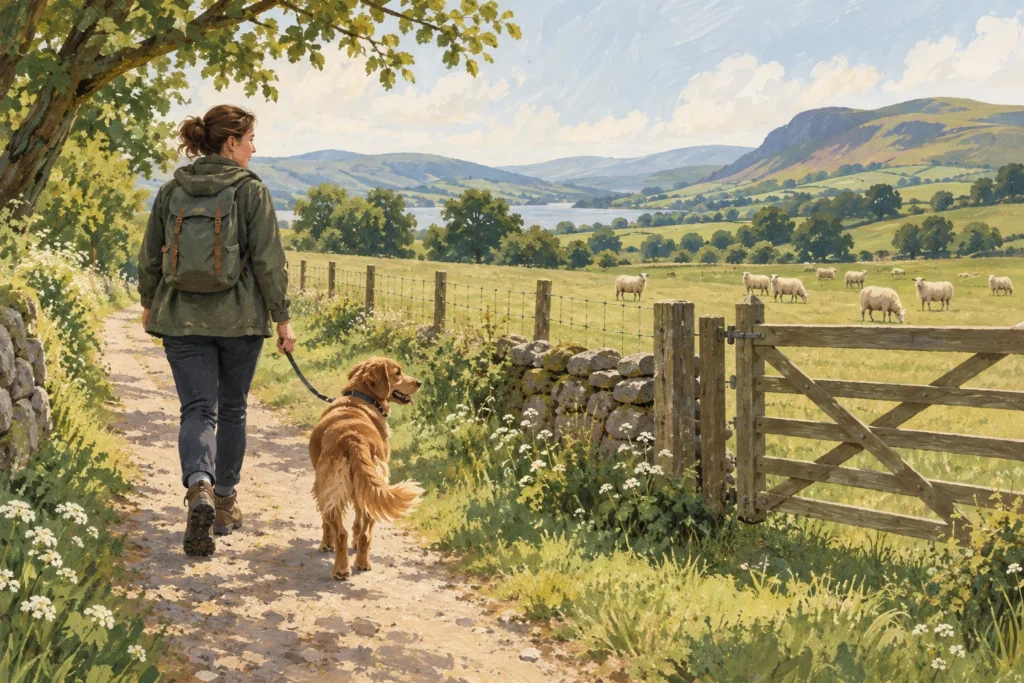
Before entering a field with livestock, stop, locate the animals and decide whether the route is suitable for you and your dog. Keep the dog close and under effective control, using a short lead around livestock as the practical default. Turning back or choosing another permitted route is often the simplest way to avoid a difficult encounter.
Access rules and legal duties differ across England, Wales, Scotland and Northern Ireland. Follow the relevant national guidance and local signs. A dog’s friendly intentions or normally good recall do not make approaching or chasing livestock acceptable.
Table of Contents
Look before opening the gate
Check the whole field, including behind a hedge or rise. Notice young animals, groups gathered near the exit and places where you could become boxed in. Do not enter simply because the first few metres look empty. Keep enough space to reassess without the dog already pulling through the gate.
Identify the permitted route and the next exit. Avoid walking between adults and young animals or making a close approach for a photograph. A lead should prevent the dog reaching livestock, not merely give you something to pull on after contact begins.
| Before entry | Practical check |
|---|---|
| Animals | Where are they, and are young animals present? |
| Route | Can you follow the permitted path with generous distance? |
| Dog | Can you maintain comfortable, effective control? |
| Exit | Can you see a suitable way through or back? |
| Alternative | Is there another permitted route if this one is unsuitable? |
Use the guidance for the country you are in
The Countryside Code for England and Wales advises keeping dogs on leads around livestock and identifies additional lead requirements on open-access land and the coast. Read the local restrictions, including seasonal rules; a familiar route may have different requirements at another time of year.
The Scottish Outdoor Access Code says not to take dogs into fields with lambs, calves or other young farm animals. Around other farm animals it calls for a short lead or close-at-heel control with as much distance as possible. That specific young-animal advice should shape route planning before entry.
Northern Ireland’s official guidance states that dogs on land with livestock must be properly controlled by a chain or lead held by the person in charge. Do not transfer a rule remembered from a Scottish holiday to a walk in Northern Ireland.
Manage the lead before you need it
This article contains Amazon affiliate links. As an Amazon Associate, we earn from qualifying purchases.
Use a suitable fixed lead and well-fitted attachment, with clips and stitching checked. Find fixed dog walking leads on Amazon UK if your existing lead is worn or awkward to hold. Choose a length that allows close control without loops trailing around legs. The harness guide covers fit considerations alongside training.
A long training line gives too much range near livestock unless managed appropriately, and an extended retractable lead can allow the dog to reach animals before you react. Do not use a livestock field to practise unproven recall.
Keep the dog focused on moving calmly through the area rather than stopping close to animals for a game or food scatter. If the dog is already highly excited or frightened, choose a simpler route and work on relevant skills elsewhere.
If livestock threatens you
Both the Countryside Code and Scottish guidance advise releasing the dog if livestock, particularly cattle, threatens your safety. Do not risk injury by trying to protect or hold onto the dog. Stay calm and take the safest available route away. This is emergency guidance, not permission to let a dog loose routinely around animals.
Avoid creating that situation by giving animals space and choosing a different route where needed. If an incident occurs, get to safety and contact emergency services or the relevant land manager as appropriate. Do not remain in danger to retrieve equipment or take photographs.
Leave the route as you found it
Follow signs about gates and leave them as found unless instructed otherwise. Avoid damaging fences or climbing with the dog in an unsafe way. Pick up dog waste and take it to an appropriate bin; the official codes explain that it can affect livestock and wildlife as well as people.
Carry spare bags and a route map in your walking bag. Expect patchy phone signal and retain enough flexibility to turn back. A successful countryside walk is one where people, dogs and farm animals all keep the space and control they need.