
Last updated: 9 September 2026
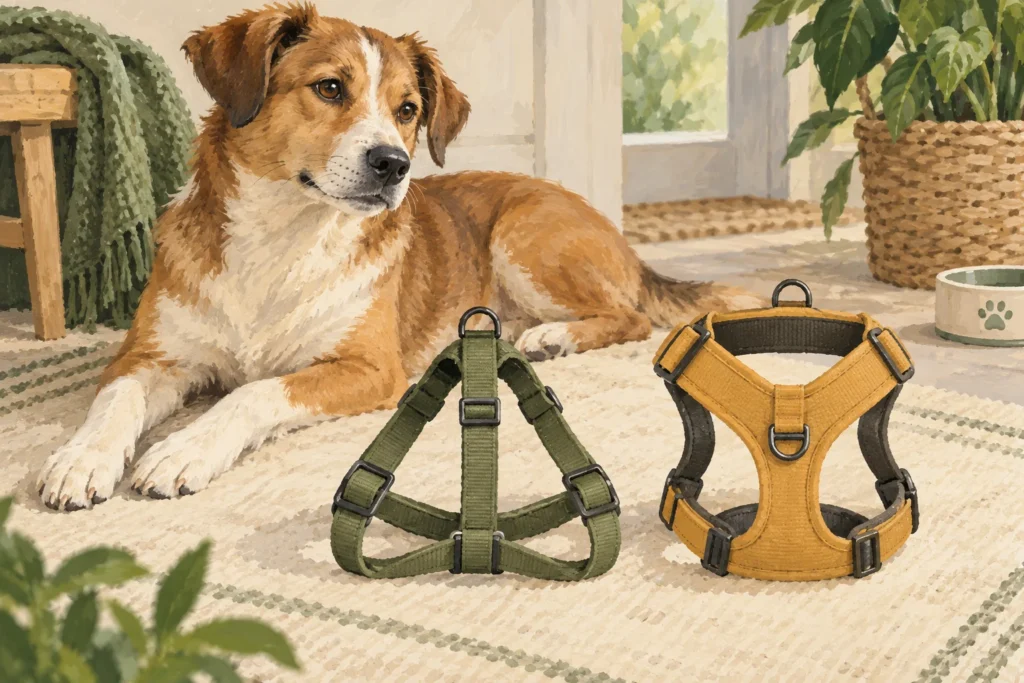
Step-in vs over-head dog harnesses is primarily a question about fitting and handling. A step-in design avoids pulling a neck opening over the head, but it asks the dog to place or allow handling of their front legs. An over-head harness can be simpler for a dog comfortable with that movement. Neither design automatically fits better.
This article contains Amazon affiliate links. As an Amazon Associate, we earn from qualifying purchases.
Table of Contents
Watch the part your dog dislikes
Does your dog move away when a harness appears, when it touches their face or when you lift a paw? These are different handling problems. Changing the fastening route may help with one part, but a dog who is worried about the whole process also needs gentle training.
Sudden sensitivity can reflect discomfort and deserves a veterinary check. Do not keep tightening straps or restraining the dog more firmly to finish fitting equipment they previously accepted.
| Feature | Step-in | Over-head |
|---|---|---|
| Putting it on | Front legs enter openings before the harness is fastened. | The head passes through an opening before body straps are secured. |
| Potential handling advantage | No neck loop passes over the face. | May require less deliberate paw handling. |
| Potential difficulty | Stepping into small openings or lifting legs. | Concern about the neck opening or equipment near the ears. |
| Fit check | Look closely at leg openings, chest coverage and fastening security. | Check neck opening, chest position and girth adjustment. |
Step-in example: Ancol Viva
The Ancol Viva Step-in harness uses a mesh body, hook-and-loop adjustment and a snap buckle. The manufacturer provides chest-girth bands for its sizes. This makes it a named option to investigate when avoiding an over-head opening is the main aim.
Find Ancol Viva Step-in harnesses on Amazon UK. Use the current size guide and measure your dog rather than selecting by a previous harness’s letter size. Check the fit around the front legs and watch whether the body twists as the dog moves.
A broad mesh panel may suit some dogs while offering less precise adjustment than a multi-strap design for others. The useful question is whether the actual harness sits securely and comfortably on this body shape.
Over-head example: a multi-adjustment everyday harness
Ruffwear Front Range is an example of an everyday harness with several adjustment points and both a back attachment and a reinforced front attachment. It offers a different construction from a step-in vest, so compare body coverage and adjustment as well as the fitting route.
Find Ruffwear Front Range harnesses on Amazon UK. Confirm the exact version and manufacturer’s size guide. A front attachment is an equipment feature, not a guarantee that pulling will stop without training.
Introduce the neck opening gradually, rewarding comfortable voluntary movement rather than pushing the dog’s head through. Start with the harness away from the walk’s excitement so there is no rush to complete the fitting.
A third option: clips around the neck
Some harnesses avoid both a fixed over-head opening and a step-in routine. PerfectFit’s three-piece system allows components to be selected separately and uses clips that can be opened for fitting around the dog. This can be worth investigating where proportions or handling make standard designs awkward.
Check the manufacturer’s fitting advice for the exact combination. Modular construction gives options, but it also requires selecting and assembling appropriate parts. It is not an automatic guarantee against escape.
Assess fit while the dog moves
After initial adjustment, watch an ordinary walk indoors or in another safe space. Check for straps pressing into the armpits, panels riding towards the throat, loose sections catching legs and twisting when the lead changes direction.
Use the manufacturer’s fitting guidance rather than one universal finger rule for every model. Recheck as puppies grow, coats change and equipment is washed. Inspect clips and stitching, particularly if the dog has recently pulled back suddenly.
Consider escape risk separately
A frightened dog reversing out of equipment needs a careful fitting and management plan. Do not choose a step-in harness solely because it appears to enclose more of the chest, or an over-head model solely because it has more straps.
Ask a competent fitter or qualified trainer for help with a difficult body shape or a history of escaping. Test ordinary movement in a safe enclosed place before relying on new equipment near traffic.
Choose the easiest suitable routine
Buy the design that fits securely, allows comfortable movement and can be put on without a struggle. Our harness-versus-collar guide covers the wider equipment choice. The successful harness is one you can fit correctly every day while continuing to teach comfortable handling and lead skills.