
Last updated: 9 September 2026
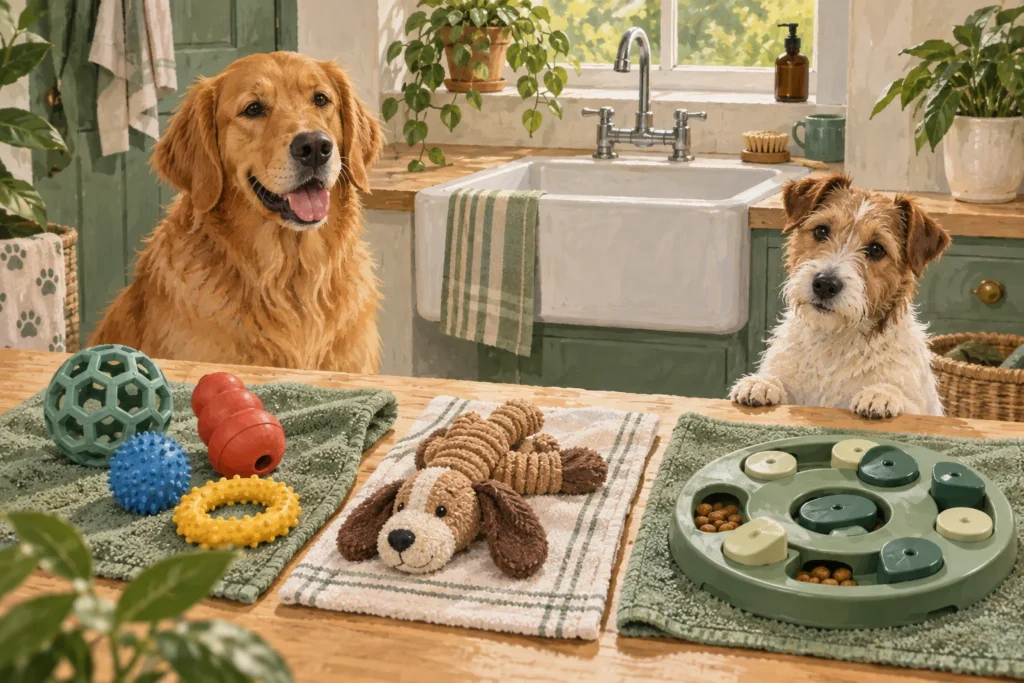
The safest way to clean dog toys is to identify the exact toy and follow its care instructions. Rubber, stuffed fabric, rope, wood and electronic components need different treatment. Start by checking for damage: washing cannot make a split rubber toy, loose squeaker or frayed rope safe again.
Sort toys into three groups before you begin: sound toys to wash, items whose instructions need checking and damaged toys to remove. This prevents a worn favourite from going straight back into circulation simply because it looks cleaner.
Table of Contents
Use the label to choose a cleaning method
| Toy type | Check first | Avoid assuming |
|---|---|---|
| Food-filled rubber toy | Dishwasher permission, rack position and drying-cycle guidance | That every rubber formulation tolerates the same heat |
| Fabric or plush toy | Machine-wash instructions, filling and removable parts | That the centre is dry when the surface feels dry |
| Food puzzle or lick mat | Hidden compartments, detachable parts and material-specific care | That a matching-looking model has identical instructions |
| Electronic toy | Battery and water-exposure instructions | That a washable cover makes the electronics washable |
Keep packaging photographs or a saved product page for toys you use regularly. Model names are especially helpful when different versions share a colour or a similar shape.
Cleaning food-filled rubber toys
Remove remaining food promptly rather than leaving it to harden inside. KONG’s cleaning instructions describe warm water and dish soap, soaking stubborn residue, brushing the interior and rinsing thoroughly. Its rubber-toy guidance allows top-rack dishwasher cleaning while avoiding the heated drying cycle. Check the instructions for your exact product before extending that advice to another brand or material.
Inspect the openings in good light. A clean-looking outside can hide food around an internal ledge. Use a brush that reaches the cavity without scraping or damaging it, then rinse until no cleaning residue remains. Allow the toy to dry before storage or refilling.
This article contains Amazon affiliate links. As an Amazon Associate, we earn from qualifying purchases.
If you need a dedicated tool for hollow toys, Find brushes for hollow dog toys on Amazon UK. Check its reach and head size against the opening so it cleans the cavity without getting wedged inside.
Lick mats and sliding puzzles
Work residue out of grooves and underneath moving pieces where the manufacturer permits disassembly. Keep small detachable components together and account for all of them before returning the toy. Do not force a slider apart just because it looks removable.
LickiMat lists its Tuff Pro Soother as dishwasher-safe, but that is a model-specific statement. A different mat or a wooden holder can have different care requirements. Our puzzle-toy guide can help you compare designs; make cleaning access part of the purchase decision rather than an afterthought.
For sticky food, cleaning soon after use is usually more manageable than tackling a dried layer later. Follow the food’s own handling directions too. A toy used for a meal is part of the feeding equipment, not something to leave dirty in a general toy basket for the next week.
Fabric, rope and soft toys
Remove loose dirt and inspect seams before washing. Follow the label’s temperature, detergent and drying instructions. If the toy has a replaceable squeaker or removable sound unit, only remove it in the way the maker describes. Keep the parts away from the dog while you work.
Let the whole toy dry thoroughly, including dense seams and stuffing. A damp toy stored in a closed box is unpleasant to retrieve and harder to keep fresh. If a favourite cannot be cleaned adequately, replacing it may be more sensible than experimenting with harsher products or excessive heat.
A rope that is unravelling needs removal, not a tighter knot to disguise the damage. Check for swallowed or missing pieces and seek veterinary advice if you think your dog has eaten part of a toy or develops symptoms afterwards.
Build a routine around actual use
A food puzzle used every day needs attention after meals. A muddy outdoor toy needs cleaning before returning to indoor storage. A dry comfort toy used gently may need less frequent washing, but it still needs regular damage checks. There is no useful single schedule for every toy in the house.
Keep a clean, dry set available while another set is being washed. You do not need a large collection: two appropriate food toys may be enough to avoid reusing one before it has been cleaned. Store cleaned toys separately from muddy ones, and keep detergents and small parts out of reach.
Cleaning should leave the toy usable, intact and appropriate for the next session. If you cannot establish the care method or remove trapped food without damaging it, choose a simpler replacement that you can maintain reliably.