
Last updated: 9 September 2026
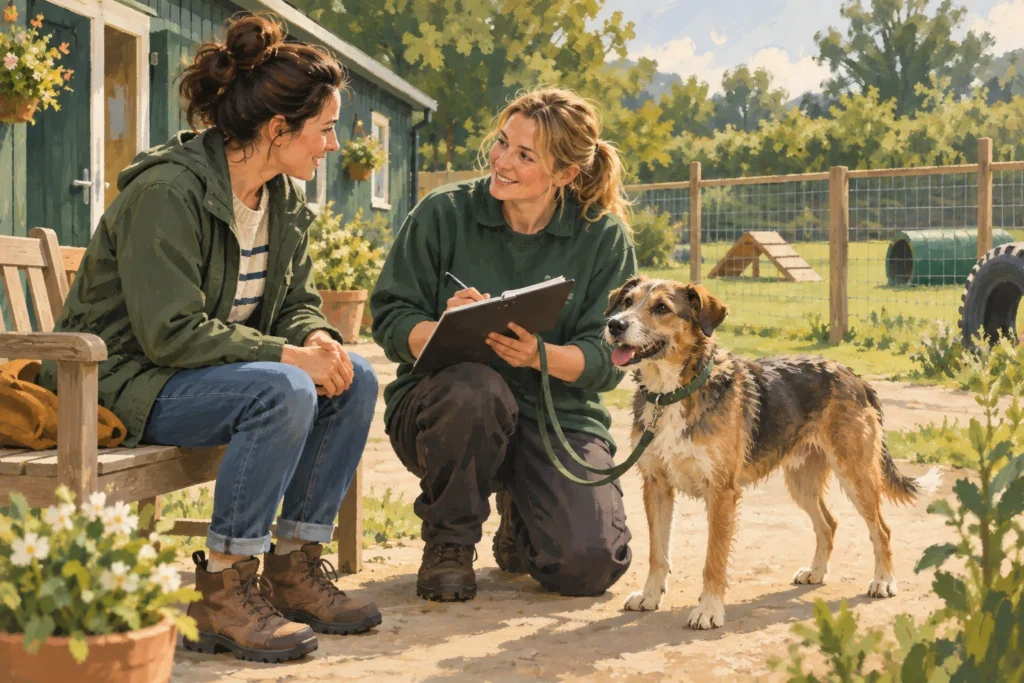
Before adopting a dog, ask what the rescue knows, how it knows it and what support is available after the dog comes home. Focus on the match between this dog’s needs and your household. A useful conversation includes uncertainty rather than asking for promises that no organisation can responsibly make.
This article contains Amazon affiliate links. As an Amazon Associate, we earn from qualifying purchases.
Table of Contents
Ask about the dog’s everyday routine
Find out what and when the dog eats, where they rest, how they travel and what walking equipment they currently use. Ask which activities they enjoy and which situations staff or foster carers avoid.
These details help you reproduce a few familiar elements at first. They can also reveal a mismatch: a dog needing a quiet environment may find a busy open-plan household difficult, even if everyone is enthusiastic about adoption.
Clarify health information and ongoing care
Ask for available veterinary records, current medication instructions, known conditions and any planned follow-up. Find out whether a particular diet, grooming routine or physical limitation needs to be considered.
Discuss ongoing costs rather than only the adoption fee. A known condition may affect insurance arrangements, so obtain relevant information before selecting cover. Ask your own vet to clarify medical details you do not understand.
| Topic | A useful question |
|---|---|
| Health | What care is currently needed, and which records will transfer? |
| Being alone | What has actually been observed, in which setting and for how long? |
| Other animals | What introductions or shared living have been assessed? |
| Children | What experience is known, and what household restrictions are advised? |
| Handling | How does the dog respond to equipment, grooming and veterinary care? |
| Aftercare | Who helps if difficulties appear, and what is the return process? |
Ask for behaviour descriptions, not just labels
Terms such as friendly, lively or nervous can mean different things. Ask for an ordinary example: what happens when another dog passes, when a visitor enters or when someone approaches food? Be clear about any bites, guarding or escape history that is known.
Distinguish behaviour observed in kennels, in foster care and reported by a previous owner. Each provides information, but none guarantees the same response in your home. Unknown history is not proof of a problem, nor proof that no problem exists.
Explain your household accurately
Describe working hours, children, visitors, resident pets, housing and practical limits. Do not minimise time away or invent future exercise habits to make the application sound stronger. The organisation needs the real routine to help with matching.
Our breed-choice guide can suggest additional care questions, but individual evidence should carry more weight than a breed reputation.
Understand the adoption process
Ask about meetings, home checks, fees, contract terms and what happens between a proposed match and collection. Different rescues use different processes. Dogs Trust, for example, describes matching from an application rather than treating a favourite profile as a guaranteed reservation.
Read the agreement before committing. Clarify what is included, what you must arrange and who to contact if the dog cannot remain in your care. Keep copies of the paperwork and agreed advice.
Plan the first days before buying everything
Ask what familiar equipment or food will come home with the dog. Measure for essentials and avoid changing several routines immediately. A plain washable blanket may be useful once the resting setup is known; Find washable dog blankets on Amazon UK.
Delay expensive specialist purchases until you know they fit the individual. A shopping list should follow the care plan, not drive it.
Leave room for a second conversation
Write down questions after the meeting and ask for clarification where needed. Bring other household decision-makers into the process appropriately. It is reasonable to decide that a particular dog needs a home different from yours.
A good outcome is a considered match with realistic expectations and a clear route to help. The most valuable answer may be an honest “we do not know yet”, followed by a sensible plan for finding out safely.