
Last updated: 9 September 2026
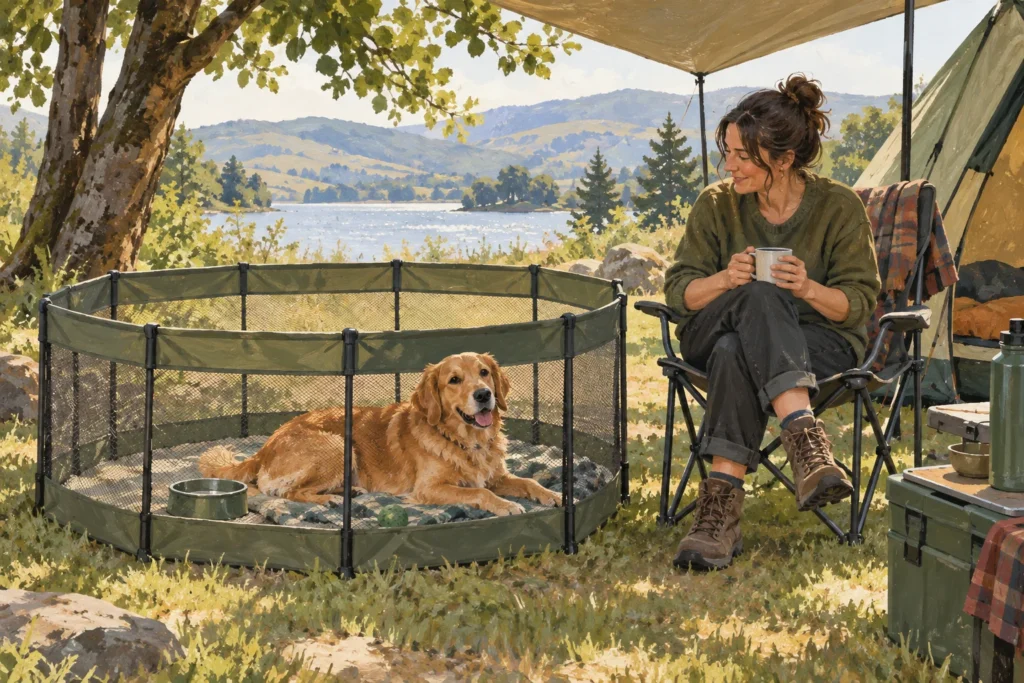
A portable dog fence can define a supervised resting area on a campsite, but it should not be treated as a secure permanent boundary. A dog may jump, push, dig or squeeze through a setup that looks substantial when empty. Choose it only if the dog is comfortable behind that type of barrier and the campsite permits the arrangement.
Start with the site’s rules and your dog’s behaviour. If dogs must remain on leads, do not assume placing a pen around the pitch removes that requirement. If the dog becomes distressed when separated or barks continuously at passing people, a fence alone does not solve the problem.
Table of Contents
Measure the pitch and the packed load
A set of panels creates a perimeter, not automatically a large usable area. Sketch the shape with the tent, caravan door, guy lines, furniture and access route included. Leave enough space for the dog to rest, turn and reach water without crowding equipment.
Check packed dimensions and total weight. Metal panels may be straightforward to clean but awkward to lift repeatedly from a loaded vehicle. Lightweight mesh can be easier to carry while offering less resistance to chewing or pushing. Consider the whole journey, not just the attractive photograph of the assembled pen.
| Design | Practical strength | Limitation |
|---|---|---|
| Metal panel pen | Defined sections and a visible boundary | Weight, ground anchoring and movement under pressure |
| Fabric or mesh pen | Compact packing and light handling | Chewing, scratching and flexible walls |
| Portable fencing panels | Can create a larger shape | More joins and ground gaps to inspect |
A windbreak is not a dog fence merely because it surrounds the pitch. Its fabric, poles and bottom edge may not be designed to contain an animal.
A named panel format to investigate
This article contains Amazon affiliate links. As an Amazon Associate, we earn from qualifying purchases.
MidWest’s Exercise Pen with Door is an example of the folding-panel style. Find MidWest exercise pens with a door on Amazon UK if you want to compare that construction, checking the exact height, panel count, packed size and outdoor instructions. This is a source-based example, not a claim of campsite escape resistance or current UK stock.
A door may be easier than stepping over the side, especially when carrying a bowl or managing a lead. Check that its latch closes positively and that people in the group understand how to secure it. A low threshold can help access but may create a different gap or trip consideration.
Do not buy height from the dog’s shoulder measurement alone. A dog who jumps or climbs needs an individual management plan; adding a little more panel height may not make an open-topped pen appropriate.
Check the ground before assembly
Follow the manufacturer’s anchoring instructions and use the intended components. Uneven ground can create gaps or make panels lean. Hardstanding may not accept stakes, while very soft ground may not hold them adequately. Do not improvise sharp exposed fixings where paws or people can catch them.
Inspect the entire lower edge after assembly. If adjoining a vehicle or awning, look under it as well as beside it. A caravan is not a complete wall unless every relevant opening is securely addressed in a suitable way.
Keep the pen away from cooking equipment, hot surfaces, vehicle movement and guy lines. A shade position can change through the day, so check temperature and water access repeatedly rather than assuming the morning arrangement remains comfortable.
Introduce the pen before the trip
Set it up at home according to the instructions and let the dog investigate with you nearby. Reward calm voluntary entry and practise brief comfortable pauses with the door closed only when ready. Do not make the first experience an unfamiliar campsite while you disappear to collect supplies.
The clicker training guide explains one way to mark behaviour, but the important part is the dog’s comfort and the gradual pace. A pen should not be used to force a worried dog to endure passing activity.
Stay close enough to supervise and respond. Do not leave the dog alone on the pitch in a portable enclosure. If separation is difficult, our separation anxiety guide points towards the need for a broader support plan.
Recheck throughout the stay
Look at latches, joins, stakes and bottom gaps after the dog has moved around, after rain and whenever the setup is shifted. Keep a suitable lead ready for controlled transfers through the gate. Agree who is watching when adults are busy cooking or unpacking.
A camping pen is useful when it creates a comfortable supervised place within a well-managed pitch. Choose the arrangement you can assemble correctly, inspect easily and carry realistically, while keeping a separate plan for walks, busy moments and any time the barrier is unsuitable.