
Last updated: 9 September 2026
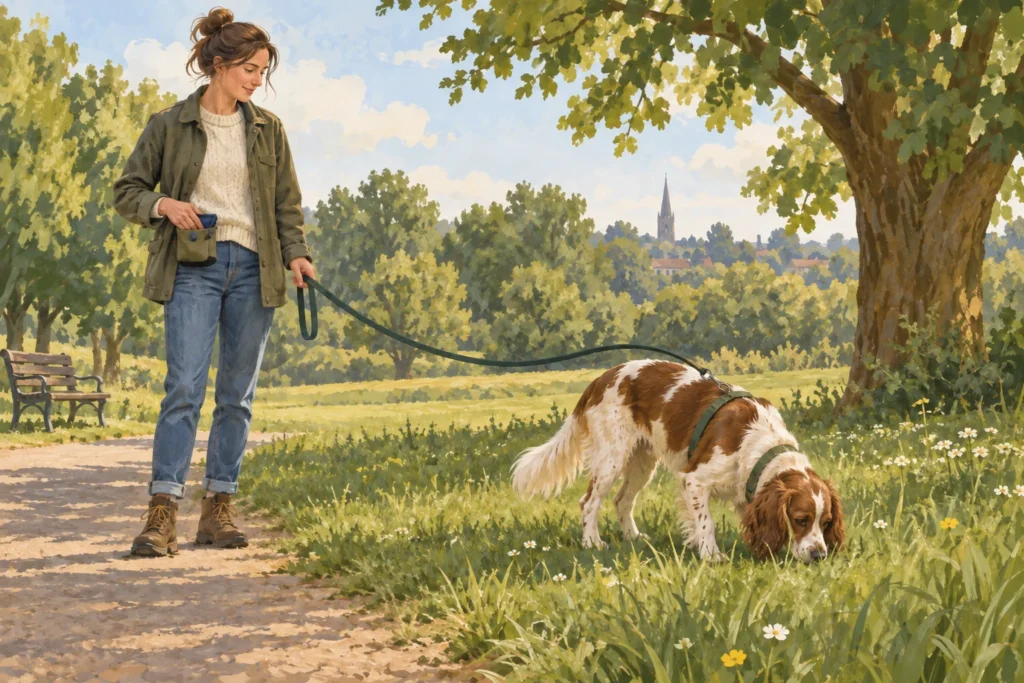
When a dog will not take treats outside but eats them at home, make the training situation easier before buying a succession of stronger-smelling rewards. The environment may be too distracting or uncomfortable, the dog may not want that food at that moment, or health may be affecting appetite. Refusal is useful information, not proof of stubbornness.
Look at the whole dog and the context. Eating a treat does not prove they feel relaxed, and refusing one does not diagnose anxiety. Your aim is to find circumstances in which the dog can comfortably engage with you, then build from there.
Table of Contents
Check whether the change is specific to outdoors
Does the dog still eat normal meals and accept the same reward in a familiar room? Is refusal limited to one busy route, or does it happen in the quiet garden too? Has it always been this way, or started recently? Those distinctions help separate a training setup question from a broader appetite change.
If appetite has reduced generally, chewing seems uncomfortable or the dog is unwell, contact your vet. Do not withhold meals to force interest in training rewards. For a prescribed diet, ask the vet which reward options are suitable rather than trying rich foods at random.
Check mundane details too: the treats may have dried out, become stale or be awkwardly large. Offer a familiar suitable piece without asking for a task in a calm place. If it is rejected there as well, the outdoor environment may not be the only issue.
Lower the difficulty in a visible way
Dogs Trust lists reduced response to words, treats and toys among possible signs of stress, considered alongside other behaviour. PDSA’s training guidance also notes that discomfort or stress can reduce interest in food. Those sources support changing the situation rather than increasing pressure.
Move farther from the busy path, choose a quieter time or practise nearer home. Ask for an easier behaviour, or simply reward a voluntary glance towards you. A long sequence of sits, stays and turns can be too much when the dog is still processing the surroundings.
| Current difficulty | Possible adjustment |
|---|---|
| Watching nearby dogs | Increase distance before asking for engagement |
| Busy pavement | Choose a quieter location with space to pause |
| Long session | Finish after a few comfortable successes |
| Unfamiliar cue outdoors | Practise the skill in an easier setting first |
| Awkward reward handling | Prepare suitable small rewards before starting |
Change one factor at a time and notice what happens. If the dog begins to explore calmly and engage again at a greater distance, that is useful progress. Do not immediately return to the hardest point to test whether the problem has disappeared.
Choose rewards the dog actually values
Food is convenient, but it is not the only possible reward. Dogs Trust describes using things an individual dog enjoys, including play and attention. In an appropriate place, permission to continue sniffing can also be part of a thoughtful training plan. A qualified trainer can help you use those opportunities clearly.
Try a small selection of suitable food textures at home rather than offering a large buffet during a difficult walk. Some dogs prefer an easy soft bite to a dry biscuit; others happily work for part of their usual ration. Avoid repeatedly pushing food towards a dog who turns away.
Our training treat guide discusses reward formats. The packet is only one part of the setup; better food cannot make an overwhelming situation appropriate for learning.
Improve timing without adding pressure
This article contains Amazon affiliate links. As an Amazon Associate, we earn from qualifying purchases.
Keep rewards within easy reach so you can acknowledge a useful moment promptly. Find washable training treat pouches on Amazon UK if pockets are slowing you down. Wash the pouch regularly and avoid leaving perishable food inside between walks. Convenience helps delivery, but it should not become an excuse to ask for more than the dog can manage.
If using a marker such as a clicker, establish its meaning in an easy environment first. The clicker guide explains its role; clicking repeatedly does not solve a refusal to eat or an unclear training task.
Know when to get individual help
If the dog is intensely worried, reacts towards others or repeatedly cannot engage even after the situation is made easier, speak to your vet and a qualified reward-based behaviour professional. Bring notes about locations, distances and the dog’s responses.
Success is comfortable participation, not merely getting one treat swallowed beside a trigger. Build from the conditions in which your dog can learn, and let their behaviour guide the next increase in difficulty.