
Last updated: 9 September 2026
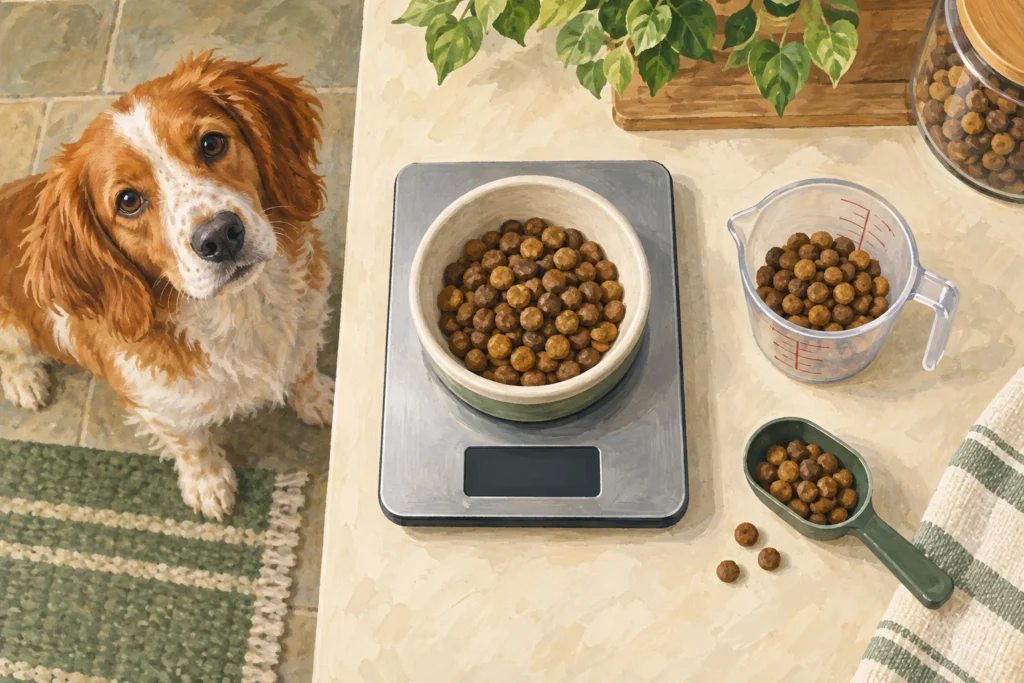
Dog food scales are usually the more useful choice when a feeding guide gives an amount in grams. A measuring cup records volume, which depends on the shape of the kibble and how you fill it. You can still use a scoop to transfer food; let the scale determine how much goes into the daily ration.
PDSA recommends weighing food with electronic scales to help keep portions consistent. This does not mean buying specialist pet electronics. A suitable kitchen scale can do the job if it handles the required amount, has a clear grams setting and can subtract the container’s weight.
Table of Contents
What each tool actually measures
| Tool | Measures | Useful role | Limitation |
|---|---|---|---|
| Digital scale | Mass, usually displayed in grams | Following a gram-based ration | Needs correct setup, appropriate precision and power |
| Measuring cup | Volume | Moving food or following a product-specific volume guide | A cupful changes with kibble size and filling method |
| Ordinary scoop | No reliable quantity by itself | Transferring food onto the scale | “One scoop” can mean something different to each person |
Why the same cup can produce different meals
Imagine filling a jar with small beads, then with large irregular pebbles. The empty spaces differ. Kibble shapes also pack differently, so a mark used for one recipe is not automatically valid after a food change.
The person serving matters too. A level cup, a rounded cup and a cup tapped several times before topping up can contain different amounts. A child helping with dinner may reasonably interpret “one scoop” differently from an adult unless the amount is measured.
A small daily discrepancy is easy to overlook. As a purely arithmetic example, 10g extra every day becomes 300g over 30 days. Whether that matters for a particular dog depends on the food and intended ration, but the calculation shows why consistency is useful.
How to weigh a daily ration
- Place the scale on a firm, level surface and select grams.
- Put an empty clean bowl or container on the platform.
- Press the tare or zero control so the display returns to zero with the container in place.
- Add the amount of food specified in your dog’s feeding plan.
- Divide that daily amount between meals and any suitable training use.
- Keep the remaining allocation in a clearly labelled container so other people know what is left.
Check whether the packet’s number is per day or per meal. Weighing accurately cannot fix a mistaken interpretation of the guide. The right amount also depends on the dog; ask your vet for help with body condition, growth, weight changes or a therapeutic diet.
Features worth buying
Look for a display you can read with the bowl on top, an accessible zero button and a platform large enough for the container. Check both maximum capacity and measurement increments. A high maximum load is irrelevant if small portions do not register usefully.
Salter’s electronic scale instructions demonstrate the common add-and-weigh function: zero the container, add food, then zero again if measuring another component separately. You do not need a phone connection to use that method.
This article contains Amazon affiliate links. As an Amazon Associate, we earn from qualifying purchases.
Find Salter digital kitchen scales grams tare on Amazon UK. Compare the actual model’s instructions and measurement increments before buying. This is a search for a suitable tool, not a claim that every Salter model has identical specifications.
What about wet food and mixed meals?
Weigh wet food into a clean container or bowl using the same tare method. Do not assume half a tray by eye is half its weight, especially when food remains stuck around the edges.
For mixed feeding, obtain the appropriate amount of each food. Half of a dry-food allowance plus half of a wet-food allowance is different from mixing equal gram weights. Keep the two targets visible so someone does not give the full amount of each.
If using a slow feeder, weigh the food in a convenient container first and then distribute it through the bowl. There is no need to balance a large awkward feeder on a tiny platform.
Keep the system dependable
Replace low batteries, keep the platform clean and store the scale where it will not be damaged. Follow the manufacturer’s cleaning instructions; electronic scales are not generally washed like bowls.
A scoop and a scale can work together perfectly well. The practical improvement is replacing an ambiguous household instruction with a visible daily amount, then adjusting that amount with appropriate advice as your dog’s needs change.