
Last updated: 9 September 2026
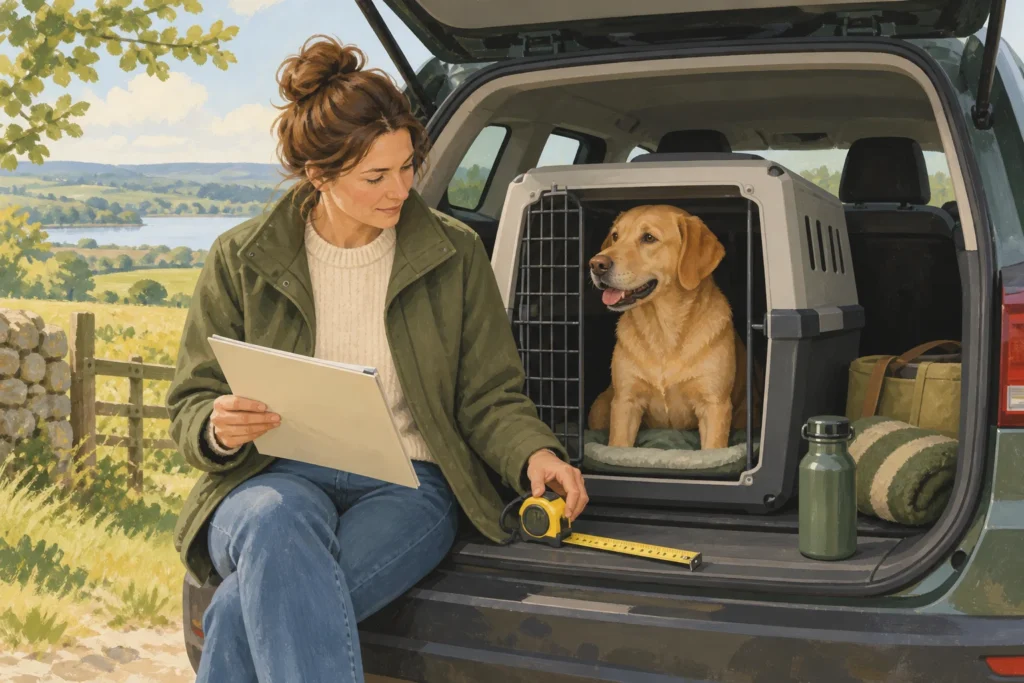
When comparing crash-tested dog crates, ask what was tested, how it was installed and which exact model the evidence covers. The words “crash tested” are a starting point for investigation, not a guarantee of safety in every collision. A crate must also fit your dog and your vehicle in the configuration the manufacturer requires.
This article contains Amazon affiliate links. As an Amazon Associate, we earn from qualifying purchases.
Table of Contents
Separate restraint guidance from product testing
Highway Code Rule 57 says dogs and other animals should be suitably restrained in a vehicle so they cannot distract the driver or injure occupants during sudden stopping. It mentions several restraint types. It does not certify a particular crate or make every product sold for car travel equivalent.
A home wire crate or soft travel kennel may contain a dog during ordinary use without having comparable crash evidence. Do not infer crash performance from thickness, weight or a photograph of the crate inside a car.
Read the test claim as a set of questions
| Question | Why it affects the comparison |
|---|---|
| Which model and size? | Evidence for one configuration may not cover every product in the range. |
| Who performed or certified the work? | Manufacturer testing and external certification describe different roles. |
| Which impacts or movements? | Front, rear and rollover scenarios are not interchangeable. |
| How was the crate installed? | Seat position, restraints and mounting points can be central to performance. |
| What outcome was assessed? | Containment, occupant protection and simulated animal loading can be different criteria. |
Request the relevant report or certification details if the product page provides only a headline. A video is helpful context but may not show the full setup or acceptance criteria. Be cautious about rankings that compare results from different protocols as though they were one league table.
Thule Allax: clearly described test scenarios
Thule’s UK Allax information describes front and rear crash testing and a simulated rollover, alongside TÜV SÜD certification. It also describes an adjustable-depth crate, a crumple-zone design and an escape hatch accessible from the back-seat side.
Find Thule Allax dog crates on Amazon UK. Check the size, vehicle-fit information and installation instructions for the exact version. The published features provide useful questions to compare; they do not establish that Allax is the safest product in every car or collision.
Look at the practical access too. Can you open the door with the boot’s threshold and tailgate shape? Can the emergency access route be reached with your normal seat arrangement? These details matter after the initial measurement.
MIMsafe VarioCage: check the SPCT setup
MIMsafe describes VarioCage testing under the Safe Pet Crate Test method and provides model-selection and installation information. Its documentation makes the intended vehicle position relevant to the product’s use.
Find MIMsafe VarioCage dog crates on Amazon UK. Compare the actual model and fitting arrangement, and ask the supplier to confirm compatibility where the vehicle selector is unclear. Do not assume that another owner’s success in a similar estate car proves the same fit in your vehicle.
Claims from different manufacturers should be read in their own documented context. This guide does not declare a head-to-head crash-test winner because the available descriptions do not establish a single directly comparable test programme.
Measure the dog before sacrificing interior space
The dog needs a suitable position for travel, including comfortable standing, turning and resting as directed by the manufacturer. A crate that fits the boot but forces an awkward posture is not a successful purchase.
Use our travel crate sizing guide alongside the chosen brand’s measurements. Allow for the actual mat you intend to use, since thick bedding reduces internal height and changes footing.
Install and load the car as a complete system
Follow the manual for fixing points, straps, depth adjustment and position against vehicle structures. Avoid improvised attachment methods or drilling changes without manufacturer approval. Secure other luggage so it does not become an additional hazard.
Check that ventilation remains adequate and never treat the crate as protection from a hot parked car. Reinspect installation after moving the crate, folding seats or changing vehicles.
Introduce travel separately from the purchase
A dog unfamiliar with confinement needs gradual, positive introduction before a demanding journey. Our crate training guide provides foundations; fit and crash documentation cannot make an anxious dog comfortable by themselves.
Choose a documented product you can install exactly, with appropriate dog space and usable access. Keep the instructions and contact the manufacturer after damage or an incident rather than assuming a crate that still looks straight remains suitable.