
Last updated: 9 September 2026
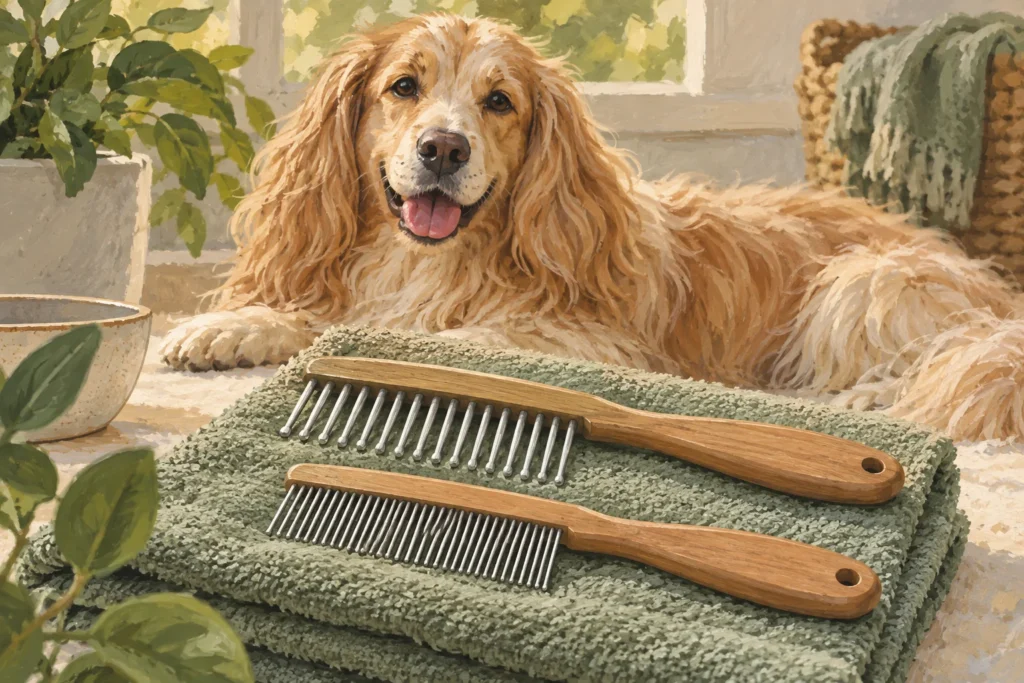
The best dog combs for long coats have tooth spacing and length that let you check the coat without dragging painfully through it. A comb is useful for finding areas a brush has missed; it should not be used to force out tight mats. Choose a manageable tool and ask a groomer to demonstrate the technique for your dog’s coat.
This article contains Amazon affiliate links. As an Amazon Associate, we earn from qualifying purchases.
Table of Contents
Decide what the comb is meant to do
Long silky hair, dense undercoat and a curly coat can need different routines. Describe the actual coat rather than buying solely from a breed picture on the packet. Length, thickness, current condition and your dog’s tolerance of handling all matter.
A comb can check whether sections are free of small tangles after appropriate brushing. It can also help you notice areas that need professional attention. It is not a substitute for a complete grooming plan, and adding more pressure does not make the wrong tool suitable.
| Comb design | Useful feature | Buying caution |
|---|---|---|
| Wide-spaced metal comb | Allows a less crowded first pass through a long or thick coat. | Check tooth length, smooth finish and comfortable grip. |
| Combined coarse/fine comb | Offers two spacings in one simple tool. | The fine end is not permission to pull through resistant areas. |
| Rotating-tooth comb | Teeth can move while passing through the coat. | Still stop at pain, resistance or a tight mat. |
| Small detail comb | Can be easier to position in limited areas. | Delicate areas require careful handling and professional instruction. |
Mikki Anti-Tangle Thick Coat: a named option
Mikki’s Classic Anti-Tangle Thick Coat comb uses rounded, rotating teeth and a handled design. The manufacturer positions it for thicker and longer coat types and distinguishes it from the Fine Coat version. That is a useful reason to check the exact variant rather than buying any red-and-black Mikki comb.
Find Mikki Anti-Tangle Thick Coat combs on Amazon UK. Confirm that the product supplied is the Thick Coat model and examine the pins for damage before use. Rotating teeth are a design feature, not a guarantee of pain-free removal of every knot.
A simple coarse-and-fine comb can be enough
If your groomer recommends a straightforward metal comb, a combined-spacing design can provide a practical checking tool without additional mechanisms. Find coarse-and-fine metal dog combs on Amazon UK. Look for smooth, firmly attached teeth and an overall size you can control comfortably.
Check how the spine sits in your hand. A long professional comb may be efficient for an experienced groomer but awkward for an owner working carefully around a small dog. Buying the longest tool is not automatically buying the most useful one.
Use the comb to check, not to win a struggle
Work on a stable non-slip surface with the dog in a comfortable position. Begin with an easy area and a short session. Follow the brushing and sectioning method demonstrated for that coat, then pass the comb gently through a manageable section.
If it catches, investigate rather than pulling harder. A small loose tangle and a tight mat close to skin are different problems. Stop if the dog shows discomfort. Do not cut mats out with household scissors near the skin, where it can be difficult to see what is caught inside.
Pay attention to areas affected by equipment
Check places where the coat is repeatedly compressed or rubbed, such as beneath a collar or harness, alongside the routine your groomer recommends. Remove walking equipment for grooming and inspect the skin and hair beneath it.
Regular brief checks can reveal a developing problem before a large mat forms. They are also easier to fit into daily life than waiting until the entire coat needs a difficult session. Our grooming kit guide can help you build a small set of complementary tools rather than several combs that do the same job.
Keep the comb clean and intact
Remove trapped hair after use. Follow the manufacturer’s cleaning directions, rinse where appropriate and dry thoroughly, including joints around rotating pins. Inspect for bent or rough teeth and replace a damaged tool.
Do not share a dirty comb between dogs with a suspected skin problem. Ask your vet or groomer about an appropriate hygiene routine rather than applying a strong household chemical that could leave residue or damage the tool.
When professional help is the better purchase
Book a groomer if the coat is extensively matted, you cannot reach the skin safely or handling has become a struggle. Seek veterinary advice about sores, pain or new skin changes. The best comb supports comfortable maintenance between suitable appointments; it should not be bought as a way to postpone care the dog already needs.