
Last updated: 9 September 2026
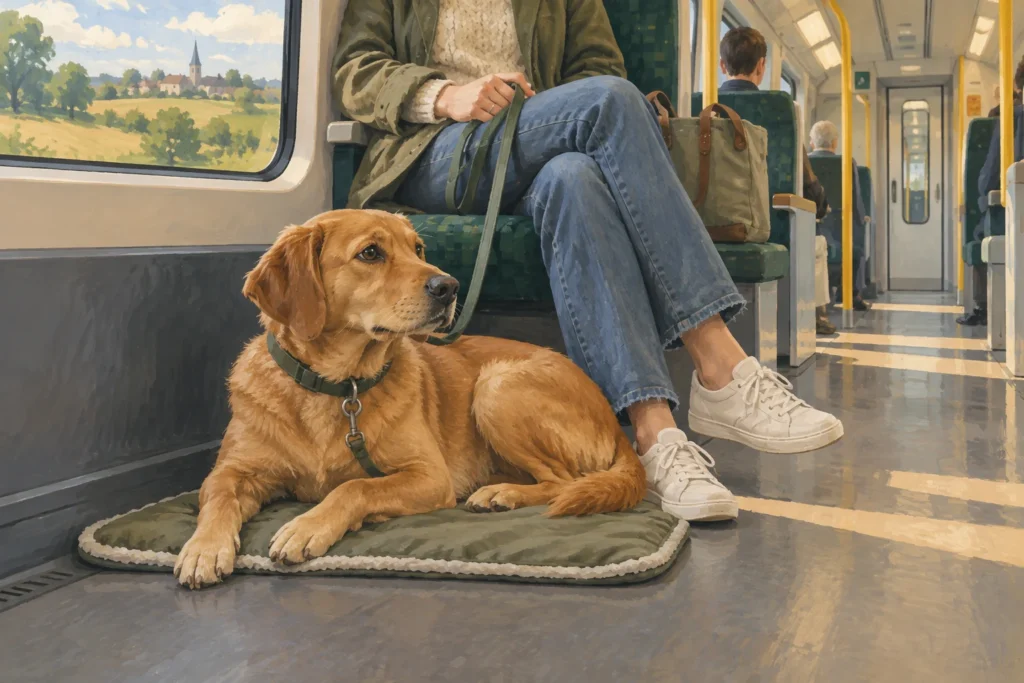
Yes, dogs can travel on National Rail services in Great Britain. National Rail currently allows up to two pets per passenger without an additional charge, with dogs on a lead or in a suitable carrier. Pets must stay off seats. Sleeper services have additional arrangements, so check your actual operator before booking.
Those are the National Rail starting rules, not a promise that every UK transport network or international train follows the same policy. Check separately for Northern Ireland rail, urban networks, replacement coaches and any onward international service.
Table of Contents
The National Rail essentials
National Rail says dogs should remain on a lead or in a carrier at stations as well as on the train. Carriers must be rigid and closed, with enough room for the animal to stand and lie comfortably. More than two animals may attract a charge; ask the operator first.
Animals are not allowed on seats in either Standard or First Class. Staff can require an animal to leave if its size or behaviour causes inconvenience. Plan a journey the dog can reasonably manage rather than assuming admission means any behaviour or amount of space will be accommodated.
Assistance dogs have separate provisions, including free travel and no sleeper cleaning charge under National Rail’s guidance. If you need assistance or have a specific access requirement, contact the operator in advance so the details can be arranged.
Overnight trains need a separate check
Caledonian Sleeper’s current pet page permits up to two domestic pets in rooms, with a £30 cleaning charge per journey. Pets must be added during booking and are not permitted in the Seated Coach or Club Car, or on the room’s beds. Confirm the current terms and total price when reserving.
The operator also says passengers cannot leave the train with their pet for a toilet stop before the booked destination. That matters more than the fee for a dog who cannot comfortably manage the overnight interval. Do not assume a station stop creates a usable break.
Other sleeper operators may have different booking arrangements. Read the policy for the exact service, including what happens during disruption. Caledonian Sleeper notes that pet carriage on a replacement service cannot be guaranteed.
Plan the station, not just the timetable
Look at entrances, lifts, steps and the distance between platforms. National Rail advises against letting dogs stand on escalators; they must be carried. If carrying your dog is not practical, choose a suitable lift or stair route and confirm it is available before travelling.
Leave enough time to move through the station without rushing. Keep the lead short enough for control without constant tension, stay back from platform edges and allow other passengers space. A retractable lead extended through a crowd creates an avoidable trip hazard.
Board when there is a clear opening and take care with the platform gap. Do not let the dog jump towards closing doors. If a connection is too tight to make calmly, a different itinerary is usually a better choice than relying on speed.
A compact train bag
| Item | Purpose |
|---|---|
| Water and a familiar bowl | Drinks without relying on station shops |
| Small washable mat | A familiar resting surface on the floor |
| Waste bags and cleaning supplies | Responsible handling of accidents |
| Suitable rewards | Reinforcing calm behaviour |
| Ticket and operator details | Checking the route and handling disruption |
This article contains Amazon affiliate links. As an Amazon Associate, we earn from qualifying purchases.
Find collapsible dog travel bowls on Amazon UK if your usual bowl is awkward to pack. Check that it stands steadily and is easy to clean. Our travel water bottle guide offers another carrying format. Avoid carrying so much luggage that you cannot manage the dog safely.
If using a carrier, compare the rules with its construction and your dog’s actual measurements. The travel crate sizing guide explains why external dimensions alone do not establish comfort.
Make the first journey manageable
Practise calm waiting and settling in easier places before attempting a busy train. A brief, quiet trip with a straightforward return can reveal what needs more preparation. Choose off-peak services where practical and avoid adding a long day of unfamiliar activities to the first attempt.
If the dog becomes distressed, focus on finding a safe, manageable next step rather than insisting on the original itinerary. Speak to staff where help is needed. For repeated or intense travel fear, get veterinary or qualified behaviour advice before booking a demanding journey.
Check service updates and the operator’s pet policy shortly before departure. A comfortable train trip depends on the dog, the route and the arrangements all fitting together, not simply on the answer being yes at the ticket office.