
Last updated: 9 September 2026
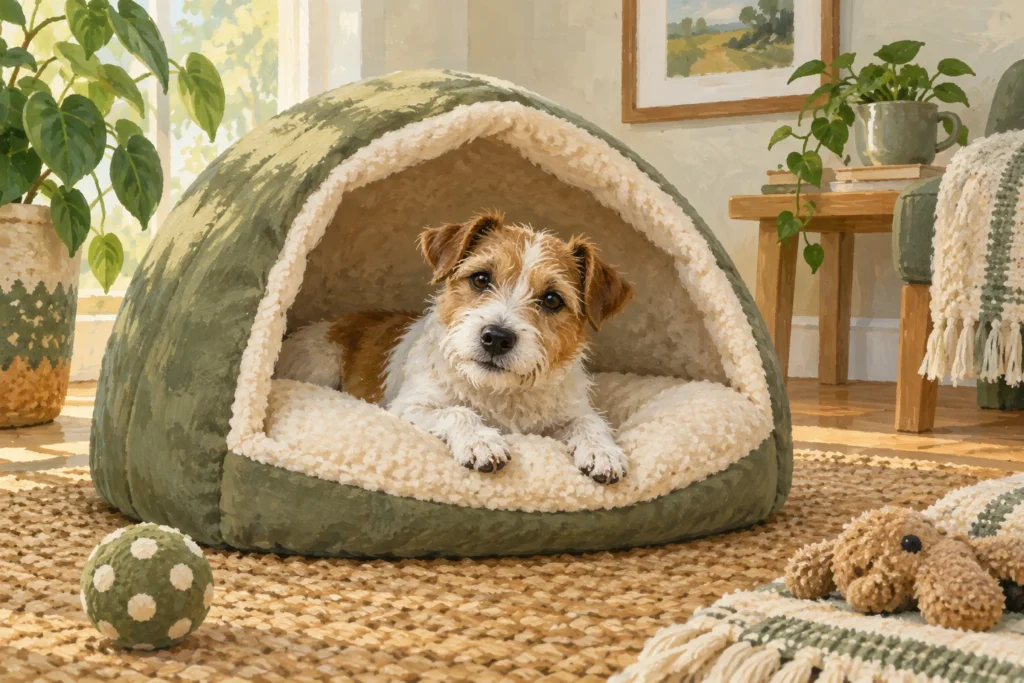
Dog cave beds suit dogs who already enjoy resting beneath a cover and can enter and leave the bed comfortably. The important differences are the usable sleeping area, how the hood stays open and what can actually be washed. A covered bed is a preference choice, not a proven treatment for anxiety.
This article contains Amazon affiliate links. As an Amazon Associate, we earn from qualifying purchases.
Table of Contents
Check whether your dog wants a cover
Notice their normal resting choices. A dog who repeatedly moves under a loose blanket may enjoy a hooded design. One who stretches out on a cool floor may prefer an open bed, even if a cave looks cosy to the owner.
Provide choice and do not place the dog inside to make them use it. Consider mobility and ease of turning around. A narrow entrance or soft edge that collapses under a paw can make a bed awkward for a dog who needs a straightforward route in and out.
Measure the sleeping space inside the hood
Measure the space your dog occupies when resting comfortably in their usual position. Compare this with the usable interior, not just the external diameter. Thick side walls and a sloping hood can reduce the available area.
| Measurement or feature | Why it matters |
|---|---|
| Internal length and width | The dog needs room to rest and reposition comfortably. |
| Entrance height | A low opening may require more bending or pushing. |
| Base thickness | Affects support, entry height and fit in the intended spot. |
| Hood support | Some designs use a removable tube; others collapse like a blanket. |
| Non-slip base | Useful when the dog pushes into the entrance on a smooth floor. |
Structured hood or loose cover?
A supported hood can make the entrance more obvious, particularly for a dog unfamiliar with pushing beneath bedding. A loose hood may suit an experienced burrower but can require more effort to open.
Inspect how any support is enclosed and whether the dog can chew or extract it. If your dog destroys bedding, a cave with hidden filling and structural parts may be unsuitable. No attractive fabric description makes it chew-proof.
Snoozer Cozy Cave: read the exact variant
Snoozer’s Cozy Cave range illustrates why model detail matters. Its traditional care guide describes a removable washable cover, with the insert and hood tube removed before washing. Newer variants use different fillings and may have different washing claims.
Find Snoozer Cozy Cave dog beds on Amazon UK. Check the exact model, internal measurements, filling and UK seller arrangements. Do not assume that instructions for a fully washable version apply to a traditional filled insert, or that a US warranty or delivery offer applies to a UK purchase.
The range is a design example to investigate, not a claim that one model is the best fit for every burrowing dog. Compare the total delivered price and the cost of replacement covers where available.
A simpler hooded bed may suit occasional burrowing
If your dog only sometimes chooses a cover, consider a design with an opening that can remain easily accessible and a removable cushion. Find hooded dog beds with removable cushions on Amazon UK. Read the component-level care instructions before choosing on colour or shape.
Ask whether the hood, outer shell and inner pad are separately washable, and whether the advertised dimensions refer to the whole bed or sleeping area. Product photographs with small dogs can make the available space difficult to judge.
Check your washing machine as well as the care label
A bed described as machine washable may still be too large for your machine. Measure the component you will wash and follow the care instructions. Drying time matters if this is the dog’s only resting bed.
Keep a suitable alternative available while the bed is being cleaned. Our dog bed cleaning guide covers the wider routine. Do not return damp padding to a cover simply because the outside feels dry.
Place the bed where resting is comfortable
Choose a quiet position with room around the entrance, away from busy doorways and direct sources of excessive heat. Watch how the dog uses it over several ordinary rest periods. If they repeatedly leave the hooded section, that may tell you the open area is their preference.
Persistent difficulty settling, pain on lying down or a sudden change in sleeping position deserves veterinary attention. A different bed can improve practical access, but it should not be used to explain away a health concern.
Choose the bed you can maintain
Prioritise easy entry, adequate space and a realistic cleaning routine. A removable cover and obtainable spare parts can matter more over time than elaborate styling. If your dog prefers an open supportive bed, our memory-foam bed guide offers another format to compare.