
Last updated: 9 September 2026
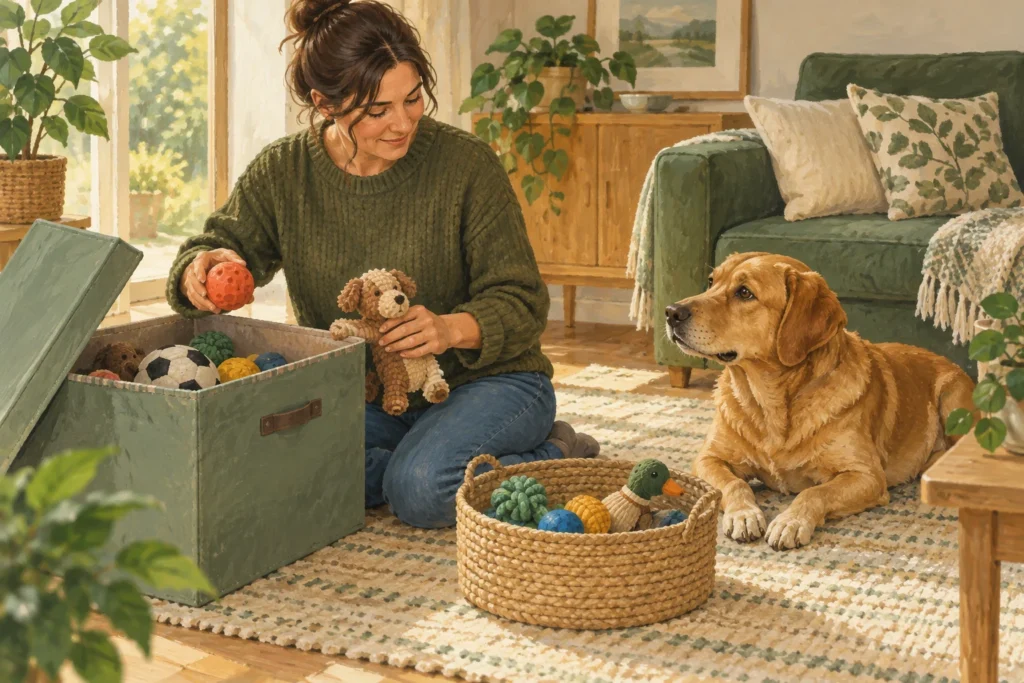
To rotate dog toys, keep a small useful selection available and put the remaining clean, suitable toys away. Swap an item when a different activity would be welcome, rather than following a rigid calendar. Keep a familiar favourite if it helps your dog settle; rotation should add useful variety, not remove everything they enjoy.
You do not need a monthly shopping habit to do this. The first step is finding out what you already own, what your dog actually likes and which items are appropriate for supervised play or other permitted use.
Table of Contents
Start with a toy audit
Gather the collection when your dog is comfortably occupied elsewhere. Check seams, cracks, loose parts, exposed stuffing and changes in size or shape. Remove damaged items from circulation; a week in a cupboard does not make a weakened toy suitable again.
Separate food toys for cleaning and check each maker’s instructions. Note which items your dog has outgrown and which were never a good fit. A barely used toy can still be unsuitable if the dog tries to swallow it, becomes distressed by its sound or cannot manipulate it comfortably.
Avoid taking a valued toy directly from the dog’s mouth simply to complete your tidy-up. If they guard possessions, arrange safe management and seek professional help. The rotation can wait until you can handle the collection without creating a confrontation.
Sort by the activity, not the colour
Group toys according to what they offer. A collection of six similar balls provides less functional variety than its size suggests. Think about chewing, carrying, gentle shared play and food-search activities, while respecting what your particular dog enjoys.
| Group | Useful question | Rotation approach |
|---|---|---|
| Comfort or carrying | Does the dog regularly choose a familiar favourite? | Keep an appropriate favourite available as the dog needs it |
| Interactive play | Does this require a person and clear space? | Bring it out for a planned session, then store it |
| Food enrichment | Can it be cleaned and used within the feeding plan? | Rotate clean, fully dry options matched to the meal |
| Chew items | Is this exact item suitable for the dog’s chewing? | Inspect before each use and supervise as instructed |
Blue Cross recommends varying activities and considering individual preferences in its enrichment advice. That is a useful principle for a rotation: change what the dog does, not merely what the toy basket looks like.
Try a flexible three-day example
On the first day, use a suitable food toy with part of the normal allowance and keep the familiar carrying toy available. On the second, offer a short shared game with a different suitable toy. On the third, return to a simple search using an existing favourite rather than introducing another purchase.
This is an organisational example, not a required activity schedule. Choose sessions according to age, health, energy, weather and the rest of the day. Dogs also need uninterrupted rest; an empty moment does not automatically need another toy.
If a dog ignores an item, put it aside without repeatedly waving it at them. Reintroduce it another time only if it seems suitable. If they consistently prefer the same format, that information can guide future purchases and prevent accumulating more unwanted styles.
Store the waiting toys properly
Keep clean and dirty toys separate. Let washed toys dry fully before closing them in a container, and check food toys for leftover filling. Keep instructions or a small care note for items with unusual cleaning requirements.
KONG’s cleaning guidance for its applicable rubber toys includes washing and, where appropriate, top-rack dishwasher cleaning without the dry cycle. That instruction does not automatically apply to plush toys, batteries, glued components or every other rubber product. Follow each maker’s directions.
This article contains Amazon affiliate links. As an Amazon Associate, we earn from qualifying purchases.
Find washable boxes for storing spare dog toys on Amazon UK if you need a place for the spare collection. Choose a simple washable container with enough room to avoid crushing items. Store supervision-only toys out of reach; an attractive open basket is not a reason to offer unrestricted access.
Measure enjoyment, not how long a toy lasts
Watch for relaxed interest and an activity the dog can complete. If a feeder causes frantic pawing or a toy prompts repeated uncomfortable movements, simplify the activity or stop. Difficulty is not inherently more enriching, and constant novelty is not necessary for every dog.
Dogs Trust advises observing how a dog interacts with enrichment and adapting it to their health, ability and preferences. Keep a brief note of successes: “likes carrying this after walks” or “uses the shallow feeder calmly”. Those observations are more useful than a timetable copied from another household.
For ideas, our puzzle toy guide covers food-game formats. Use it to identify a specific gap only after trying the toys you own. Buy a replacement when an item is worn out or a clearly useful activity is missing, and let a simpler, better-used collection be the result.