
Last updated: 9 September 2026
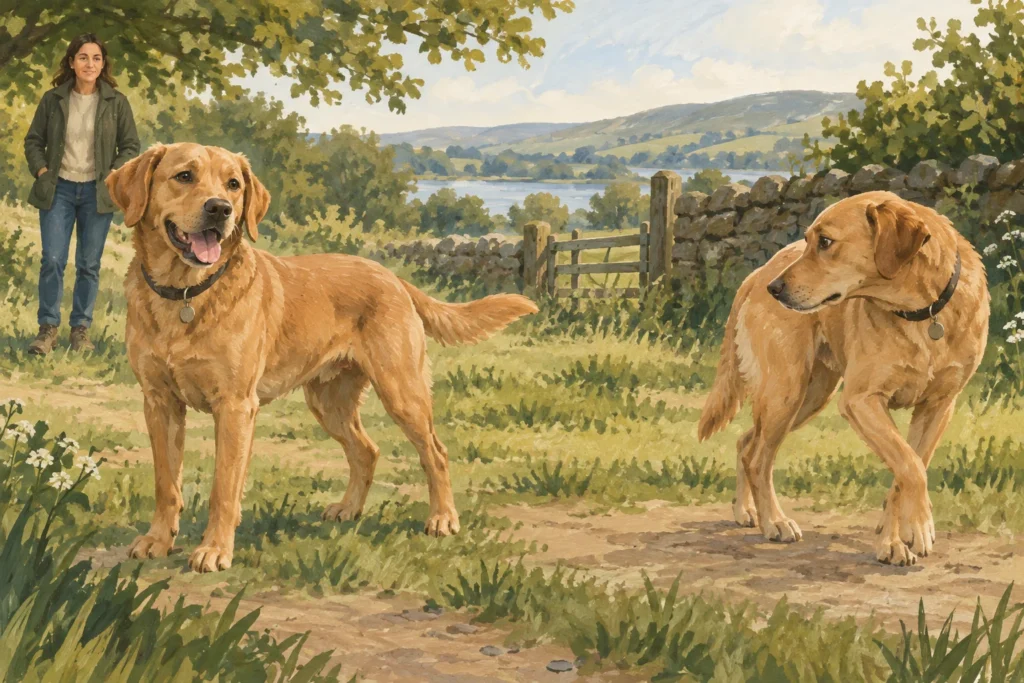
Dog body language makes more sense when you look at the whole dog, what is happening around them and how their behaviour changes. A wagging tail alone does not prove happiness, and one yawn does not diagnose stress. Learn your dog’s comfortable baseline, then notice departures from it and give them space when an interaction becomes difficult.
You do not need to identify a precise emotion before responding kindly. If the dog turns away, becomes tense or repeatedly tries to leave, pause the interaction and make the situation easier. Waiting for a growl or snap misses earlier opportunities to help.
Table of Contents
Start with your own dog’s normal appearance
Watch the dog during ordinary comfortable activities: resting nearby, exploring a familiar place or greeting someone they know well. Notice the natural position of their ears and tail, their movement and how easily they look around or settle. Shape and coat can make the same body part look very different between dogs.
Dogs Trust emphasises individual differences, whole-body observation and context. A tightly curled tail has a different resting appearance from a long straight one. Long facial hair can obscure the mouth, while floppy ears move differently from upright ears. Compare the dog with their own baseline rather than a single generic drawing.
Photographs can be useful reminders, but a short sequence often tells more than a frozen instant. A dog moving towards someone and then retreating is communicating something a smiling-looking photograph may miss.
Use a simple observation sequence
| Look at | Ask yourself |
|---|---|
| Movement | Is it loose and voluntary, or stiff, hurried or repeatedly retreating? |
| Face and head | Has the expression changed as someone approaches? |
| Whole posture | Is the dog able to reposition comfortably? |
| Attention | Can they disengage from what they are watching? |
| Situation | What changed just before these signals appeared? |
These questions help you observe; they are not a scoring system that proves an interaction is safe. Keep enough distance to watch without adding pressure, especially with an unfamiliar dog.
Context changes the meaning
Lip licking near a prepared meal may relate to food. Similar movement during unwanted handling may mean something different. Likewise, a dog lying still may be resting comfortably or finding it difficult to respond. Look for the surrounding sequence instead of assigning a fixed translation to one gesture.
Consider a visitor reaching over a dog’s head. The dog looks away, shifts backwards and stiffens. You do not need to wait to see whether a bite follows. Ask the visitor to stop reaching and let the dog move away. Removing the pressure is a practical response to the pattern you can already see.
During play, notice whether both dogs choose to return after a pause. If one keeps trying to leave or is repeatedly pursued, interrupt calmly and provide space. Do not insist that dogs must work it out themselves.
Make opting out easy
Arrange a resting place where the dog can withdraw without being followed. Teach children and visitors that resting dogs should be left alone, and supervise interactions appropriately. A gate or separate room may be useful when adults cannot actively supervise, provided the dog is comfortable with that arrangement.
This article contains Amazon affiliate links. As an Amazon Associate, we earn from qualifying purchases.
A familiar mat can make the resting location portable. Find washable portable dog mats on Amazon UK if you need one for visits, but introduce it at home first and place it where people will not step over the dog. The mat marks a comfortable place; it does not guarantee calm behaviour or make close contact safe.
For a dog who struggles with being left, use the separation anxiety guide as a starting point for recognising when individual support is needed. Body-language observations can help explain what happens before and during distress.
Respond to warnings without punishment
Growling, snapping or showing teeth means the situation needs immediate space and careful management. Do not punish the warning or move closer to test it. Keep yourself and others safe, stop the interaction where possible and seek professional advice about repeated or serious incidents.
Pain and illness can affect behaviour. A sudden change in tolerance of touch, movement or company deserves veterinary assessment, even when the dog seems otherwise familiar. For ongoing concerns, a qualified behaviour professional can interpret patterns in the individual context.
The practical goal is better everyday decisions: ending a greeting sooner, increasing distance on a walk or letting the dog rest undisturbed. Accurate observation grows from curiosity and repeated attention, not from memorising a list of supposedly universal gestures.