
Last updated: 9 September 2026
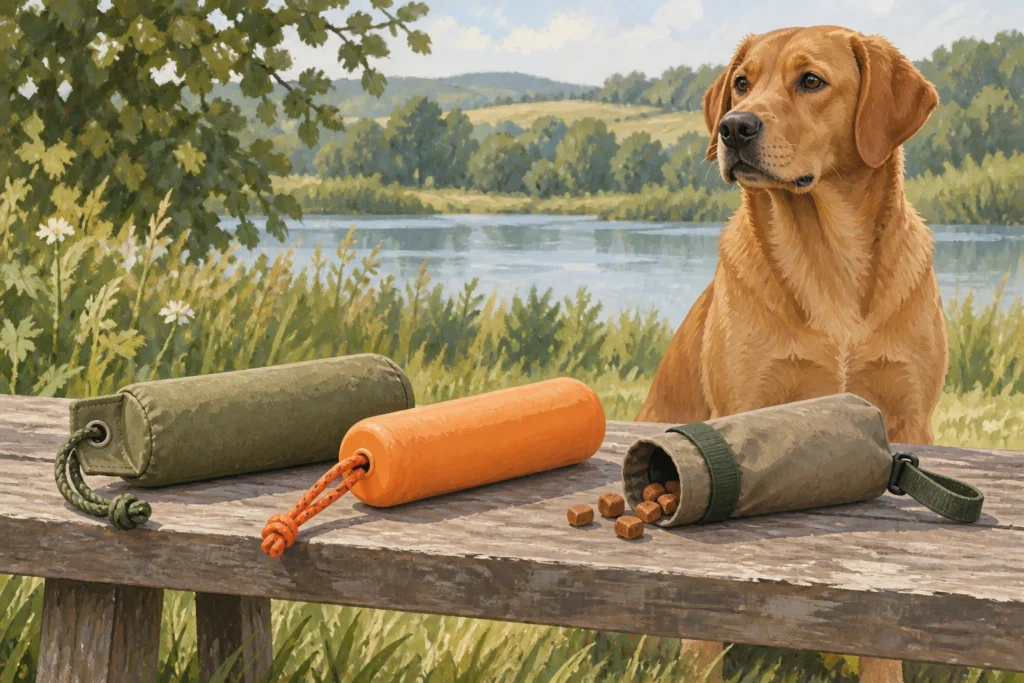
Choose a dog training dummy for the retrieve you want to teach: a conventional padded dummy for carrying practice, a specifically floating model for suitable water work, or a food-filled design that lets you deliver a reward after the return. These categories can overlap, so check the actual product rather than relying on its shape.
A dummy is training equipment for a supervised session. It should be comfortable for the dog to pick up and carry, and manageable for you to place or throw. Buying a heavier or more professional-looking version does not make it a better starting point.
Table of Contents
Compare the purpose of each design
A canvas-style dummy gives you a consistent object to practise with. Floating versions add buoyancy, but material alone does not establish whether something will float. A zipped food compartment offers a different reward arrangement and needs extra cleaning and supervision.
| Type | Useful starting purpose | Main buying check |
|---|---|---|
| Padded training dummy | Short, controlled carrying and retrieve practice | Comfortable diameter, length and weight |
| Floating retrieval toy | Approved water sessions with a suitable dog | Explicit flotation claim and visibility |
| Food-filled dummy | Rewarding a dog for bringing the item back | Secure compartment that a person opens |
| Specialist competition dummy | A course or discipline with specified equipment | The instructor’s required specification |
If you have joined a class, ask the instructor what to buy first. A general pet retrieve game and a structured gundog programme may use different weights, cues and progression. It is easier to start with one suitable item than to work around a large mismatched set.
Coachi Training Dummy: a padded option
Company of Animals describes the Coachi Training Dummy as a padded retrieval toy with cork filling that floats. Its published sizes are small, medium and large. Use the current dimensions and weight for the exact size to judge suitability for your dog’s mouth and experience.
This article contains Amazon affiliate links. As an Amazon Associate, we earn from qualifying purchases.
Find Coachi dog training dummies on Amazon UK. Check the size selection carefully; a listing photograph may be shared across several weights. The maker specifies supervised use and says it is not a chew toy. Its cleaning advice is to rinse with clean water after use.
The attached throwing rope is a handling feature, not an invitation to begin with long throws. A short placement or controlled retrieve can be more useful for a beginner. Inspect the rope and stitching as carefully as the main body, and stop using a damaged dummy.
KONG Aqua: a different floating shape
KONG Aqua uses a KONG-shaped body with a foam core and attached rope. The manufacturer identifies it as a floating retrieval toy. This makes it a possible alternative when you want that shape, rather than a conventional elongated dummy.
Find KONG Aqua retrieval toys on Amazon UK and check the exact size. Do not confuse Aqua with a hollow food-stuffing KONG because of the similar silhouette. Follow the product’s own use and care instructions and remove it if damaged.
Flotation does not make a water location safe. Before any water training, consider access, exit, conditions and your dog’s health and confidence, and obtain appropriate instruction. Keep the first buying decision separate from the decision to send the dog into water.
Coachi Fetch & Reward: a food-compartment option
The Coachi Fetch & Reward has a zipped treat compartment. Company of Animals describes opening it to reward the dog after they bring the toy back. The practical distinction is that the person supplies the reward; the dog is not meant to tear the compartment open.
Find Coachi Fetch & Reward toys on Amazon UK if that approach suits your training plan. Choose food compatible with the product instructions and your dog’s dietary needs. Empty leftovers after the session and check the zip, seams and inside before storing it.
A food-filled design may interest a dog that is less keen on ordinary toys, but it is not a guaranteed solution. If the dog prefers to run off and chew it, ask a reward-based trainer to help adjust the session rather than making the compartment increasingly difficult to open.
Make size and comfort the final deciding factors
Watch for easy, relaxed carrying. A dummy should not force an awkward grip or be so small that it presents a swallowing risk. Puppies and dogs with dental or mobility concerns need an individual assessment; ask your vet about physical concerns and your instructor about training suitability.
Start in a clear, quiet area with a surface that offers secure footing. Keep sessions brief enough to maintain interest and finish before the dog becomes tired or frustrated. Reward the behaviour you are teaching without forcing the mouth open or punishing a dropped object.
Our clicker guide explains reward markers if you use one. For the equipment itself, prioritise a suitable mouth size, a clear training purpose and instructions you can follow. One well-chosen dummy with a sensible session plan is usually a more useful purchase than a bag of objects selected only by colour or discount.