
Last updated: 9 September 2026
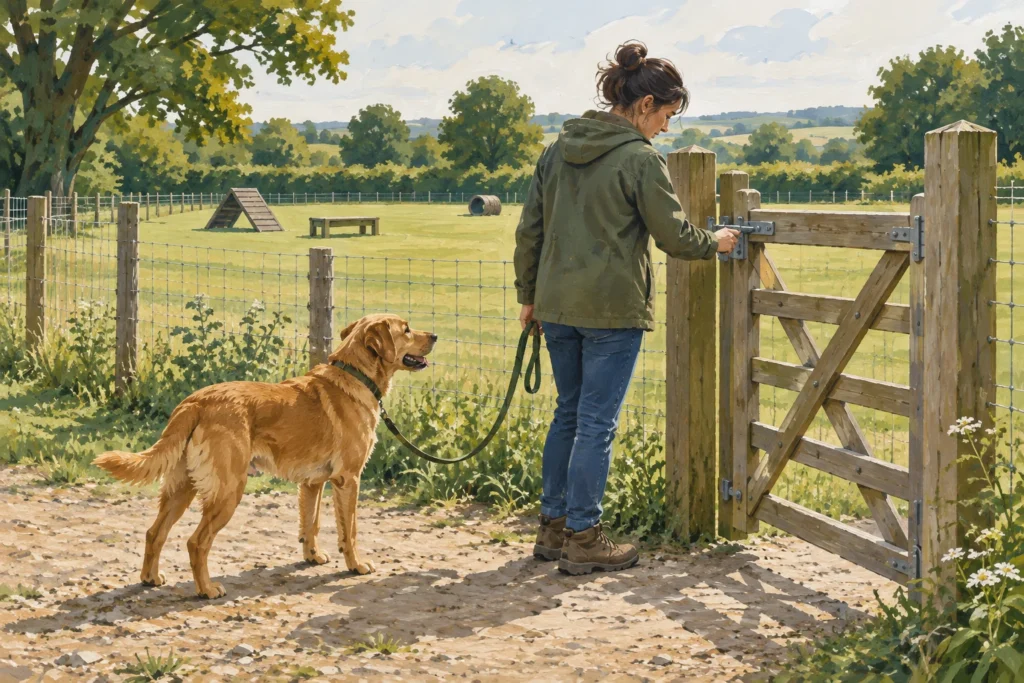
A secure dog field is worth booking only when its enclosure, access arrangements and rules suit your particular dog. Before paying, ask about the fencing and gates, whether the session is exclusive and how arriving dogs are kept apart. The word “secure” in a listing is a description to investigate, not a guarantee against escape.
A private session can offer useful space for sniffing or practising familiar skills. It does not make every dog comfortable, remove handling responsibilities or replace support for fear and reactivity. Plan the whole visit, including the car park and the journey home.
Table of Contents
Confirm what the booking includes
Establish whether you are hiring the whole enclosure or a place in a shared session. Some directories include private fields, social areas and indoor spaces. Check the individual operator’s description rather than assuming every search result offers the same arrangement.
Ask how long the session lasts, whether that includes arriving and leaving, how many dogs and people are allowed and whether someone else may enter. Read vaccination, behaviour, insurance and any dog-specific conditions relevant to your booking. Ask the operator when a rule is unclear rather than arriving with a different interpretation.
The Dog Walking Fields directory notes that locations and suitability should be checked with field owners. Obtain the exact entrance instructions: a postcode can direct you to a nearby property rather than the field gate. Save the contact number before travelling, especially where mobile reception may be unreliable.
Ask specific questions about the perimeter
A fence height alone does not describe an enclosure. Ask about the material, gaps beneath the fence, gates, adjoining hedges and objects close enough to assist climbing. Tell the operator about known digging, squeezing or climbing behaviour so the answer relates to your dog.
| Area | What to establish |
|---|---|
| Fence and ground edge | Construction, maintenance and any gaps or changing ground levels |
| Entry gates | How they close, latch and separate the field from open access |
| Adjacent land | Livestock, dogs, traffic or public paths beside the boundary |
| Parking | Whether unloading takes place inside a secured area |
| Facilities | Water, shade, bins and any equipment available during your slot |
Recent photographs help, but inspect on arrival before releasing your dog. Keep them attached while checking the gate and accessible boundary. If you see a gap, damage or a feature that makes the site unsuitable, contact the operator and use a different plan. Do not test the fence by seeing whether your dog attempts to cross it.
Make arrival and departure part of the booking
Ask how much separation there is between customers. A field may be empty during your session yet have a busy car park at changeover. For a dog worried by other dogs, that brief encounter can matter more than the quality of the enclosure.
Follow the operator’s waiting procedure and keep the dog safely contained until your area is ready. Confirm the exit route and finish with enough time to attach the lead and leave within your slot. A familiar cue and reward can make departure clearer than waiting until the next customer appears.
If your dog reacts strongly to dogs, people or nearby livestock, ask about visual barriers and neighbouring activity. Dogs Trust’s reactive-dog guidance supports understanding triggers and getting appropriate help. Private hire does not promise a trigger-free environment, and another location or quieter time may be more suitable.
Bring a small, useful kit
Take your usual well-fitted walking equipment, a normal lead, water, a bowl, waste bags and familiar rewards. Check that identification details are current. Carry any items you need to clean up or manage muddy paws before getting back into the car.
This article contains Amazon affiliate links. As an Amazon Associate, we earn from qualifying purchases.
Find portable dog water bowls on Amazon UK if you need a portable bowl. Look for a stable shape, a size that lets your dog drink comfortably and cleaning instructions you can follow. Bring drinking water even when the listing mentions a tap, unless you have confirmed the current supply and its suitability.
A long line may help with an appropriate training plan, but ask the operator whether it is permitted and consider entanglement around equipment or other dogs. Our recall guide can support planned practice. Avoid making a new field session a test of skills your dog has not yet learned.
Choose activities that fit the dog and conditions
Allow time for quiet exploration. You do not need to fill every minute with ball throwing to make the booking worthwhile. Check surfaces for holes, debris, standing water or anything your dog might eat, and supervise any unfamiliar equipment.
Adapt or cancel if heat, weather or ground conditions make the visit unsuitable. A field with space to run still requires judgement about your dog’s comfort and fitness. Leave gates secured, remove waste and report damage so the operator can act. Record what worked about the visit; the best repeat booking is one that makes the entire outing manageable for both of you.