
Last updated: 9 September 2026
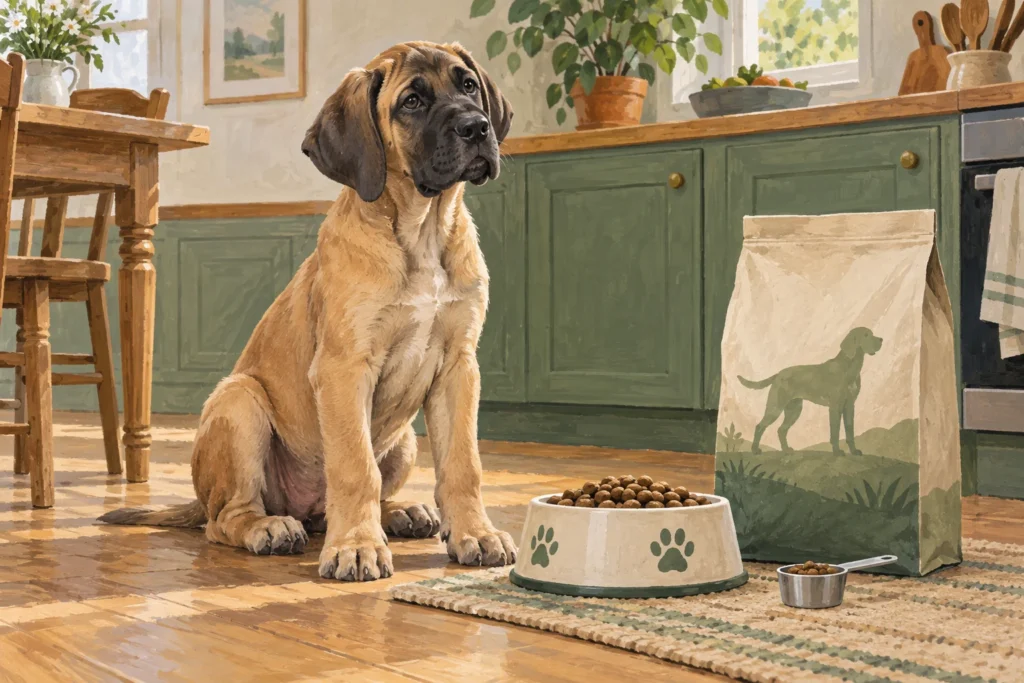
Large-breed puppy food should be complete, appropriate for growth and suitable for your puppy’s expected adult size. Start with the food and routine already used, then discuss any change with your vet or vet nurse. Bigger portions and extra calcium are not shortcuts to healthy growth.
This article contains Amazon affiliate links. As an Amazon Associate, we earn from qualifying purchases.
Table of Contents
Read the life-stage statement first
Look for a complete puppy or growth food and the size range it is designed to cover. Adult maintenance food, complementary meat and training treats serve different purposes. Attractive ingredient descriptions do not establish that a product meets the puppy’s whole nutritional need.
Ask for help estimating adult size, especially with a crossbreed or uncertain background. Do not use today’s weight as though it were the adult-weight category on a feeding chart.
Understand why size categories matter
Growing dogs need an appropriate balance of nutrients and energy. PDSA recommends food suitable for the puppy’s size and regular weighing to monitor development. UK Pet Food warns that adding supplements to a complete puppy diet can disrupt the balance, with particular concern for large and giant breeds.
Ask the manufacturer which growth standards the recipe follows and whether it is appropriate for the expected adult size. You do not need to formulate calcium ratios yourself to make a sensible purchase.
| Question | Why it helps |
|---|---|
| Is it complete for growth? | Separates a main diet from a complementary product. |
| Which adult size does it cover? | Checks the puppy fits the intended group. |
| Which age stages does the range use? | Prevents assuming every brand changes at the same age. |
| How should mixed feeding be calculated? | Avoids giving full portions of two foods. |
| Who can answer nutrition questions? | Provides a route to clarify the recipe and feeding guide. |
Royal Canin Maxi Puppy: a defined size bracket
The UK Maxi Puppy dry-food specification is for puppies expected to reach 26–44 kg as adults, with the product described for the growth period up to 15 months. That is a specific product range, not a universal definition of when every large dog matures.
Find Royal Canin Maxi Puppy dry food on Amazon UK. Confirm Maxi Puppy rather than Maxi Adult or a differently sized puppy formula. Check the current bag’s age and weight guidance, particularly if the puppy is likely to be above the stated adult range.
Royal Canin publishes feeding information for different arrangements. Choose the chart matching what you actually feed; a table including a wet-food pouch should not be read as an all-dry ration.
Purina Pro Plan Large Athletic Puppy: check physique and recipe
Purina’s UK Large Athletic Puppy Healthy Start Chicken is a complete puppy food positioned for large dogs with an athletic physique. The brand also uses other size and physique descriptions, so the full name matters.
Find Purina Pro Plan Large Athletic Puppy Chicken on Amazon UK. Athletic here identifies the product’s intended physique category; it is not an instruction to exercise a growing puppy intensively. Ask the manufacturer or your veterinary team whether this version suits your dog.
These two products are examples for comparing labels and feeding support. This guide does not claim one produces better growth or fewer health problems, and a puppy doing well on another suitable complete diet need not change because a different bag appears on a shortlist.
Use portions as a monitored starting point
Follow the relevant feeding guide, weigh the daily ration and divide it according to the agreed routine. Measure training food from that allowance where appropriate. Count other rewards rather than treating them as nutritionally invisible.
Keep a simple record of weight checks, food amount and any concerns. Ask your vet nurse to show you how to assess body condition during growth. Comparing the puppy with a much heavier littermate or a social-media photograph is not a useful feeding target.
Avoid casual additions to a complete diet
Do not add calcium, mineral powders or growth supplements unless specifically advised by the veterinary team. Home-prepared additions can also change the nutritional balance when they displace enough complete food.
If you want to feed a homemade diet or the puppy has a medical condition, seek appropriately qualified veterinary nutrition advice. A shopping comparison cannot supply a personalised formulation.
Compare cost using the actual ration
Compare the current price with how long the bag will last at the puppy’s present ration, allowing for changing needs. Large packs are only convenient if you can store them correctly and use them while fresh.
Our dog-food guide explains broader buying considerations. For a growing puppy, the most useful choice is a suitable complete food backed by clear guidance and a realistic plan for monitoring development.