
Last updated: 9 September 2026
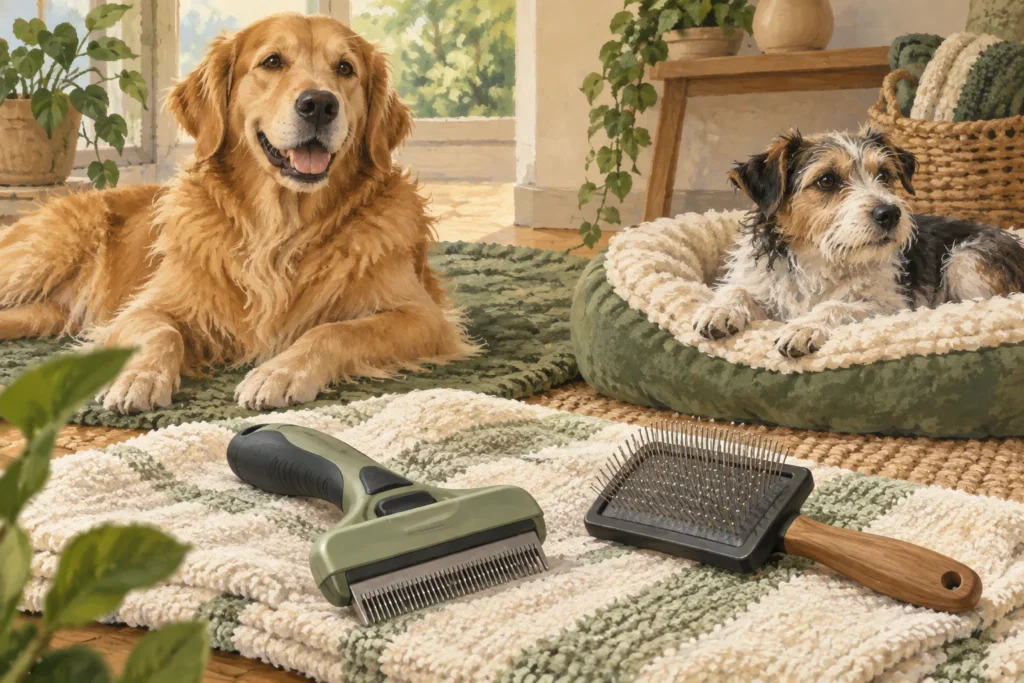
A FURminator undercoat de-shedding tool and a slicker brush do different jobs. The undercoat tool is intended for suitable shedding coats; a slicker uses fine pins for brushing tasks that depend on its design and the dog’s coat. Choose the job first, then the tool. Neither is a reason to work through painful mats at home.
FURminator is a brand with several products, so this comparison specifically concerns its Undercoat deShedding Tool. A broad search for a FURminator brush may return other designs with different instructions.
Table of Contents
Where the tools differ
| Question | Undercoat de-shedding tool | Slicker brush |
|---|---|---|
| Main construction | A defined toothed working edge | A pad or head of fine pins |
| Selection | Suitable coat, dog size and hair-length version | Pin length, firmness, head size and coat task |
| Typical buying mistake | Assuming every shedding-looking coat needs it | Choosing stiff pins without considering skin and handling |
| Limit | Not intended for every breed or sensitive skin | Not permission to force out compacted mats |
Some coat routines may use more than one tool, but buying both is not automatically necessary. Ask a groomer to show where each would fit into your dog’s routine and what a comfortable finished coat should feel like.
When the FURminator undercoat tool is relevant
FURminator says its undercoat tool is intended for suitable animals with an undercoat and should not be used on non-shedding breeds or particularly sensitive skin. The manufacturer offers versions by dog size and hair length. Check its breed and coat guidance alongside the individual dog’s condition.
This article contains Amazon affiliate links. As an Amazon Associate, we earn from qualifying purchases.
Find FURminator undercoat de-shedding tools on Amazon UK if a groomer confirms this type is appropriate. Match the exact size and short- or long-hair version before ordering. This is not a claim that it will remove a measured percentage of hair from your dog, and no before-and-after test is represented here.
Use the current instructions for pressure, direction and frequency. Do not keep working the same area simply because more hair appears. The quantity collected is not a useful target if the skin or coat is becoming uncomfortable.
What a slicker offers instead
A slicker’s pins allow a different brushing action. The suitability depends on their length and firmness, how the head flexes and how the tool is used. A small face of densely packed pins can feel very different from a wider flexible brush even though both are called slickers.
Mikki’s Classic Pro Slicker, for example, has a flexible double-sided head with soft and hard pins. That provides two working surfaces to consider, rather than one universal setting. Find Mikki Classic Pro Slicker on Amazon UK, checking the current model and asking a groomer which side, if either, suits the areas you need to maintain.
Do not interpret a manufacturer’s mention of tangles or mats as permission to pull through a tight mat next to the skin. PDSA advises against tackling mats yourself. A groomer can assess whether the coat can be comfortably maintained or needs a different intervention.
Let the coat decide the session
Start with the dog comfortable and the coat in the condition required by the tool’s instructions. Work in manageable sections with gentle handling. Pause if the dog turns repeatedly towards the area, flinches, tries to leave or the skin looks irritated. Do not treat resistance as a reason to hold more firmly and finish faster.
A comb recommended for the coat may help check whether brushing has reached beyond the surface, but it should pass without force. If it catches repeatedly, stop and ask for a demonstration rather than digging harder with either tool.
The brushes for shedding guide covers broader formats. A brush that works for one dog in the household may be unsuitable for another, even if both leave hair on the sofa.
Compare ownership as well as the first result
Look at handle comfort, cleaning access and replacement availability. Inspect pins or teeth for bending and damage. Store the working edge where it will not be dropped or knocked, and clean it as directed after use. A damaged grooming surface should not be used against the dog.
The grooming kit guide can help you organise a small routine without buying overlapping tools. Add a product only when you understand what task it performs and can use it comfortably.
For an appropriate shedding undercoat, investigate the correctly selected de-shedding tool. For a brushing routine that calls for a slicker, choose the pin and head design with coat-specific advice. If you cannot yet describe the job clearly, a grooming demonstration is the most useful purchase decision you can make first.