
Last updated: 9 September 2026
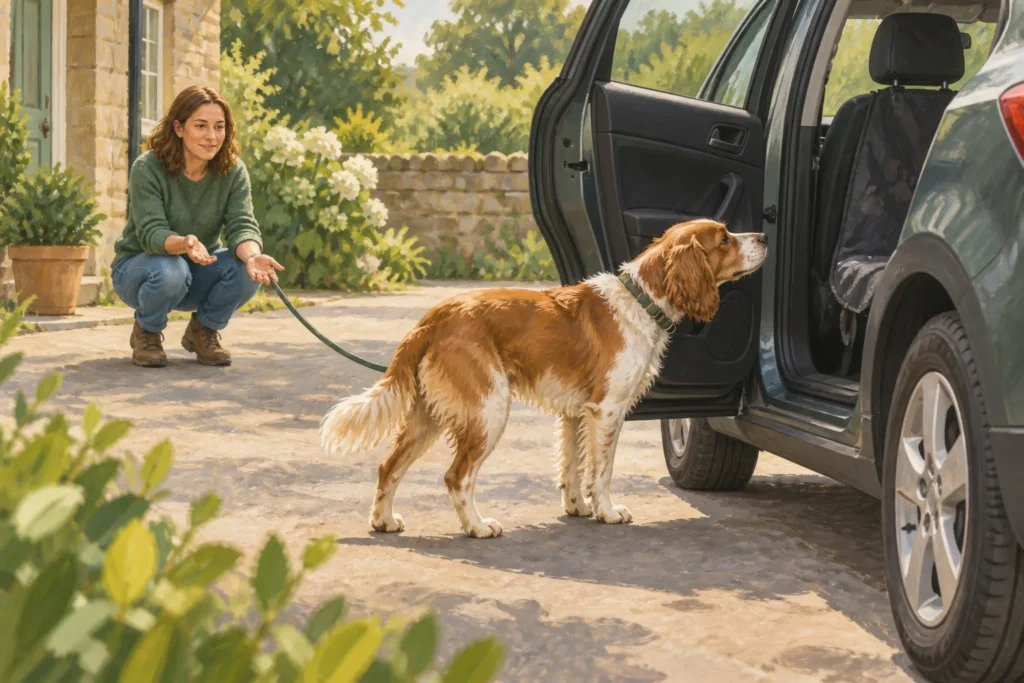
If your dog is scared of the car, begin at a point where they can remain comfortable, which may be several metres away from it. Pulling them inside and taking repeated long journeys can make practice harder. First consider whether travel sickness, pain when getting in or an uncomfortable restraint is contributing to the problem.
A dog who refuses a car journey is communicating difficulty, not failing a test of obedience. You can make the situation more predictable, separate its different challenges and seek help when health or severe distress is involved.
Table of Contents
Record what happens before deciding why
Notice when the first change appears: picking up the car keys, walking towards the vehicle, seeing the open boot, being lifted, hearing the engine or taking the first corner. These observations give your vet or trainer something more useful than “does not like travelling”.
PDSA identifies drooling, repeated swallowing, retching and vomiting among possible travel-sickness signs. Fear and nausea can overlap. Speak to your vet if these occur, if the problem is getting worse or if a previously willing traveller suddenly refuses. Reluctance to jump also warrants attention to physical comfort. Do not try human travel medicines or assume a supplement will solve the cause.
Keep a simple note of journey length, seating position and what you saw. A passenger can observe safely; the driver should concentrate on driving. Video taken by a passenger or in a stationary vehicle can help explain the sequence to a professional.
Make practice separate from necessary journeys
Arrange sessions when you have nowhere to go and can stop immediately. Choose a quiet location with the car securely parked, away from moving traffic. Keep the dog safely managed while allowing enough distance to retreat. Avoid training in a hot vehicle or running an engine inside an enclosed garage.
The first useful achievement might be looking towards the parked car and then turning away comfortably. Reward voluntary interest with something your dog enjoys. A lure held deep inside the vehicle can draw a dog further than they feel comfortable, so avoid making the reward depend on being trapped beyond their current confidence.
Break the journey into smaller tasks
| Part of travel | Example of an easier starting point |
|---|---|
| Approaching | Relaxed time at a comfortable distance from the parked car |
| Entry | Investigating a stable access surface without travelling |
| Staying inside | A brief comfortable pause in the stationary car |
| Doors and restraint | Practising each familiar movement separately |
| Engine and motion | Only adding these after earlier parts are comfortable |
This is a way to divide the problem, not a timetable. Some dogs need very small changes with professional guidance. Watch the dog’s whole behaviour and end before they become distressed. If a new step causes difficulty, return to an easier version next time rather than repeating it until the dog stops protesting.
Check access and the travelling space
Look for slipping, a high boot lip, an unstable ramp or a harness that catches during entry. Practise using any new ramp on a suitable low, stable setup according to its instructions before expecting it to solve car access. Never leave a portable ramp unsecured where it can slide.
This article contains Amazon affiliate links. As an Amazon Associate, we earn from qualifying purchases.
A familiar washable mat can help create a consistent resting surface. Find washable dog travel mats on Amazon UK if you need one, choosing a size that lies flat without obstructing restraint fittings. It is a comfort accessory, not a crash-protection device or treatment for fear. Our car seat cover guide covers protecting the vehicle; check that any cover remains compatible with the chosen restraint.
PDSA advises appropriate restraint during travel. Check the exact harness or carrier installation instructions, ventilation and usable space. A travel crate must fit the dog, not just fit neatly into the boot.
Plan unavoidable travel with support
Veterinary appointments and house moves may not wait for a training programme. Tell your vet about the difficulty ahead of time and ask how to manage necessary journeys. Choose the least demanding practical route, maintain a comfortable temperature and avoid leaving the dog alone in the car.
Progress means the dog approaches and travels with increasing comfort, not simply that you can get the door shut. If fear is intense, the dog risks escaping or practice is making things worse, involve your vet and a qualified behaviour professional. That support can make the next step smaller and more suitable for the individual dog.