
Last updated: 9 September 2026
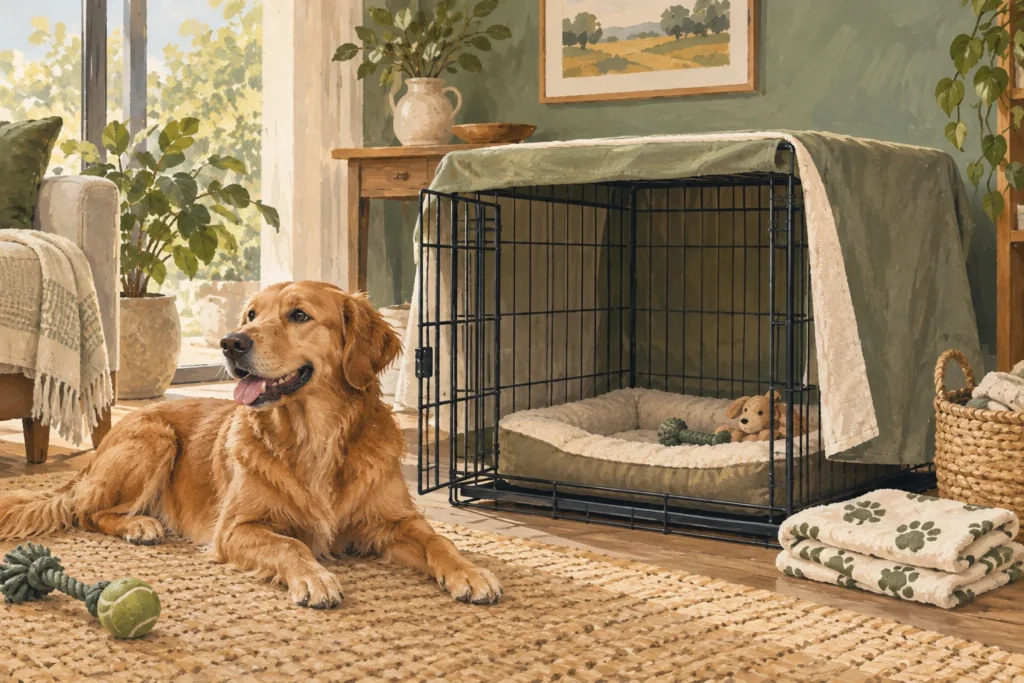
A dog crate cover can reduce visual disturbance around a familiar resting space, but it is optional. Some dogs settle with part of the crate covered; others prefer an open view. Start with your dog’s response and the room conditions, not the idea that every crate needs to look like an enclosed den.
The crate should already be a comfortable, positively introduced space. Covering a dog that is trying to escape, panting heavily or distressed does not address the reason for that behaviour. Open the setup, check the dog’s comfort and seek individual advice when distress persists.
Table of Contents
Measure more than the advertised crate size
Two crates sold as the same nominal size can differ in height, roof shape and door placement. Measure the actual outside length, width and height, including handles and protruding hinges. Note which doors you use: a cover designed around an end door may obstruct a side entrance that matters in your room.
Draw a quick plan showing the wall, the door opening and the route the dog takes into the crate. A cover should not turn easy access into a narrow tunnel or require you to disturb the whole crate whenever you open a latch. Check that the tray can still be removed for cleaning.
Compare three ways to provide a visual screen
| Approach | Potential advantage | Practical limitation |
|---|---|---|
| Fitted fabric cover | Panels can align with the model’s doors | Compatibility and ventilation depend on the exact design |
| Partial screen behind or beside the crate | Reduces one source of movement without enclosing every side | Needs stable placement with no reachable loose fabric |
| Leaving the crate uncovered | Maximum visibility and straightforward inspection | May need a quieter room position if passing activity disturbs rest |
An ordinary blanket is not automatically a suitable cover. It may slip across openings or be pulled through the bars. If your dog grabs fabric, avoid accessible hanging material and discuss a different resting arrangement rather than repeatedly replacing shredded covers.
Treat airflow as a design requirement
Place the crate away from direct sunshine, radiators and draughty doorways. A breathable-sounding fabric label does not tell you how warm a covered crate becomes in a particular room. Keep ample ventilation and an open view for checking the dog. A waterproof outer shell intended for a different use may trap warmth or make the space unnecessarily dark.
Assess the setup while you are present. Look at how the panels sit when doors are open, whether fabric sags and whether the dog can comfortably change position. Reconsider the cover when the room warms up or the season changes. Do not add layers simply to make the crate appear cosier in a photograph.
Buy for the daily routine
Useful features include panels that secure in an open position, accessible fastenings and clear laundering instructions. Check whether the whole cover can be washed or whether it is spot-clean only. If your dog returns from muddy walks, a pale fabric that cannot be machine-washed may be impractical even when it looks attractive.
This article contains Amazon affiliate links. As an Amazon Associate, we earn from qualifying purchases.
For a purpose-made option, Find dog crate covers with opening panels on Amazon UK. Check the exact measurements and door arrangement in each listing. This is a search for compatible covers, not a claim that any listed product fits your crate.
Introduce the change gradually
Begin with a small visual screen while the dog is relaxed and you are nearby. Allow the dog to approach the resting space voluntarily. Keep the familiar bedding and normal access arrangement, changing one feature at a time so you can observe its effect. If the dog chooses another bed, that is useful information rather than a training failure.
Do not shut the dog into a newly covered crate to test whether they eventually become quiet. Quietness alone is not a reliable measure of comfort. Our crate-training guide explains the broader introduction, which remains more important than a cover.
Work out whether it earns its place
Before buying, write down the problem you want to change: perhaps movement through a glass door wakes the dog, or one side of the room is busy in the evening. A furniture move or a separate bed in a quieter corner may solve that more simply. If the crate is too small, a cover cannot improve its usable space.
Choose a cover only when you can identify a benefit, keep the crate well ventilated and maintain easy access. Check it routinely for damaged seams, loose fastenings and reachable fabric. The successful result is a dog resting comfortably in an appropriate space, whether that space ends up covered, partly screened or completely open.