
Last updated: 9 September 2026
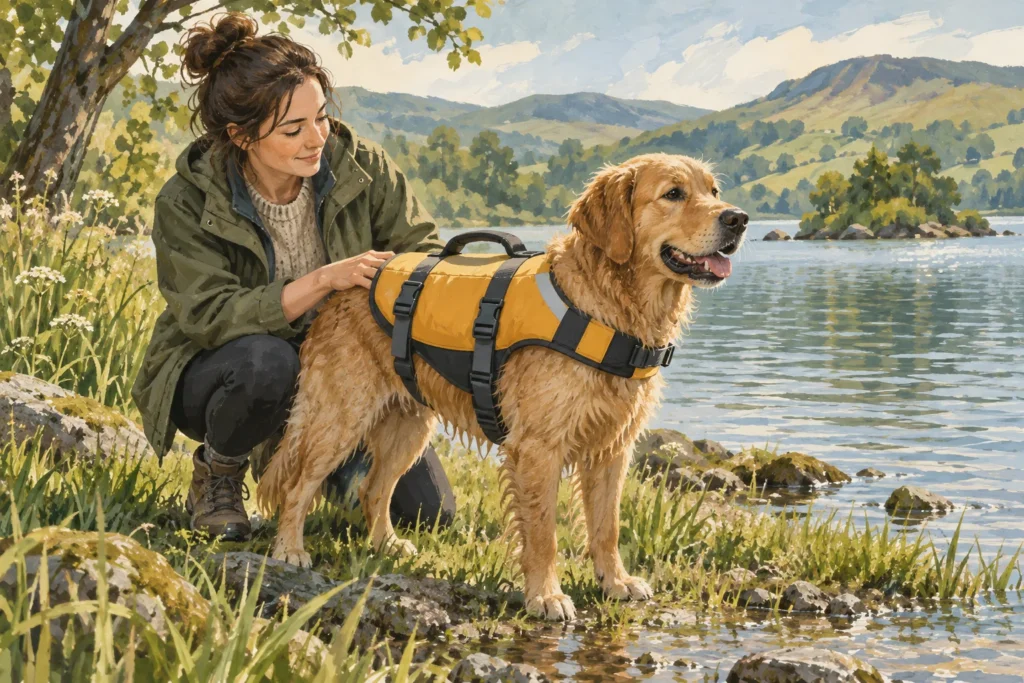
The best dog life jacket fits securely, allows comfortable movement and has clear instructions for its flotation and lifting features. A grab handle is useful only if you can reach it safely and help the dog onto a suitable exit. No jacket makes strong currents, rough water or an unsuitable outing safe.
Ruffwear Float Coat and Hurtta Life Savior ECO are two designs worth comparing because their manufacturers publish sizing, construction and handle information. This is a comparison of those specifications and the decisions they raise, not an independent flotation test or a claim that one suits every dog.
Table of Contents
Two designs with different buying checks
| Design | Published features | Check before ordering |
|---|---|---|
| Ruffwear Float Coat | Foam panels, adjustable neck closure, reinforced handle and reflective details | Rib-cage measurement, body coverage and the exact model’s size chart |
| Hurtta Life Savior ECO | Flexible floats, adjustable chest section, supportive underside and lifting handle | Weight range together with measurements and adjustment limits |
This article contains Amazon affiliate links. As an Amazon Associate, we earn from qualifying purchases.
Find Ruffwear Float Coat dog life jacket on Amazon UK or Find Hurtta Life Savior ECO dog life jacket on Amazon UK to compare the available versions. Match the model name and selected size to the manufacturer’s information. Older stock and similarly named products can have different instructions, so do not choose from a marketplace photograph alone.
Measure more than the dog’s back
Ruffwear bases its size selection on the widest part of the rib cage. Hurtta also presents weight ranges, which makes an up-to-date weight useful. Follow each manufacturer’s full fitting process instead of transferring a size such as “medium” from a walking harness.
Check the jacket on dry land before water use. The chest and neck should remain comfortable when the dog turns, lowers their head and walks. Straps should not hang where they can catch, and the body should not rotate loosely around the dog. If fit is ambiguous between sizes, ask the maker rather than guessing from weight alone.
For a growing dog, reassess each time. Buying a loose jacket with room for months of growth compromises the very thing you are purchasing it for: a secure fit now. A good returns policy can be more useful than an attractive colour available only in the wrong size.
Read the handle’s purpose literally
Hurtta explicitly describes its handle as an aid for lifting a dog into or out of water and says it is not intended for carrying the dog. Ruffwear describes its handle as helping dogs out of the water. Neither statement should be expanded into permission to suspend a dog for an extended period or lift them over any obstacle.
Think through the geometry before setting off. A low platform with a practical exit is different from a high quay wall. A large wet dog may exceed your ability to assist safely even when the jacket fits perfectly. The handle cannot solve an unreachable edge or an unsafe lifting position.
Ask an appropriate instructor to help plan boarding and recovery for a boat or paddleboard. Do not improvise a practice lift above hard ground or use the jacket as a climbing harness.
Flotation claims need careful interpretation
Hurtta publishes information about buoyancy and handle testing. That is manufacturer evidence about the product, not our own certification assessment. Avoid reading a reference to a standard as a guarantee that every dog will remain upright or that an unconscious dog will be turned face-up.
Body shape, condition and behaviour still matter. Introduce the jacket gradually on land, then choose calm, controlled conditions with an easy exit and suitable supervision for a first water experience. Do not throw a reluctant dog into water to test either the jacket or the dog.
Plan the outing before selecting the colour
The RNLI advises checking tides and weather, avoiding choppy water and bringing fresh drinking water. Keep dogs controlled near cliffs and fast-flowing water. Bright fabric can help you see a dog, but reflection depends on light and is not a substitute for staying close enough to supervise.
Check local access rules and conditions on arrival, including warning signs. If the planned location looks unsuitable, change the activity. A short shore visit can still be a worthwhile day out without swimming.
If a dog gets into difficulty at the coast, call 999 or 112 and ask for the Coastguard. Do not enter dangerous water after them. Our first-aid preparation guide can help organise contact details before travel.
Inspect and dry after use
Follow the exact care label, checking straps, buckles, stitching and foam condition before the next outing. Dry equipment fully before storage. Choose the jacket whose fit, instructions and exit plan you can verify; those details matter more than a broad “safety vest” label.