
Last updated: 9 September 2026
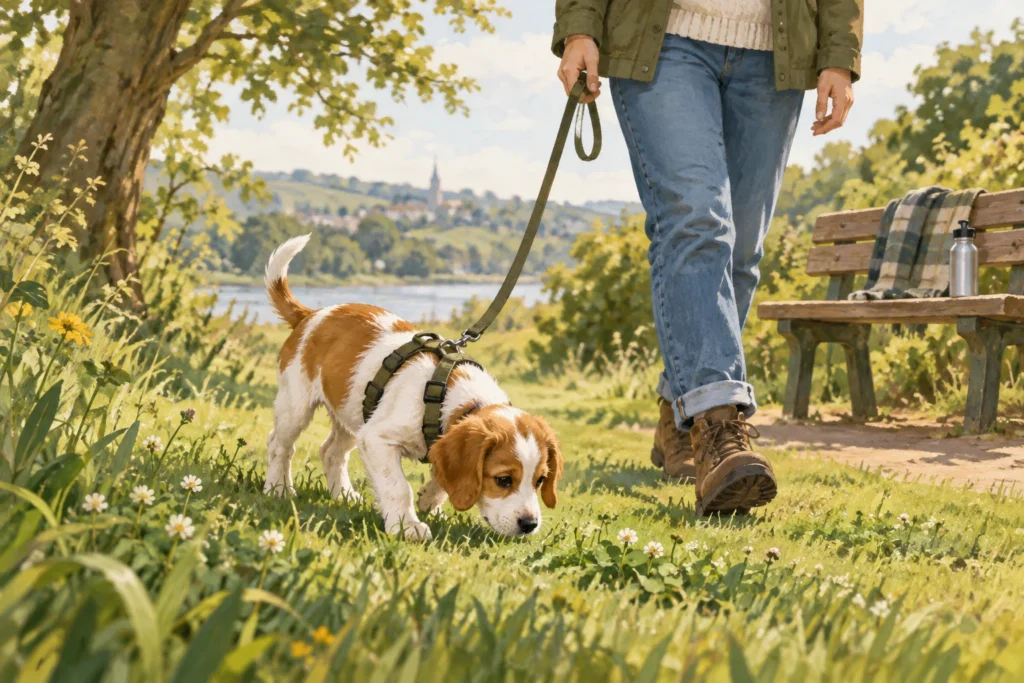
How much exercise a puppy needs depends on their development, health, size and the kind of activity involved. There is no reliable universal walking allowance that you can calculate from age alone. PDSA specifically says there is no scientific evidence behind the popular five-minutes-per-month rule and that it is unsuitable for most puppies.
A better starting point is a varied day with short, manageable activities, opportunities to rest and a plan agreed with your vet if you are unsure. Look at what the puppy actually does, rather than trying to hit a daily distance target.
Table of Contents
Why identical minutes can mean different exercise
Imagine two outings of the same length. On one, a puppy ambles along a quiet path, stopping to investigate leaves. On the other, the puppy repeatedly chases a ball downhill and brakes sharply. The stopwatch records the same time; the movements and effort are very different.
| Activity | What to consider |
|---|---|
| A short sniffing walk | Pace, surface, weather and the puppy’s response |
| Play with another dog | Size difference, intensity and whether both can take breaks |
| Repeated jumping or sharp turns | Impact and slipping; choose a gentler activity |
| Quiet reward-based training | Attention and frustration as well as physical movement |
| A busy outing while carried | New experiences can still be tiring |
This is why adding every activity into a single “exercise minutes” total can be misleading. Record the type of activity alongside its approximate length if you want useful information to discuss with your veterinary team.
Build a day with changes of pace
PDSA recommends short walks, play and training with plenty of rest, while avoiding high-impact activities during development. Puppies do not always stop themselves when they have had enough. You are responsible for making breaks possible, even when a game still looks exciting.
A practical household rhythm might include a toilet opportunity after waking, some gentle interaction, a meal, another toilet opportunity and a quiet place to settle. Later, a short outing can replace one of the active periods. This is an example of organising the day, not a fixed timetable every puppy must follow.
Tell the rest of the household what has already happened. A puppy may have had a garden game with one person, a training session with another and then be offered a walk by someone who assumes they have been sleeping all morning.
Make first walks easy to shorten
Dogs Trust advises taking first walks at the puppy’s pace, allowing time to explore and choosing a quieter setting. Ask your vet when public-ground walks can begin after vaccination; the answer depends on the vaccination course and local disease risk.
Choose a route with an easy return rather than a long circular walk that commits you to finishing. Start near home, avoid rushing to keep up with an adult dog and leave room to change the plan. Carrying a young puppy for suitable outings can support early experience before public-ground walking is appropriate.
Check equipment at home first. A harness that seemed comfortable while standing may rub when moving. A lead should allow sensible close control without pulling the puppy along. A successful first outing may cover very little ground.
Do not use exhaustion as a training method
If evenings are difficult, examine the whole routine: rest, toilet needs, food timing, household activity and the kind of play offered. Adding another energetic session every time the puppy becomes bitey or excitable can turn into an unhelpful cycle.
Try noting what happened immediately before the difficult period and bring that record to a qualified reward-based trainer or your vet. It gives them something specific to assess. “Restless after visitors and a long outing” is more useful information than “needs more exercise”.
Wait before adding adult sport
PDSA advises delaying sustained running, cycling and long hikes until the dog is fully grown. Maturity varies, so do not assume a first birthday automatically makes every activity appropriate. Ask about the individual dog and the proposed sport, including surface, distance and pace.
Limping, pain, unusual reluctance to move or a marked change in energy needs veterinary attention. Do not try to build fitness through those signs. If an outing is uncomfortable, stop and arrange a safe return.
Our puppy class guide can help you choose support for learning and confidence. Keep exercise enjoyable and adaptable: the useful measure is a puppy who can participate comfortably and rest afterwards, not a completed number on a chart.