
Last updated: 9 September 2026
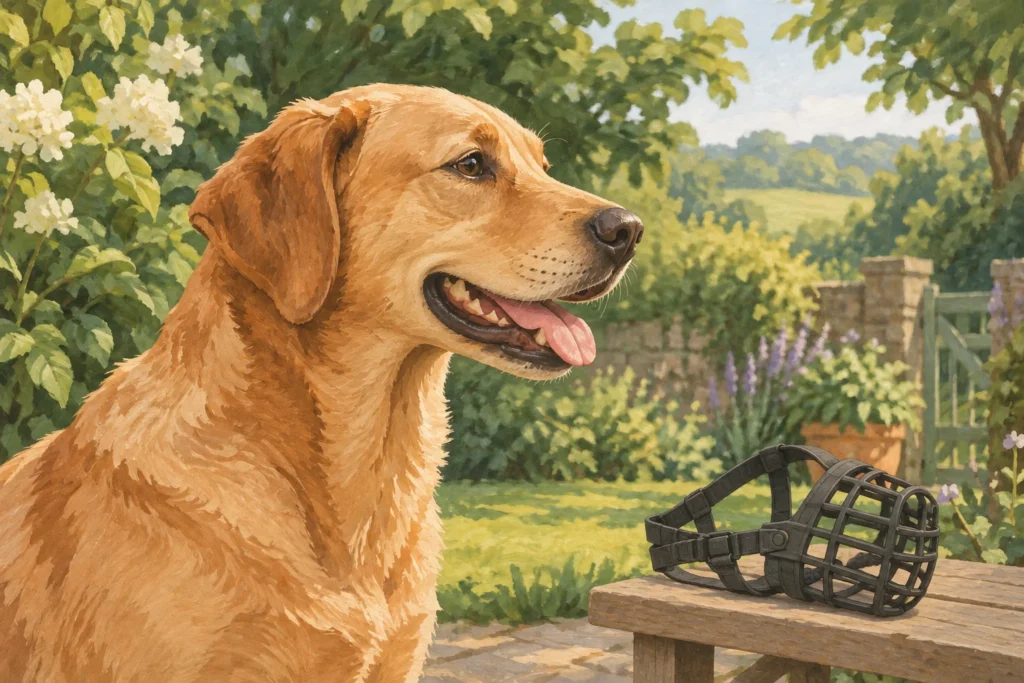
The best basket muzzle fits your dog’s face without pressing on the nose or eyes, leaves adequate room to open the mouth and pant, and stays securely in place. Choose the shape and intended use before the size number. A basket that fits a closed mouth tightly is not a comfortable walking muzzle.
Muzzles can be useful for several reasons, including planned veterinary handling, managing scavenging or supporting a behaviour safety plan. They should be introduced positively before they are needed, and they do not change how a worried dog feels about a situation.
Table of Contents
Start with the purpose
| Need | Feature to investigate | Do not assume |
|---|---|---|
| Everyday supervised walks | Pant room, drinking access and comfortable straps | Any basket shape fits every face |
| Scavenging management | An appropriate guard or opening design | A bite-management basket stops every small item entering |
| Known bite risk | Professional fitting and a complete safety plan | A flexible basket is an absolute bite-proof guarantee |
| Broad or short nose | A design intended for those proportions | Sizing up a long narrow basket solves the shape |
| Brief clinical handling | Veterinary direction for the particular situation | A tight fabric muzzle is suitable for a walk |
Dogs Trust recommends a muzzle that permits eating, drinking and panting, with unobstructed vision and comfortable mouth movement. For significant bite risk, involve a qualified behaviour professional and your vet. Product descriptions alone cannot assess your dog’s individual risk.
Compare the Baskerville designs separately
The Baskerville Ultra is a thermoplastic-rubber basket with adjustable securing straps and a shape the manufacturer says can be customised according to its heat-shaping instructions. Treat access and airflow are part of its design. Correct sizing remains necessary before any permitted reshaping.
This article contains Amazon affiliate links. As an Amazon Associate, we earn from qualifying purchases.
Find Baskerville Ultra dog muzzle on Amazon UK. Check the current version, fittings and size chart; the basket should not be bought purely from a breed example printed beside a number.
Company of Animals describes the Classic as having an optional nose guard for scavenging-related use, while the Wide Fit is intended for broader, shorter noses. Its sizing guidance notes that removing the Classic guard changes the usable nose length. These details make the intended configuration part of the fitting decision.
Find Baskerville Classic dog muzzle removable nose guard on Amazon UK if you specifically need to compare the Classic design. Do not remove an insert to make it fit and then assume it retains the same scavenging protection. Ask the maker about the complete setup.
Measure without forcing the dog’s mouth
Follow the exact maker’s measurement instructions for nose length and circumference. Take relaxed measurements and ask for fitting help if handling the face is difficult. Do not wrap a tape tightly around the muzzle or force the mouth open to obtain a number.
Check the width as well as length, especially for a broad-headed dog. A muzzle can be long enough yet too narrow, or roomy around the nose but positioned too close to the eyes. Allowing panting is a functional check after sizing, not simply adding an arbitrary number to one measurement.
Keep packaging and check fitting-return conditions before use. Photographs from several angles may help a manufacturer’s fitting service, but an in-person assessment is valuable if the dog has unusual proportions or a substantial bite history.
Inspect the complete fit while the dog moves
Once your dog has been introduced to the muzzle, check the gap at the nose, the position below the eyes and the straps behind the head. Ask them to move gently and lower their head. Look for rotation, rubbing or contact with the nose tip.
Confirm they can pant comfortably and drink in the intended setup. Treat delivery should not require putting fingers close to a bite-risk dog’s mouth. Use the safety approach your professional recommends and do not deliberately provoke the dog to “test” the muzzle.
A collar loop or additional strap is useful only when installed as designed. Avoid homemade modifications that weaken the basket or create catching points. Heat-shape only products whose instructions allow it, away from the dog, and let them cool fully before fitting.
Budget time for learning
Begin with calm, short introductions and voluntary nose placement. Build comfort with the basket before fastening, then increase wearing time gradually. If the dog freezes, paws repeatedly or tries to escape, reassess both the fit and the training step.
Our clicker guide explains one way to mark comfortable participation; a familiar reward word can also work. Keep the dog supervised while muzzled and avoid situations that overwhelm them. A well-chosen muzzle supports responsible management, with comfortable fit and an appropriate plan doing the essential work.