
Last updated: 9 September 2026
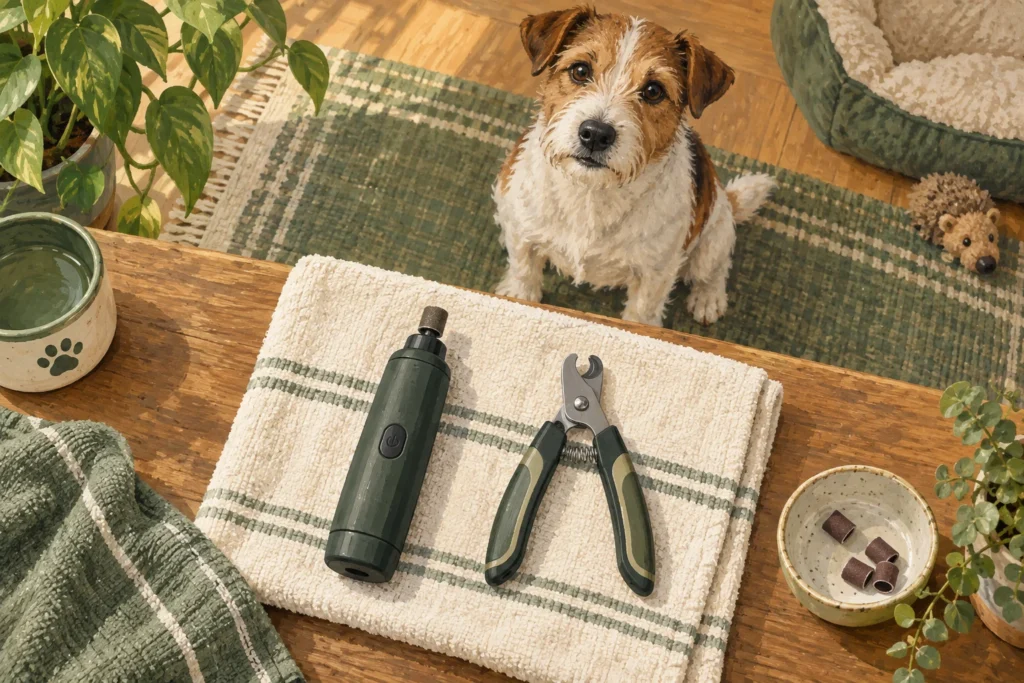
In the dog nail grinder vs clippers decision, choose the tool you can handle accurately while your dog stays comfortable. Clippers make a quick cut; a grinder removes smaller amounts through repeated contact. Neither makes the sensitive part inside the nail disappear, and neither is automatically the safest choice for every dog.
A calm dog with an owner who has had a practical demonstration may accept either method. If holding a paw already causes a struggle, start with handling support from your vet or a qualified groomer before buying a more powerful tool.
Table of Contents
What changes when you switch tools?
| Decision | Clippers | Grinder |
|---|---|---|
| How nail is removed | One cut removes a section | A rotating abrasive gradually removes material |
| Sound and sensation | Brief clipping sound and pressure | Continuing motor noise and vibration |
| Time per nail | Usually a shorter individual action | Several brief contacts may be needed |
| Finishing an edge | May leave an edge needing a file | Can shape an edge gradually |
| Practical maintenance | Keep cutting surfaces clean and in good condition | Check abrasive wear, power supply and replacement heads |
These differences explain why buying both is not necessarily wasteful. An owner might use clippers for an appropriate initial trim and a file for the edge. But a second device adds no value if the dog finds its sound frightening.
When clippers are the more practical purchase
Clippers suit owners who prefer a tool without charging, leads or motor noise. Look for a comfortable grip, a cutting opening appropriate to the nail and a locking mechanism for storage. A tool that requires you to squeeze awkwardly is a poor match even if its packaging says “professional”.
Do not treat a guard on the clipper as a guarantee against cutting too far. The appropriate amount depends on the individual nail. Ask the person demonstrating the technique to show where they would stop on your dog, including the darker nails, rather than memorising a universal number of millimetres.
For the main shapes and handle choices, use our dog nail clipper guide. Take photographs of the actual tool and nail size when seeking advice; a generic “small dog” label can hide considerable variation.
When a grinder earns its place
A grinder offers gradual removal and edge shaping. It also introduces noise, vibration and a moving head near fur. Check how you will keep surrounding hair away, whether the head is visible during use and whether you can switch the machine off without changing your grip.
The Wahl Electric Nail Grinder is one mains-powered example with interchangeable grinding accessories. Its practical advantage over a rechargeable purchase is that battery charging is not part of preparation; its trade-off is managing a power cable. That is a design comparison, not evidence that this machine is quieter or better tolerated than alternatives.
This article contains Amazon affiliate links. As an Amazon Associate, we earn from qualifying purchases.
Find Wahl Electric Nail Grinder on Amazon UK. Check that the package contains the accessories you expect and that replacements are available for that model. An attractive introductory price matters less if its worn abrasive cannot be replaced.
A useful introduction before the first trim
- Choose a stable position. Work where the dog can stand or rest without slipping. Arrange lighting and tools before asking for a paw.
- Practise the separate parts. Let the dog become comfortable with the tool nearby, then with gentle paw handling. With a grinder, introduce its sound at a comfortable distance.
- Keep the first objective small. A relaxed look at the tool can be a successful session. Completing every nail is not a requirement.
- Use the demonstrated technique. Make conservative progress, checking the nail and your dog’s response between actions. Follow the grinder’s instructions on brief contact and heat.
- Stop when accuracy is slipping. Poor light, a tired hand or a restless dog are reasons to pause, not squeeze in another nail.
A second adult can reward calmly if the dog welcomes their presence, but holding a struggling dog more firmly does not solve the underlying difficulty. Repeatedly forcing the job can make the next attempt harder.
When neither should be your next purchase
Ask a vet about a damaged nail, bleeding that does not settle, swelling, apparent pain or a sudden change in tolerance. For routine nails that have become difficult to manage, book help and request a demonstration. The aim is comfortable feet and manageable care, not proving that you can finish the job unaided.
Before buying, answer three questions: can I see what I am doing, can I control this tool comfortably, and can my dog cope with its handling and sensation? A “yes” to all three is more useful than a long list of attachments.