
Last updated: 9 September 2026
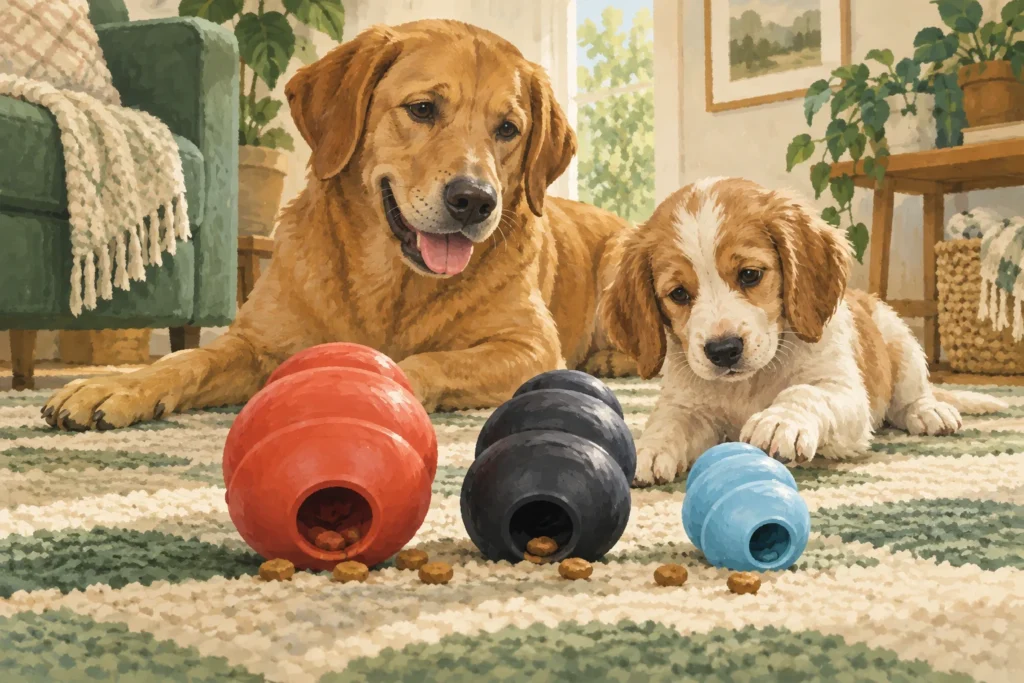
KONG Classic, Extreme and Puppy toys use different rubber formulas for different chewing needs. Classic is the general adult starting point, Extreme is the range intended for power chewers and Puppy uses a softer formula for puppy mouths. Choose the formula and the physical size separately; a stronger rubber does not make an undersized toy suitable.
This article contains Amazon affiliate links. As an Amazon Associate, we earn from qualifying purchases.
This guide compares the manufacturer’s range descriptions and care guidance. It does not claim that we tested how long each toy survives, and no version should be treated as indestructible.
Table of Contents
Compare the three core options
| Range | Typical identifying colour | Manufacturer’s intended role | What to assess |
|---|---|---|---|
| Classic | Red | Ordinary adult chewing needs. | Whether the dog uses it without rapidly damaging the rubber. |
| Extreme | Black | Power chewing. | Suitable size, comfortable use and frequent wear checks. |
| Puppy | Pink or blue | A softer formula for puppies. | Current puppy size and whether changing chewing needs require another range. |
Find KONG Classic (medium example) on Amazon UK, Find KONG Extreme (medium example) on Amazon UK or Find KONG Puppy (medium example) on Amazon UK. Check that the listing is for the intended rubber toy rather than another KONG product with similar branding. Size selectors and marketplace images can show several versions together.
Watch the chewing style
Consider how your dog handles suitable toys already available. Do they lick out food gently, compress rubber repeatedly or try to tear off pieces? That behaviour is more informative than assuming every large dog needs the strongest range or every small dog is a light chewer.
KONG’s chewing-style guidance distinguishes the formulas by intended use. Use that as a starting point, then supervise the introduction. If the toy is being damaged, remove it and discuss a more suitable activity or product with a knowledgeable professional.
Do not keep upgrading hardness indefinitely in search of an object the dog cannot damage. A different activity may be more appropriate than a chew toy for that dog.
Choose the size using the current guide
Consult the size and weight guidance for the exact range, and consider your dog’s mouth and chewing style as directed. Compare the physical dimensions rather than assuming a size label means the same thing across every toy.
A toy should not be small enough to be swallowed or become lodged in the mouth. If you are uncertain about suitability, ask your vet or the manufacturer before offering it. Do not choose a smaller toy just because it holds the amount of food you wanted to serve.
Food capacity is adjustable: you can partly fill an appropriately sized toy. The outside size is a safety and handling decision; the amount inside is a feeding decision.
Make the first filling easy
Start with a small amount of familiar suitable food that the dog can reach readily. Do not pack the cavity tightly or freeze a complicated mixture for the first attempt. The point is to help the dog understand a manageable activity.
Measure the filling and account for it in the daily feeding plan. If it comes from the dog’s normal meal, keep that portion separate from the remaining bowl meal. Follow the food’s own storage rules as well as the toy’s care instructions.
If the dog walks away or becomes frustrated, simplify the preparation. You can also choose a flat feeding surface or a search game. Our puzzle-toy guide compares other enrichment formats.
Inspect and clean after use
Look for cracks, missing pieces, substantial wear and damage around openings. Remove a damaged toy rather than waiting for the next scheduled replacement. Supervision remains relevant even after the dog has used the same model successfully before.
KONG’s cleaning guidance says its Classic rubber toys can go on the dishwasher’s top rack and describes warm soapy-water cleaning with a bottle brush for hard-to-reach residue. Follow the specific product’s directions, inspect the cavity afterwards and dry before storage. Do not extend rubber-toy instructions to plush or rope toys.
When to reconsider the choice
A growing puppy may need both a larger size and a different formula as its mouth and chewing behaviour change. An older dog’s needs can change too. New reluctance to chew, dropping food or mouth discomfort warrants veterinary advice rather than simply a more tempting filling.
For an adult dog using rubber calmly, compare Classic first against the maker’s guidance. For a power chewer, investigate Extreme with the same size and supervision checks. For a puppy, choose the appropriate Puppy size and recheck it during growth. The right purchase is a suitable tool for today’s dog, not a permanent guarantee.