
Last updated: 9 September 2026
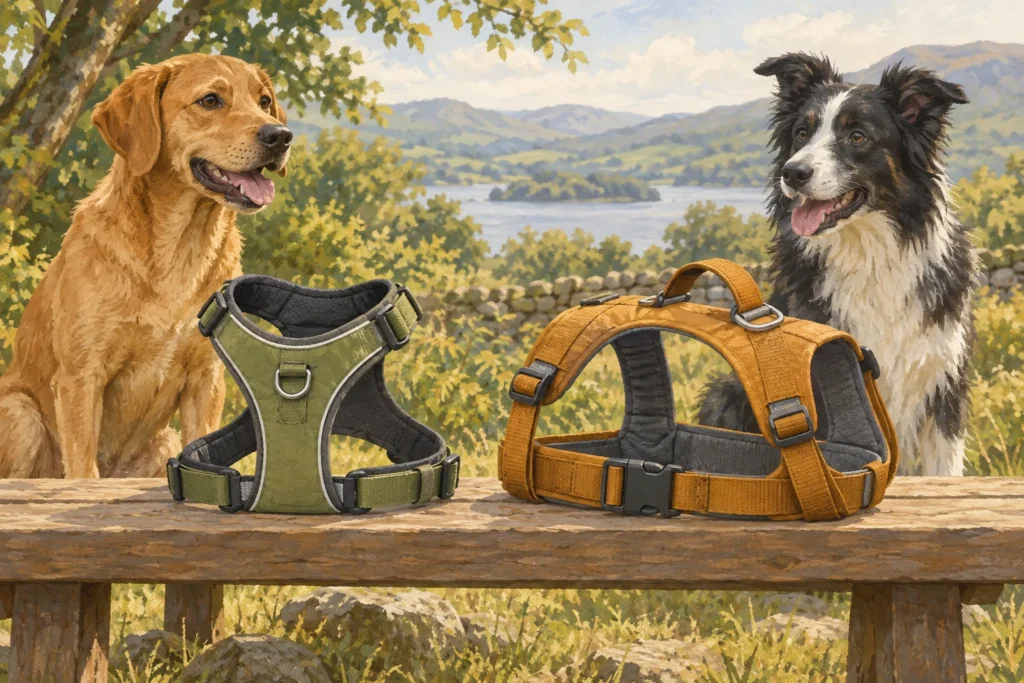
In the Ruffwear Front Range vs Flagline comparison, Front Range is the simpler everyday option to investigate, while Flagline adds a longer body design and an assistance handle. The extra features are useful only if they suit your dog and your walks. Neither model should be chosen from a breed photograph without measuring and fitting it.
If your present harness is comfortable and secure, a second lead point or handle needs a real job to justify an upgrade. Start by identifying what is missing: adjustment, body coverage, easier handling or an occasional need for appropriate support.
Table of Contents
The design differences that affect daily use
| Feature | Front Range | Flagline |
|---|---|---|
| Adjustment points | Four | Six |
| Lead attachment points | Two: back and chest | Three, as described by Ruffwear |
| Assistance handle | No dedicated lifting handle in this design | Padded handle and supporting chest/belly panel |
| General shape | Compact everyday harness | Longer body coverage with an additional rear strap |
| First buying question | Does the simple fit stay comfortable during normal walks? | Does the longer design fit well and serve an actual handling need? |
Those are manufacturer-described design differences. They do not establish that more straps are always safer, or that either harness is impossible to escape.
Why choose Front Range?
Front Range is worth trying if you want a padded walking harness without a handle or extended body panel. Its chest and back attachment choices allow different permitted lead arrangements. You can keep the setup straightforward while still having more than one connection option.
This article contains Amazon affiliate links. As an Amazon Associate, we earn from qualifying purchases.
Find Ruffwear Front Range dog harness on Amazon UK. Check Ruffwear’s current size chart against the actual dog and the selected generation. A size that worked in another brand is not a reliable substitute for measurements.
The main practical test is movement. Watch from the front and side while the dog walks, turns and sniffs. The harness should not visibly drag round the body, crowd the front legs or require constant readjustment. Adding a lead can reveal fit problems that are less obvious while the dog stands still.
Why choose Flagline?
Flagline deserves attention when its longer shape fits the dog well and the handle has a defined purpose. Ruffwear describes its handle and chest/belly panel for balanced lifting assistance. That is different from assuming it is a rehabilitation sling, climbing harness or car restraint.
Find Ruffwear Flagline (medium, Basalt Grey) on Amazon UK. Look carefully at the rear strap position and clearance around the dog’s underside. Extra adjustment is useful only when the straps can sit in the right places without interfering with movement or toileting.
If a dog needs regular lifting because of pain, weakness or recovery, ask the vet which support method is appropriate. An occasional assist over a small obstacle and repeated lifting of a dog with a medical problem are different requirements.
Will Flagline stop a dog backing out?
The extra rear strap is a reason some owners investigate this shape, but “escape-proof” would be too strong a promise. Correct size, body shape, adjustment and the way the lead is handled all affect security. A frightened dog backing away needs careful management and appropriate behaviour support as well as equipment.
Test a new harness in a secure area before relying on it near traffic. Follow the maker’s guidance for any compatible backup attachment rather than inventing connections between random rings. A loose extra clip can create its own snagging problem.
Front attachment does not teach loose-lead walking
Both models offer options that may help a handler manage the lead, but walking comfortably is still a training task. Dogs Trust recommends introducing a harness gently and attending to fit and unrestricted movement. Reward the walking behaviour you want and choose manageable environments.
Our front-clip harness guide explains that attachment decision. For strong pulling, use the pulling-harness guide alongside a reward-based plan, rather than expecting a model change to do the teaching.
Before removing the return labels
- Record chest and other required measurements accurately.
- Fit the harness indoors using the manufacturer’s adjustment sequence.
- Check the dog standing, walking, turning and lowering its head.
- Attach the intended lead and inspect whether the harness rotates.
- Practise the putting-on routine without rushing or forcing the dog’s head through.
Choose Front Range if it supplies the comfortable everyday fit you need. Choose Flagline if its longer fit and handle solve a specific problem without introducing another one. The better harness is the one that works on your dog, not the one with the longest feature list.