
Last updated: 9 September 2026
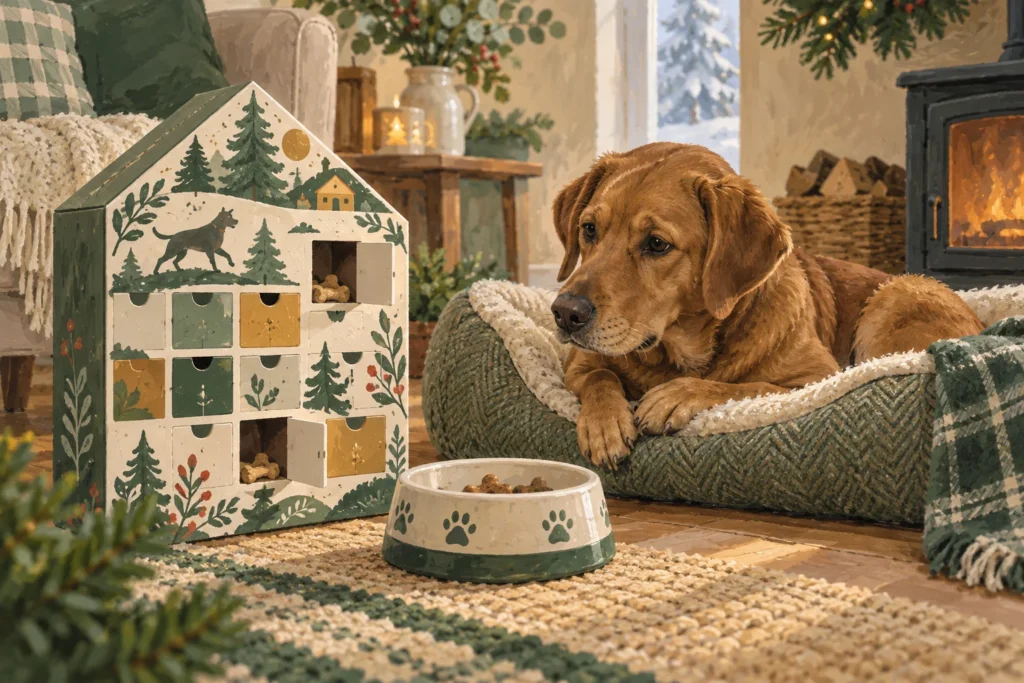
A good dog advent calendar adds a small enjoyable ritual to December without adding a large amount of unfamiliar food. For most dogs, the useful choice is either a ready-filled calendar whose entire ingredient list suits them or a refillable calendar that you fill yourself. A festive design comes after those decisions.
This article contains Amazon affiliate links. As an Amazon Associate, we earn from qualifying purchases.
Seasonal recipes and pack sizes can change. Compare the actual calendar offered this year, including its best-before date and feeding instructions, rather than relying on a photograph or review of an older edition.
Table of Contents
Which type suits your household?
| Calendar type | Useful when | Check carefully |
|---|---|---|
| Ready-filled dog treats | You want minimal preparation and your dog can eat the complete recipe. | All ingredients, minimum age, daily quantity and total contents. |
| Refillable pockets or drawers | You want to use familiar food or vary the daily activity. | Food-safe storage, secure positioning and loose decorations. |
| Toy calendar | You prefer activities to additional food. | Every toy’s size and construction; small novelty pieces may be unsuitable. |
Good Boy’s manufacturer collection includes meaty and dog-choc calendar formats. Those are different products, so inspect the selected pack instead of assuming they share a recipe. Find Good Boy dog advent calendars on Amazon UK. Check that the listing shows the back of the current pack as well as its front.
A refillable design gives more control over what goes inside. Find refillable dog advent calendars on Amazon UK if you want a reusable organiser, but treat it as an object for a person to open. Fabric pockets, ribbons and drawer handles are not dog toys.
Read the ingredients before the marketing
Start with the foods your dog already tolerates. A calendar is a poor place to experiment with several new treats at once, particularly during a busy month when normal routines may change. For a dog on a prescribed diet or elimination trial, ask the vet whether anything beyond the agreed food is appropriate.
Read every variety in a mixed calendar. “Chicken calendar” does not necessarily mean every ingredient is chicken, and a front-of-pack phrase such as natural does not answer an allergy question. Check the minimum age and chewing instructions for the exact product. A manufacturer’s general puppy range does not establish that its Christmas calendar is suitable for puppies.
Make the portions work
PDSA advises keeping treats to a small part of the daily food allowance. Include the calendar alongside training rewards, dental chews and scraps from other household members. One door is a packaging unit, not a nutritional recommendation for every dog.
For illustration, imagine a calendar contains 240g of treats across 24 equal portions. That averages 10g per day. It does not tell you the calories until you also check the food’s energy information, and real calendars may have unequal portions. If the label gives 300kcal per 100g, an illustrative 10g portion provides 30kcal. Use the actual label, not these example numbers, when planning your dog’s food.
You can put a portion of the dog’s usual dry food in a reusable organiser, keeping it in suitable food packaging. For wet food, put an activity card behind the door and prepare the food fresh from its normal storage. Do not leave perishable fillings in decorative pockets throughout December.
Make the daily activity engaging
The calendar need not deliver a new product every morning. Write cards for a short sniffing game, a calm training session, an extra opportunity to explore a familiar walk or a gentle toy game the dog already enjoys. Our puzzle-toy guide has related enrichment considerations.
Open the calendar yourself, remove packaging and offer the contents appropriately. In a multi-dog home, give each dog space and its own suitable portion. Do not encourage dogs to compete over a box of treats or let children reach into a dog’s resting space to deliver the surprise.
Store it out of reach
Keep the unopened calendar away from dogs, even when it contains dog treats. Eating the whole month’s contents and its packaging is a different situation from receiving one planned portion.
Ordinary chocolate is not a dog treat. If your dog eats chocolate, retain the packaging and contact your vet immediately; do not wait for symptoms or try to make them vomit at home. Store human and dog calendars separately so visitors cannot confuse them.
Choose the smallest useful purchase that fits your dog’s diet and your December routine. A familiar treat and a few minutes together can make a better calendar than a large assortment of unsuitable novelty items.