
Last updated: 9 September 2026
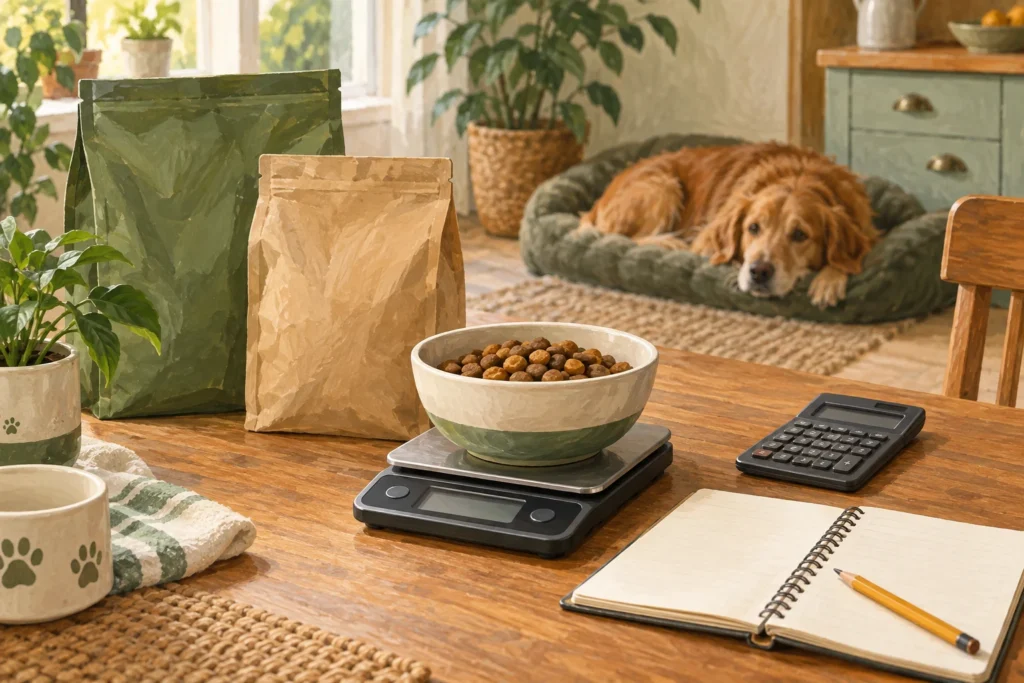
To calculate dog food cost per day, divide the pack price by the number of days the pack will last. If you know the weight and daily ration, use: pack price × daily grams ÷ pack grams. Include delivery where applicable and compare the normal repeat price, not just a first-order discount.
This article contains Amazon affiliate links. As an Amazon Associate, we earn from qualifying purchases.
This worksheet compares expenditure. It does not calculate how much your dog should eat. Get the daily amount from the food’s feeding guidance and your dog’s agreed feeding plan, adjusting with veterinary advice where needed.
Table of Contents
Collect four numbers
- Pack weight in grams. Multiply kilograms by 1,000.
- Actual food price. Use what you would normally pay for that pack.
- Daily food amount in grams. Include food taken from the same pack for training.
- Relevant delivery charge. Allocate a shared charge fairly across the order.
Write the recipe and pack size beside the figures. Two bags with similar branding can contain different foods or weights. If a retailer changes the pack size, reuse the calculation instead of assuming an unchanged sticker price means unchanged value.
Worked dry-food example
Imagine a 12kg bag costs £48 and the agreed ration is 240g per day. These figures are illustrative, not a current product quote or feeding recommendation.
- Pack weight: 12 × 1,000 = 12,000g.
- Days per bag: 12,000 ÷ 240 = 50 days.
- Daily cost: £48 ÷ 50 = £0.96.
- Thirty-day food cost: £0.96 × 30 = £28.80.
If the bag also has a £4 delivery charge, the delivered daily cost is £52 ÷ 50 = £1.04. The difference is small per day but visible over repeated orders. An annual equivalent uses 365 days; it is a budgeting estimate, since actual intake and prices can change.
Worked wet-food example
Suppose 12 trays containing 400g each cost £24, and the feeding plan uses 600g daily. The order contains 4,800g and lasts eight days. The daily cost is therefore £3 before delivery.
Notice the partial tray. You need to store opened food according to the manufacturer’s instructions and use it within the stated period. If you routinely discard unused food, record the actual amount wasted over a normal week. Add a realistic observed allowance rather than inventing a waste percentage.
A mixed-feeding calculation
Calculate each food separately at the amount actually served, then add the two daily costs. If your dog’s plan uses 120g of the example dry food and 300g of the example wet food, those portions cost 48p and £1.50 respectively. The combined food cost is £1.98 per day before delivery.
These example amounts are half of each example’s full-day ration. They are not equal weights. Use a manufacturer-provided mixed-feeding plan or veterinary advice for your dog; do not combine two complete daily allowances just to simplify the arithmetic.
Copy this shopping worksheet
| Entry | Food A | Food B |
|---|---|---|
| Recipe and pack size | Write in | Write in |
| Normal delivered price | £ | £ |
| Total pack grams | g | g |
| Daily grams for your dog | g | g |
| Days per pack | Pack grams ÷ daily grams | Pack grams ÷ daily grams |
| Daily cost | Delivered price ÷ days | Delivered price ÷ days |
For a subscription, replace pack price and days with the actual delivery charge and the days that delivery covers. A four-week box is 28 days, which is different from a calendar month. Record any required extras and the ongoing price after introductory offers end.
Measure before deciding to switch
Weigh what you currently serve for several ordinary days. A large difference between the planned amount and the amount poured from a scoop can distort your budget. PDSA recommends accurate portion measurement and monitoring body shape as part of weight management.
Find digital kitchen scales on Amazon UK if your current equipment cannot measure the portion conveniently. You need a readable gram display and tare function; a dedicated branded pet scale is not necessary just to weigh ordinary meals.
Cost is one part of suitability. Confirm that the food is complete for the appropriate life stage, fits any veterinary dietary advice and can be stored properly. Our dog-food buying guide provides related buying considerations. A lower daily price is useful only when the feeding arrangement still meets the dog’s needs.