
Last updated: 9 September 2026
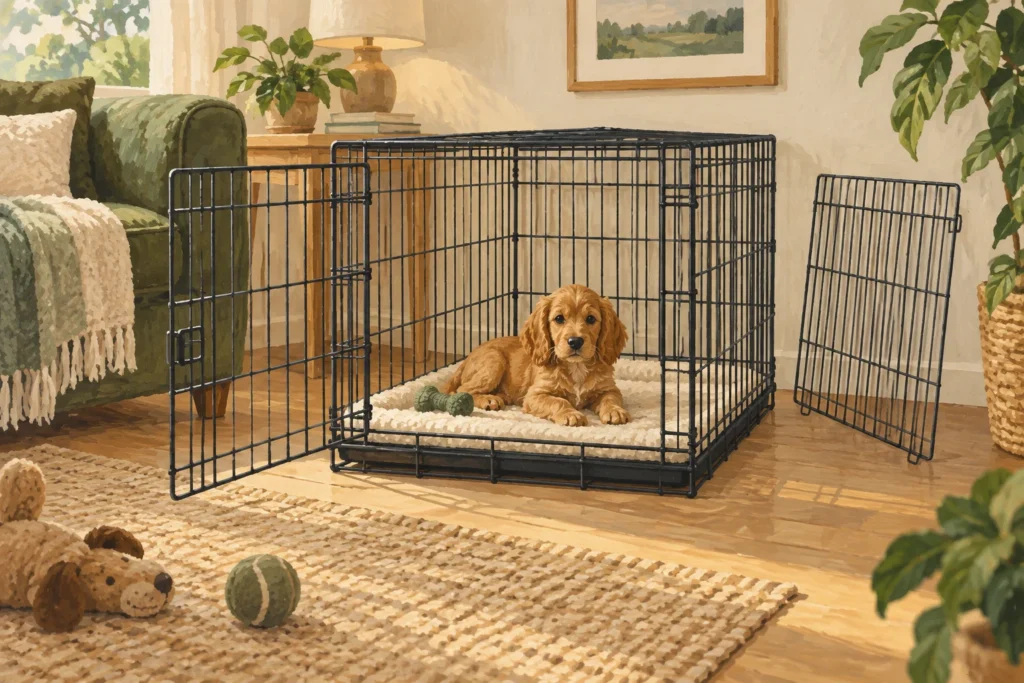
A dog crate with a divider can let you adjust the usable length as a puppy grows, but the occupied space must still allow comfortable movement and rest. Buy a matched crate-and-panel system, check what the package includes and follow the manufacturer’s fitting instructions. A divider is an accessory, not a shortcut around toilet breaks or crate training.
This article contains Amazon affiliate links. As an Amazon Associate, we earn from qualifying purchases.
The strongest comparison is between a complete crate package that includes the correct panel and a crate with a separately purchased, explicitly compatible divider. “Fits a 30-inch crate” alone is not enough: width, height, wire spacing and fixing positions can differ.
Table of Contents
Two systems worth comparing
| System | What the manufacturer describes | Check before ordering |
|---|---|---|
| MidWest iCrate | A folding crate range with an included divider panel. | The exact model, number of doors, supplied components and UK seller’s listing. |
| Ellie-Bo crate with Ellie-Bo divider | A separate divider range designed for Ellie-Bo cages. | The matching cage and divider size; the divider listing alone is not a complete crate. |
Find MidWest iCrate packages on Amazon UK or Find Ellie-Bo crates and matching dividers on Amazon UK. Match the listed model to the manufacturer’s instructions. A marketplace photograph showing a bed, cover and bowls may depict accessories rather than the contents of the package.
Ellie-Bo specifically tells owners to position the divider hooks away from the dog’s section. Treat that as a model instruction, not permission to improvise a panel that uses different fixings. MidWest directs owners to use the product name and item number when checking parts with customer service.
Decide whether a divider is useful for your puppy
Some owners buy a suitably sized crate and later increase its usable length by moving the divider. Others prefer to change the resting arrangement as their puppy grows. Neither approach removes the need to monitor comfort, provide water and arrange regular opportunities to toilet.
Dogs Trust says a crate should allow the puppy to stand, sit, turn, lie down, wag their tail and stretch out fully. Apply that comfort requirement to the space in front of the divider, not the entire empty crate behind it. If the puppy cannot rest naturally, move the panel or choose a different setup.
Breed estimates and weight charts are only starting points for choosing an adult crate. Watch the actual puppy and recheck fit during growth. A divider cannot increase the width or height of a crate; a long crate that is too low remains unsuitable.
Measure the room as well as the crate
Record the assembled outer dimensions, then allow room for the door to open and for you to remove the tray if the design has one. Check the internal sleeping space separately. A side-door model can be useful where a front door would open into furniture, but the chosen divider position must not make access awkward.
Place the crate in a calm part of the home where your dog can rest without being isolated from every ordinary household activity. Avoid direct heat sources, trailing cables and a position where another door can strike the crate. Think through cleaning access before filling the space around it with furniture.
Inspect and assemble before your dog enters
- Read the instructions for the exact crate and divider model.
- Assemble the empty crate fully and check every required latch and fixing.
- Inspect for bent wires, damaged edges or loose components.
- Fit the divider only in the intended positions and direction.
- Check the occupied space with the intended bedding and water arrangement.
- Recheck security after moving, folding or cleaning the crate.
Do not use cardboard, loose boards, cable ties or another improvised barrier as a substitute for the specified panel. If a supplied divider does not fit as described, contact the seller or manufacturer before use. Do not bend parts into a new arrangement and assume it is equivalent.
Keep comfort separate from confinement
A crate should become a comfortable resting option through gradual, positive introduction. Start with the door secured open and let the puppy investigate. Increase difficulty only while they remain relaxed. Our crate-training guide covers the broader process.
If your puppy needs a larger managed area, compare a suitable puppy playpen setup. Making a crate smaller is not a solution to crying, panic, a full bladder or a dog being left for too long. Persistent difficulty deserves advice from a qualified trainer or your vet.
Choose a divider system for verified compatibility and sensible daily use. The best purchase is the one you can assemble correctly, inspect easily and adjust without compromising the puppy’s room to rest.