
Last updated: 9 September 2026
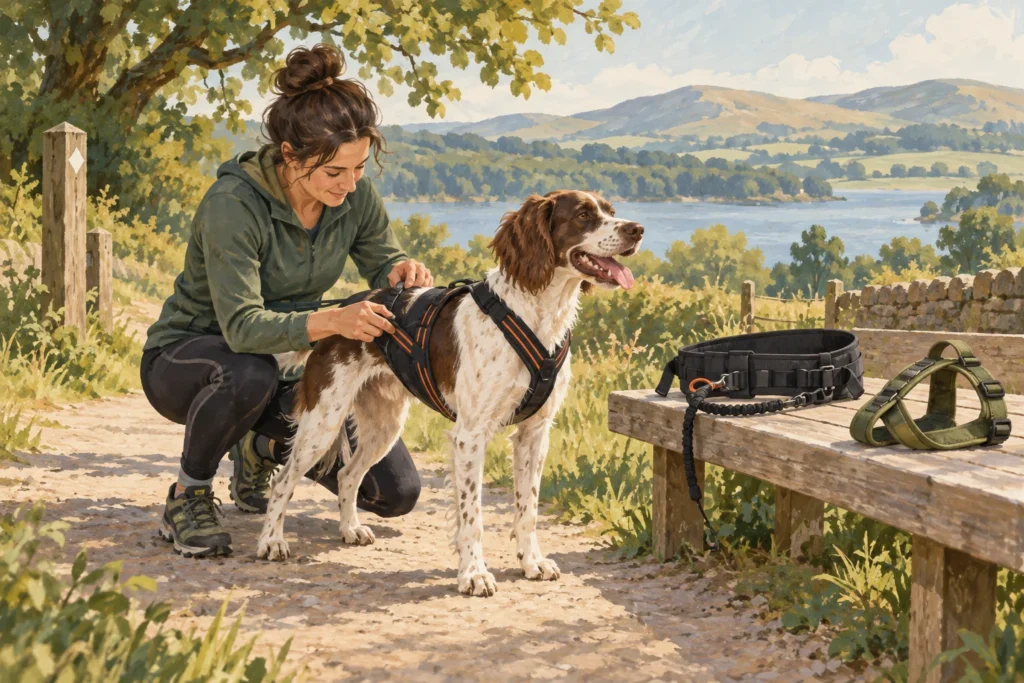
A canicross harness must be suitable for the dog moving ahead and pulling against a line attached to the runner. An everyday walking harness may be designed mainly for loose-lead use and close control. Choose the intended pulling geometry and individual fit, rather than assuming any padded harness can do both jobs.
This article contains Amazon affiliate links. As an Amazon Associate, we earn from qualifying purchases.
Table of Contents
Decide which activity you actually mean
Jogging beside your dog on a loose lead is different from dog-powered running with sustained tension. Tell a fitter which you intend to do, how strongly the dog tends to pull and whether you need a separate setup for ordinary walks.
Canicross normally combines a dog harness, a runner’s belt and an elasticated line. Treat them as a system. A suitable harness connected at an unsuitable angle or through improvised equipment may not behave as intended.
| Question | Everyday walking setup | Canicross setup |
|---|---|---|
| Where is the dog? | Usually nearby, ideally on a loose lead. | Ahead of the runner during pulling work. |
| Is sustained tension intended? | Not necessarily. | Yes, with equipment designed for it. |
| Key fitting check | Comfort and stability during ordinary movement. | Comfort and correct positioning under the intended line tension. |
| Useful support | A knowledgeable harness fitter or trainer. | A canicross coach, experienced club or specialist fitter. |
Non-stop dogwear Freemotion: a pulling design
The Freemotion family is designed around a high pulling point, as found when a dog pulls ahead of a runner. Non-stop dogwear describes adjustable body sections and a padded Y-shaped front within its Freemotion design approach.
Find Non-stop dogwear Freemotion harnesses on Amazon UK. Confirm the version and its size chart. The manufacturer has introduced several Freemotion versions, including a Pro model, so do not transfer every specification from a review of an earlier harness.
The practical question is whether the harness sits correctly on your dog when connected and used as intended. This guide does not establish a measured injury-prevention or performance benefit from a particular model.
Rush: a shorter option to investigate
Non-stop dogwear’s Rush is a shorter harness that the manufacturer positions for high-pulling-point activities and everyday active use. It includes side buckles and adjustable sections, offering a different shape from a long pulling harness.
Find Non-stop dogwear Rush harnesses on Amazon UK. A shorter format may be worth considering with a specialist if the dog’s build or mixed activity makes a long harness inconvenient. The manufacturer itself distinguishes introductory or shorter pulling use from sustained strong pulling over longer distances.
Short does not automatically mean unsuitable, and long does not automatically mean better. Intended use, connection angle and the dog’s response need to be assessed together.
Check the fit under the right conditions
Follow the exact model’s measurement and fitting instructions. Observe the neck opening, chest section, body straps and rear attachment while the dog moves naturally. A harness viewed loosely on a standing dog may sit differently under working tension.
Arrange a fitting demonstration rather than pulling randomly on straps to simulate a run. Check that the dog can move and breathe comfortably and that the harness does not twist or rub. Recheck after initial short use.
Keep everyday training equipment separate where useful
A front-attachment anti-pulling arrangement is not the default setup for a sport in which you are deliberately asking the dog to pull forward. Follow sport-specific equipment guidance and the manufacturer’s intended attachment.
Our walking-harness guide for dogs that pull addresses a different everyday need. A dog can learn distinct routines, but buying a second harness alone does not teach the difference.
Check readiness before building distance
Discuss suitability with your vet, particularly for a growing dog, a dog with health concerns or one new to sustained exercise. Event minimum ages are eligibility rules, not personalised proof of physical readiness.
Work with a coach on gradual conditioning, directional cues, stopping and passing other trail users. Choose suitable surfaces and conditions. Heat, humidity and the dog’s response matter more than following a distance target regardless of weather.
Inspect the whole connection before each outing
Check webbing, stitching, fastenings, line and belt for wear. Ensure everyone using the equipment understands its adjustment and release arrangements. Do not adapt a collar or headcollar into a pulling setup.
Borrowing or trying club equipment can help identify what fits before purchase. Start with the harness that suits the dog and activity, then buy the compatible supporting kit once you understand how it works.