
Last updated: 9 September 2026
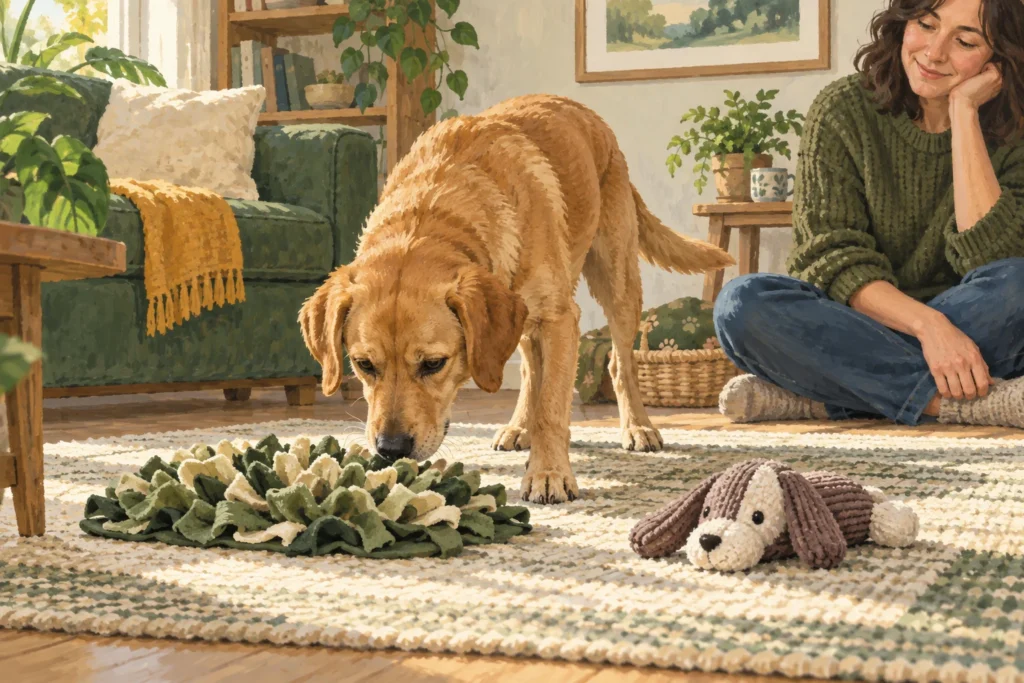
For quieter dog play, start with a food-stuffable rubber toy used on a mat or an easy fabric sniffing activity. Removing the squeaker helps, but rolling, dropping and scraping can be equally noticeable on a hard floor. The best quiet dog toy suits both the dog’s play style and the room where it will be used.
Quiet is a practical comparison, not a guarantee of silence. A dog may thump a rubber toy against furniture or bark at a frustrating puzzle. Choose an activity the dog already understands and enjoys instead of simply buying the product with the least obvious noise-making component.
Table of Contents
Match the format to the source of noise
| Format | Why it may be quieter | Remaining limitation |
|---|---|---|
| Stuffable rubber toy | No hard puzzle lids to move | Can still bounce or be dropped |
| Snuffle mat | Fabric rests on the floor | Some dogs shake or chew the fabric |
| Plain fabric toy without sound inserts | Avoids squeakers and crinkle sheets | Seams and filling still need inspection |
| Stationary food puzzle | Does not need to roll across the room | Plastic pieces may click or scrape |
A toy described as stuffing-free may still contain several squeakers. Likewise, a plush toy can conceal crinkly film. Read the full construction details and reviews about actual sound, while remembering that reviewers may have different floors and dogs.
KONG Classic for a familiar rubber format
This article contains Amazon affiliate links. As an Amazon Associate, we earn from qualifying purchases.
The KONG Classic is a natural-rubber toy designed to hold food and to bounce during play. For a quiet-room use, its food-stuffing function is the relevant part; fetch and bouncing are different activities. Find KONG Classic (medium example) on Amazon UK, checking the manufacturer’s size and chewing-style guidance before selecting a version.
Begin with an easy filling using food suitable for the dog’s diet. A puzzle that is too difficult can encourage throwing or chewing at the opening. Use it where you can supervise and clean the resting surface afterwards. This is a source-based suggestion, not a measured noise comparison with every competing toy.
The manufacturer’s instructions require supervised use and removal if damaged. The absence of a squeaker does not mean a rubber toy can automatically be left with every dog unattended.
Sniffing options for dogs who prefer searching
A snuffle mat can offer a quieter way to find a portion of suitable dry food. Choose a design that lies flat, is easy to wash and has fabric sections that remain securely attached. Find washable dog snuffle mats on Amazon UK if this format suits your dog, then inspect the exact construction rather than choosing by colour alone.
Place the food where it is initially easy to find. Watch whether the dog sniffs patiently or grabs and shakes the mat. In the latter case, simplify the activity or choose another format; repeatedly replacing torn fabric is neither quiet nor economical.
You can also make a brief supervised search game in a safe area without buying a toy. Dogs Trust includes food-searching activities among its enrichment ideas. Keep the space free of hazards and separate dogs if competition for food would make the game uncomfortable.
The room changes the result
Try the toy on a stable washable mat rather than bare laminate. Keep play away from stairs, fragile objects and gaps beneath heavy furniture where the toy may become trapped. A dog scraping to retrieve it from under a cabinet can be louder than the toy itself.
Consider where you need quiet. A five-minute meeting, a baby’s nap and an entire working day are different requirements. Plan an appropriate walk, toilet opportunity and comfortable rest beforehand, rather than expecting a single object to occupy the dog for hours.
Our mental stimulation toy guide looks at different activities. For quiet use, choose a manageable version of an activity the dog likes; novelty and difficulty are not the same as quality enrichment.
Check the total workload
A fabric toy may be quiet but slow to dry. A rubber cavity may need a brush to remove food. Before buying several, try one and assess how often it needs cleaning, whether the dog enjoys it and how it behaves on your floor.
Count any food used in toys within the dog’s daily intake. Store cleaned toys dry and inspect them regularly. If the dog becomes distressed when left, a quiet toy is not a treatment for that problem; seek appropriate support.
The most useful choice is often a small collection: a familiar rubber food toy, a suitable sniffing activity and a comfortable place to rest. That gives you alternatives without turning the living room into a pile of toys the dog finds noisy or frustrating.