
Last updated: 9 September 2026
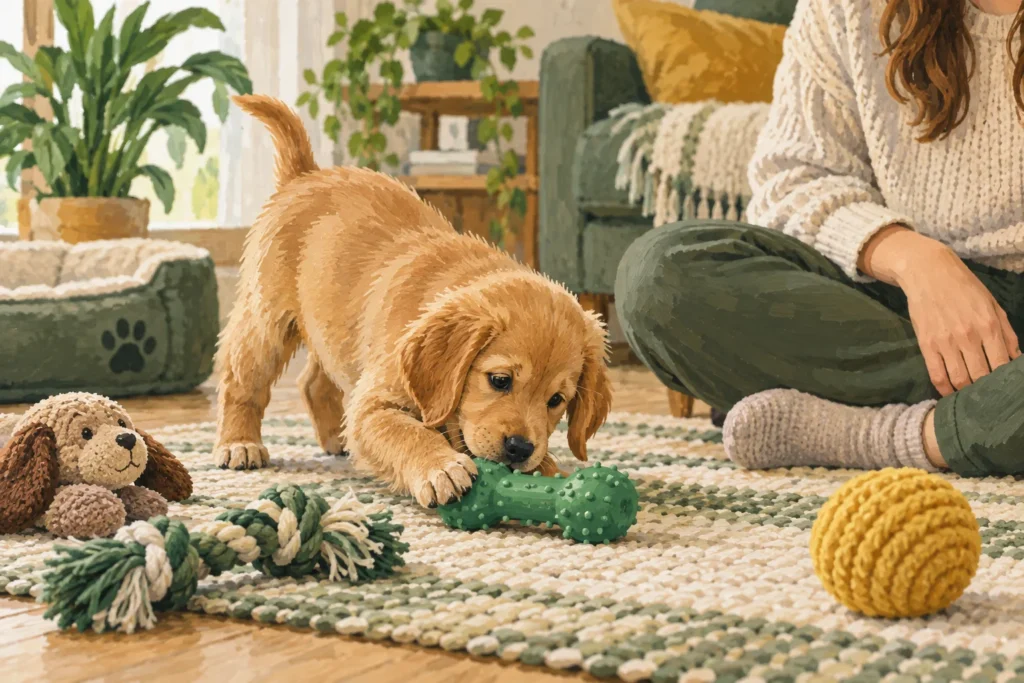
The best puppy teething toys are comfortably sized, appropriate for the puppy’s chewing style and easy for you to inspect. A small selection of suitable textures is usually more useful than a large multipack of uncertain materials. Start with a puppy-labelled rubber toy, a manageable play toy and a plan for replacing anything damaged.
This article contains Amazon affiliate links. As an Amazon Associate, we earn from qualifying purchases.
Table of Contents
Buy for the puppy in front of you
A toy that suits a gentle puppy may be quickly damaged by another of the same age. Watch how yours interacts: carrying and mouthing, nibbling at edges or trying to remove pieces. Check the manufacturer’s size and age guidance alongside that behaviour. Puppy products still require supervision.
Choose a size that cannot be swallowed or become lodged, but is manageable enough for comfortable play. Growing puppies need repeated size checks. Saving a tiny toy because it is a favourite is not worthwhile when it no longer fits safely.
| Type | Useful for | Main buying check |
|---|---|---|
| Puppy rubber food toy | Short supervised chewing and food-based activity. | Current size guidance, filling access and internal cleaning. |
| Puppy-labelled rubber ring or bone | Offering a different shape to investigate. | Material, narrow sections and whether pieces can be bitten off. |
| Soft play toy | Carrying and gentle interactive play. | Seams, stuffing and whether the puppy destroys fabric. |
| Tug toy | Brief shared play with a person. | Comfortable grip, room for hands and prompt removal of damaged fibres. |
KONG Puppy: a sensible first rubber option
KONG describes its Puppy range as using a softer rubber formula than its adult toys. The familiar hollow Puppy toy is sold in several sizes and can hold an appropriate portion of food. That makes it adaptable for a puppy who enjoys licking and gentle chewing as well as playing with an empty toy.
Start with an easy filling your puppy already tolerates. A tightly packed toy that frustrates a beginner is not better enrichment. Account for food used inside it, clean the interior thoroughly and follow both the food’s storage instructions and the toy’s care directions.
Find KONG Puppy (medium example) on Amazon UK. Check that the listing is the Puppy version, rather than assuming a pink photograph or the word “puppy” in a seller’s title establishes the rubber formula. KONG’s current Puppy guidance also sets an age limit; move to an appropriate later-stage product as directed rather than keeping the softer version indefinitely.
Choose the second toy by shape and play preference
Instead of buying three almost identical food toys, consider what is missing. A rubber ring offers different holding positions. A soft toy may appeal to a puppy who likes carrying objects. A tug can give you a practical way to redirect mouthing into shared play.
Find puppy-labelled rubber chew toys on Amazon UK. Read the individual age and size guidance before purchase, including any detachable pieces. Avoid choosing the hardest possible object simply because it may last longer: durability and suitability for a young mouth are different questions.
Fabric and rope toys are play equipment, not things every puppy can safely chew unattended. Remove them if your puppy starts pulling out or swallowing fibres. No toy in this shortlist is described as indestructible.
Use toys to help with mouthing
Keep a suitable toy within reach at predictable lively moments, such as when someone sits on the floor. Offer it before hands or clothing become the game. If the puppy is already highly excited, make the interaction quieter and allow a break rather than repeatedly waving a toy at their face.
Dogs Trust explains that mouthing and biting can be part of normal puppy exploration and play. Toys give the puppy something appropriate to do, but they do not replace sleep, suitable activity and patient handling. Avoid physical punishment or holding the mouth shut.
A simple inspection and rotation routine
Check toys before each session for splits, missing material, loose seams and damage around openings. Wash according to the instructions, let them dry and keep a few clean choices ready. Rotate by preference, not by a requirement to present something new every day.
Contact your vet if mouth discomfort affects eating, you see an injury or your puppy’s behaviour changes markedly. Do not assume every painful mouth is routine teething. For more activity ideas once you know what your puppy enjoys, see our guide to toys for mental stimulation, checking every suggestion against your puppy’s age and size.