
Last updated: 9 September 2026
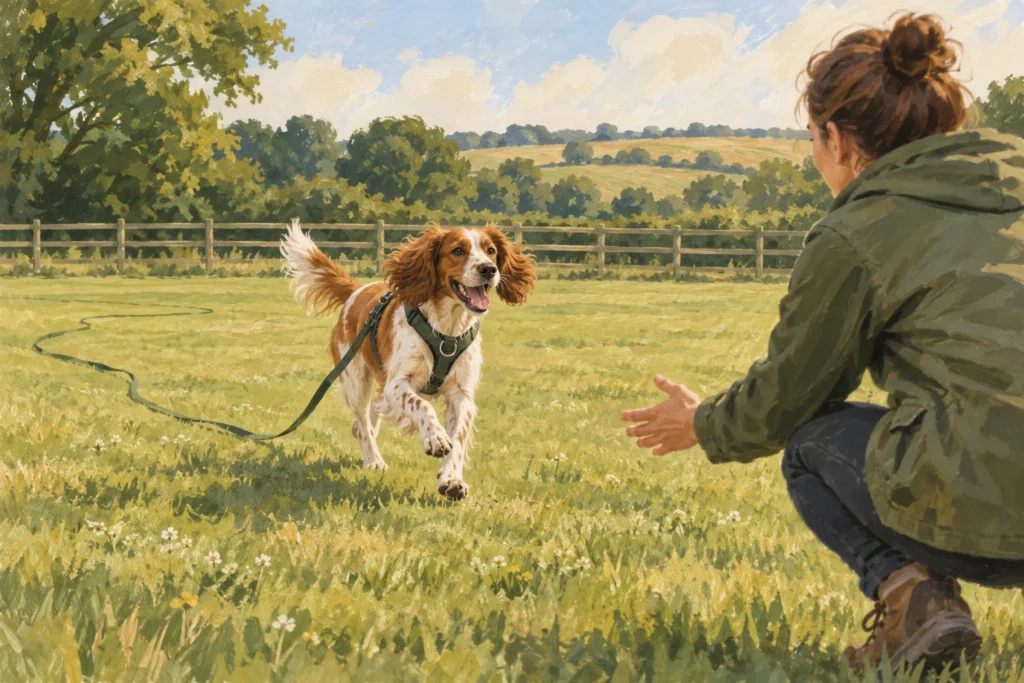
The best long line dog lead for recall training is long enough for your chosen exercise but light and manageable enough to control without tangling. For many owners, the first useful comparison is between a shorter webbing line and a longer waterproof model. The longest option is not automatically the most helpful.
A long line supports practice while the dog learns to return. It is not permission to allow uncontrolled running near roads, livestock, people or other dogs. Choose an appropriate open area and use a well-fitting harness; avoid attaching a long training line to a headcollar.
Table of Contents
Choose length for the space and handler
| Option | Reason to consider it | Trade-off |
|---|---|---|
| About 5m | Short-distance practice and less line to organise | Less range for later exercises |
| About 10m | More distance in suitable open space | More material to manage and keep clear |
| Longer specialist line | A defined training requirement with experienced handling | More opportunity for speed, snags and entanglement |
These are use-case comparisons, not prescribed distances for every dog. A small dog can be burdened by a heavy clip even on a short line. A large fast dog can create a difficult handling situation well before reaching ten metres.
Coachi webbing and waterproof lines
Coachi’s range includes 5m and 10m training lines and a waterproof 10m version. The manufacturer distinguishes cushioned webbing from a non-absorbent waterproof material. The choice is mainly about handling and cleanup rather than a claim that one teaches recall better.
This article contains Amazon affiliate links. As an Amazon Associate, we earn from qualifying purchases.
Find Coachi Training Line 5m on Amazon UK. If you regularly practise in wet or muddy places, Find Coachi Waterproof Training Line 10m on Amazon UK. Compare clip size, overall weight and the feel of the material in your hand. A smooth coating that rinses easily still needs careful handling when the dog changes direction.
The waterproof product has no end handle, which the maker says helps reduce snagging when trailing. That does not make trailing appropriate everywhere. Follow the product instructions and your trainer’s advice about how the line should be managed during a particular exercise.
Grip and organisation matter more than colour
Practise holding and gathering the line before adding the dog. Keep loose sections organised so they do not loop around fingers, ankles or another person. Do not wrap the line tightly around your hand or waist to compensate for a setup you cannot control.
Wear suitable footwear and consider gloves that still allow accurate handling. Do not plan to stop a dog at full speed by suddenly grabbing a moving line. Set the exercise at a distance and distraction level where you can maintain control and prevent that situation developing.
Bright material can be easier to notice against some surfaces, but visibility depends on the background. Check your line against grass, gravel and fallen leaves rather than assuming a particular colour is always conspicuous.
Set up a first recall session
- Inspect the harness, line and clip in a secure starting area.
- Choose a quiet, open location away from traffic, wildlife and likely entanglements.
- Begin with a short working distance and keep the spare line organised.
- Call when success is likely, then reward the return with something the dog values.
- Release the dog to suitable exploration again when appropriate, so returning does not always end the activity.
- Finish before attention and handling become difficult.
If the dog repeatedly ignores the cue, reduce the challenge rather than repeating it more loudly or using the line to jerk the dog back. A qualified reward-based trainer can help adjust the environment, motivation and exercise.
When a normal lead is the better tool
Use a short lead in busy or confined places where a long line could cross someone’s path. A training field and a narrow pavement require different equipment. Our lead and collar guide covers everyday options.
For dogs that pull strongly, start with a setup you can handle and a suitable training plan. Our pulling-harness guide helps with fit and features, but neither a long line nor a new harness replaces the learning.
After the session
Remove the line before the dog rests or is left unattended. Check for cuts, worn stitching, damaged coatings and a clip that no longer closes fully. Clean and dry according to the instructions, and store it without tight knots that make the next setup frustrating.
Choose the line that lets you practise calmly and accurately. More distance is useful when it serves the training; it is a liability when it exceeds the space, the dog’s skills or your handling comfort.