
Last updated: 9 September 2026
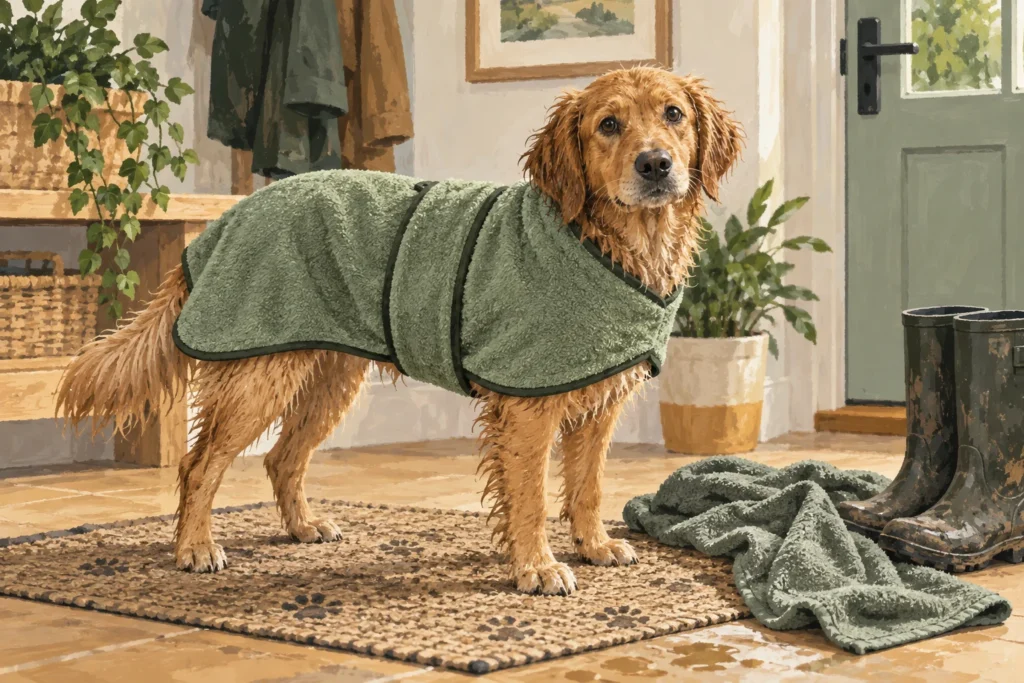
The best dog drying coat is easy to put on a wet dog, covers the areas that stay damp and can be washed and dried before the next muddy outing. Absorbency matters, but so do an unobstructed toilet opening, comfortable movement and a dog who accepts wearing it.
A towelling coat is especially useful when a dog repeatedly shakes water over the hallway or sits against furniture after a rinse. It is less useful if your dog immediately rolls out of it, chews the fastening or becomes uncomfortable in clothing. A towel and a washable resting area remain sensible options.
Table of Contents
Choose the type around the drying job
| Option | Good reason to choose it | Main compromise |
|---|---|---|
| Substantial cotton towelling coat | Coverage after a wet walk or bath | Bulky laundry and drying space |
| Lighter drying wrap | Easy packing and brief use after a rinse | Less coverage or absorbency may mean another towel |
| Ordinary absorbent towel | A dog dislikes wearing coats | You do the drying and manage wet floors |
| Weatherproof walking coat | Keeping rain off during an outing | It is a different product from an absorbent indoor coat |
Do not assume that a fabric described as microfibre is automatically less effective than cotton, or that every thick towel absorbs equally well. Weave, weight, coverage and laundering all affect the result. Without comparable testing, a claim such as “dries twice as fast” is a manufacturer claim, not a reliable cross-brand ranking.
A recognisable towelling option
Ruff and Tumble’s Classic Drying Coat uses double-layer cotton towelling, with adjustable neck and belly fastenings. Its range includes body-shape options as well as ordinary sizes. That makes it a useful starting point if a generic small, medium or large coat repeatedly fits badly. Check the current size chart for the exact style.
This article contains Amazon affiliate links. As an Amazon Associate, we earn from qualifying purchases.
Find Ruff and Tumble Classic Dog Drying Coat on Amazon UK. Compare the actual coat and size with the manufacturer’s page; search results can include different ranges or accessories. This is a design-based suggestion, not a claim that we have tested its drying speed.
Measure the dog while standing
Use the measurements the maker requests, usually involving back length and body circumference, rather than choosing from breed alone. A deep-chested dog and a broad-bodied dog of the same weight may need different cuts. If your dog falls between sizes, ask the maker which measurement takes priority instead of simply sizing up.
Once fitted, check that the coat does not pull behind the front legs, ride over the tail or restrict a normal walking stride. The belly section must stay clear of toileting. Let your dog walk, turn and lie down indoors while you watch. Fastenings should hold without having to be pulled tight to stop the coat twisting.
Introduce the coat while your dog is dry and relaxed. Let them investigate it, reward a brief touch and build towards wearing it for a short period. A frantic dog struggling to remove the coat is telling you to change the approach, not tighten the fastening.
Use the coat as one part of drying
Remove surface mud with an appropriate rinse, then gently blot excess water before putting the coat on. Pay attention to paws, the belly and any areas the coat leaves exposed. A wet outer coat does not prove the skin beneath a dense coat is dry.
Check your dog regularly and remove or change a saturated coat. Avoid leaving a damp wrap on for hours or using it as unattended overnight bedding. Drying clothes are not a treatment for a cold, shivering or unwell dog. Seek veterinary advice if your dog seems unwell rather than relying on another layer.
Work out the laundry burden before buying
Ruff and Tumble advises closing hook-and-loop fastenings, washing before first use to reduce colour transfer and avoiding fabric softener. Follow the label for the specific garment’s temperature and drying method; “machine washable” does not automatically mean tumble-dryable.
Picture two wet walks on a rainy day. Can the coat dry between them? Would one coat and a towel work better than two bulky garments? Check your washing-machine capacity, available hanging space and whether hair collects in the fastening. A practical care routine is more valuable than an impressive photograph of the coat on a clean dog.
For rain protection during walks, compare the different features in our winter dog coat guide. Choose an absorbent drying coat for the return home, where comfortable coverage and straightforward washing do the useful work.